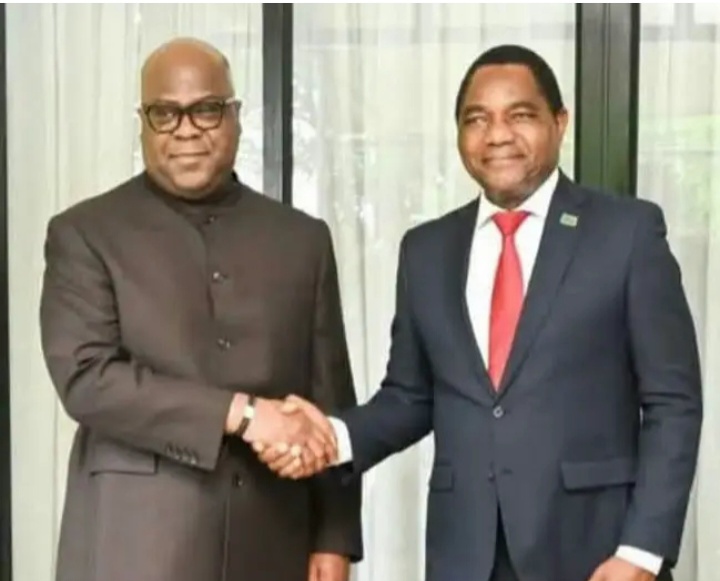

HH, TSHISEKEDI BET BIG ON BATTERIES
….two leaders pledge to unlock billions in joint energy, transport and mineral deals
By DAVID KANDUZA
AGAINST the mist and low roar of the nearby Zambezi River, Presidents Hakainde Hichilema and Félix Tshisekedi sat behind closed doors at the Royal Livingstone Hotel on Saturday, November 29, 2026, determined to turn centuries of shared history into hard economic currency.
For hours, the Zambian and Congolese leaders worked through an ambitious blueprint designed to transform their 1,900-kilometre shared frontier from a bottleneck into an industrial powerhouse.
Surrounded by the quiet luxury of the tourist capital, the atmosphere inside the talks was decidedly urgent, driven by a shared realisation: neither nation can reach its full economic potential without the other.
“Zambia’s growth ambitions cannot be met without a strong and stable partnership with its northern neighbour,” President Hichilema stressed during the engagement, framing the Democratic Republic of Congo (DRC) as the beating heart of his administration’s Grow Zambia Agenda.
At the centre of the discussions was a bold bid to capture more value from the critical minerals buried beneath both countries’ soil. Rather than merely exporting raw copper and cobalt, Presidents Hichilema and Tshisekedi doubled down on the Zambia–DRC Battery and Electric Vehicle Value Chain Initiative, agreeing to jointly hunt for development finance and technical backing.
Mr Hichilema also pushed for African-led commodity exchanges and strict mineral traceability—a direct move to choke off illicit trade and give Lusaka and Kinshasa greater pricing power in global markets.
To power these factories and move the goods, the two leaders mapped out a sprawling web of cross-border infrastructure.

The first being transport: accelerating the Lobito Corridor to link the Copperbelt to the Atlantic, alongside the Kasomeno–Mwenda Road and bridge project.
And advancing the Mambilima and Mumbotuta hydropower projects, establishing the Luapula River Authority, and exploring a petroleum pipeline extension into the DRC.
While grand infrastructure promises future wealth, the leaders also tackled the immediate headaches of frustrating truckers and traders today.
The DRC was already Zambia’s largest market for non-traditional exports, yet commerce frequently grinds to a halt at congested crossings like Kasumbalesa, Mokambo, and Sakania.
To keep cargo moving and ensure driver safety, Zambia proposed rolling out a non-stop border concept at Kasumbalesa, backed by upgraded local infrastructure and linked customs systems.
Both presidents committed to slashing red tape, speeding up the Simplified Trade Regime, and dusting off a 2015 bilateral agreement on duty-free quotas.
Even passenger travel was set for a boost, with plans on the table for direct flights connecting Lusaka and Kinshasa.
Beyond economics, the Summit carried heavy diplomatic weight.
As incoming Chair of SADC, Mr Hichilema offered unwavering backing for the DRC’s sovereignty and territorial integrity, urging full adherence to regional ceasefire deals.
He also congratulated President Tshisekedi on taking the helm of the International Conference on the Great Lakes Region (ICGLR).
Recognising that prosperity required a healthy, well-fed population, Mr Hichilema pledged Zambian agricultural and livestock exports to help meet Congolese food demand.
He called for tighter cross-border disease surveillance and local vaccine manufacturing as the DRC continued to battle Ebola.
As the Summit wrapped up, both leaders instructed their respective ministries to immediately follow up on financing, border demarcation and trade reforms.
For the millions of citizens watching from both sides of the border, President Hichilema summed up the stakes plainly: the time for warm diplomatic words is over—people now expect jobs, tradeand security.