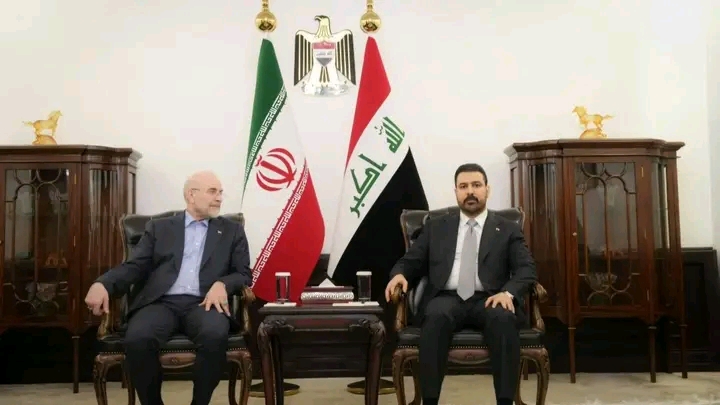

Iraq Caught Between Washington and Tehran as US Pressures Border Closures and Iran Seeks Return of Hundreds of Missiles
Iraq is facing mounting pressure from both the United States and Iran, as Washington pushes Baghdad to restrict trade routes into Iran while Tehran reportedly demands the return of hundreds of precision-guided missiles stored inside Iraqi territory.
The growing tensions have placed Iraqi Prime Minister Ali al-Zaidi in a difficult position, as his government attempts to maintain relations with Washington while preventing a confrontation with its powerful neighbor.
According to Reuters, the US Treasury Department has asked Iraq to close all but two of its border crossings with Iran as part of a wider campaign to intensify economic pressure on Tehran. Iraqi Foreign Minister Fuad Hussein acknowledged that Washington continues to press the issue, warning that closing the crossings would be difficult and could seriously damage Iraq’s economy.
Washington has also established Task Force Iron Gate, an initiative led by US Central Command to disrupt the movement of advanced weapons, dual-use technology, sanctioned materials and illicit revenue through Iran’s land borders and the Caspian Sea.
At the same time, an Almodon report published on November 11, citing an unnamed senior Iraqi official, claimed that Iran had asked al-Zaidi to help recover several hundred precision-guided missiles secretly transferred into Iraq over recent years and placed under the control of Iran-aligned Iraqi armed factions.
The report suggested that Tehran wants the weapons returned amid fears of another military confrontation with the United States and Israel. However, the number, location and types of missiles have not been independently verified.
The border situation is already becoming politically sensitive. Iraq reopened the Al-Sheeb crossing with Iran on November 10 after weeks of closure, while announcing that the Mandali crossing would temporarily close for maintenance from November 13. Iraqi authorities have attributed these decisions to technical requirements, and it remains unclear whether they are directly connected to Washington’s demands.
The economic consequences could also be substantial. Iraq’s annual trade with Iran is estimated at between $15 billion and $18 billion, while Iranian natural gas supplies account for a significant share of Iraq’s electricity generation.
Beyond trade and weapons, Baghdad faces another challenge: powerful Iran-aligned armed factions inside Iraq. Recent assessments indicate that some militias are resisting disarmament and linking their willingness to surrender weapons to whether the United States and Iran resume fighting.
The situation places Iraq at the center of an increasingly complicated regional struggle. Washington wants Baghdad to restrict the economic and military networks supporting Tehran, while Iran wants to preserve its access to Iraqi territory and maintain influence over armed groups operating there.
For Iraq, the challenge is no longer simply managing relations with two neighboring powers. It is protecting its own sovereignty, economy and internal stability without allowing its territory to become another battlefield in a renewed US-Iran confrontation.
The question now is how long Baghdad can maintain this balancing act before pressure from either side forces it to make a decision.