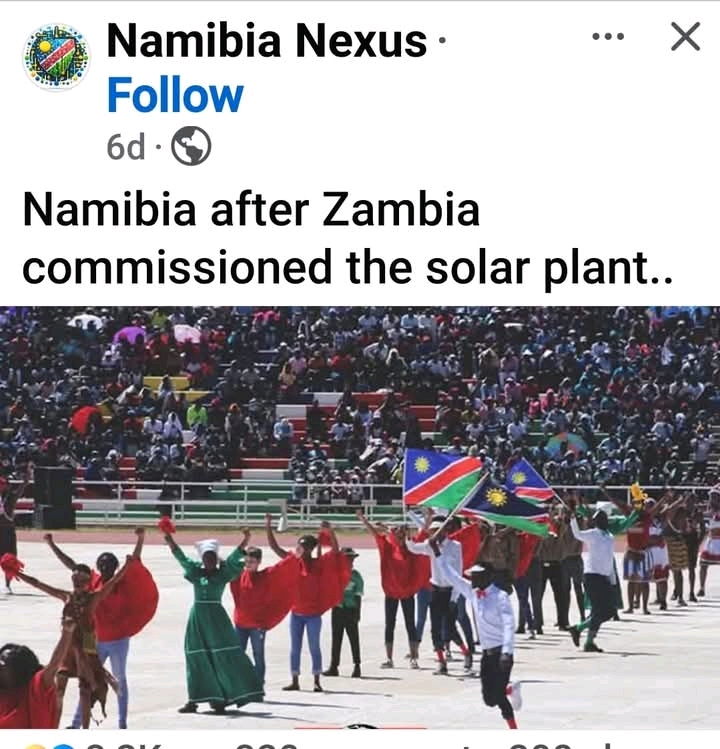

IS ELECTRICITY FROM CHISAMBA SOLAR POWER PLANT GOING TO NAMIBIA?
By Shalala Oliver Sepiso
Our PF friends are throwing banter and shade around that Namibian citizens are celebrating the commissioning of the 100MW Chisamba Solar Power Plant, saying power from that plant will go to Namibia through exports.
What is the truth?
Reality is that the Chisamba Solar Project has an offtaker for the power it is producing. All the power from Chisamba Solar Plant is going to First Quantum Mines for its mining operations in North-Western Province of Zambia. None of that power will leave the country. In order for Stanbic Bank Limited to finance the Chisamba Solar Project to the tune of a loan of USD 100m, they needed to get assurance that there was a standing order for the power produced and that money to service the loan would steadily flow in back to the bank over the tenure of the loan to timeously pay back the loan.
So, no! No power from Chisamba goes to Namibia.
Secondly, Zambia is currently exporting 80MW of power to Namibia. This is less than half of the 180MW agreed. The PF government signed a deal to export 100MW to Namibia through Nampower in 2020. This is a binding contract. The UPND then signed another contract to supply an additional 80MW. Nampower was earmarked as one of the off-takers from Kafue Gorge Lower, which the UPND expanded from 150MW in August 2021 to 300MW by March 2022 finally to 750MW by December 2023.
However, due to loadshedding, Namibia currently imports only 80 MW of electricity from Zambia. Initially, in April 2024, Zambia, which supplies between 50% and 70% of Namibia’s electricity imports, announced a reduction of 60MW in power exports by ZESCO. This was through a statement by Chief Government Spokesperson Cornelius Mweetwa. Later, in January 2025, Energy Minister Makozo Chikote announced that Zambia had reduced exports to Namibia from the contracted amount of 180MW to only 80MW. This is what Zambia exports and its actually less than what Chisamba is producing and sending to FQM.
As indicated, current exports to Namibia have been reduced due to lower generation in Zambia. Zambia’s power generation primarily relies on hydropower, accounting for about 82% of its installed capacity, with ongoing efforts to diversify energy sources and increase overall capacity. As of end of 2024, Zambia’s total installed electricity generation capacity was approximately 3,871.32 MW, an increase from previous years due to the addition of solar power plants and other facilities.
Despite the installed capacity increasing, we are not generating enough power. Last year, then Minister of Energy, Peter Kapala said that, due to poor hydrology, available average generation was dictated by water availability in the reservoirs, and it was about 900MW against the average demand of 2,400M W resulting in a power deficit of 750MW as at May 2024. In June 2025, we still had a deficit of 800MW, as confirmed by current minister of energy Makozo Chikote.
Loadshedding notwithstanding, we still have obligations to export some of the generated power. Exporting of power is not meant to lead to load-shedding as suggested by some people. Loadshedding is due to lower generation. Kariba North Bank Power Station, which is operating at about 3m below optimal level due to precious droughts and despite good rainfall this past year, is producing about 300MW to 400MW instead of the 1200MW installed capacity. Kafue Gorge, Itezhi Tezhi and Kafue Gorge Lower are all generating lower that installed capacity due to less water. Only Victoria Falls Hydropower Station, which produces 108MW, is producing power at 100%.
The exports to Namibia are continuing as the contracts signed by both the UPND and PF were binding but force majeure has forced the reduction. However, Zambia can’t afford a total withdrawal from the Namibian electricity market as the opportunity cost is too high, with the potential of others taking Zambia’s place for good, at a time we need to be producing more power for exports.
For context, Electricity became the highest non-Agro export for Zambia for March 2022, with exports of K300 million (about $18 million) in March 2022 alone. This was before ZESCO and Namibia’s Nampower, in April 2022, signed a power supply agreement for the export of an additional 80 MW in addition to 100 MW that was already being exported after the first agreement was signed in 2020. The Namibian exports, at full potential, will earn ZESCO (hence Zambia) US $50 million (about K874.4 million) per year for the next 10 years.
The demand for Zambian power is not just from Namibia. The Zimbabwe Electricity Supply Authority (ZESA) was quoted in that country’s media as saying that it was in negotiations with ZESCO over the latter exporting 100 MW to Zimbabwe. The negotiations were premised on Zimbabwe making pre-payments for the 100 MW which would come from Kafue Gorge Lower. The condition precedent was that ZESA had to pay monthly deposits of USD 6.3 million to enjoy the facility.
While copper remains the highest export earner, there are limited resultant dollars being remitted back into the country due to the nature of mine ownerships and copper trading. This is worse with increased tariffs announced by the Trump administration this week. This will have a ripple effect on the global copper trade.
However, export earnings from electricity can have a better impact on the economy, including the strengthening of the Kwacha. This is because ZESCO is wholly-owned by the people of Zambia and the company’s foreign earnings will flow back into the country.
Thank you for this information for clarifying what is going on in the country.Certain people like Muamba/Mwamba from Tanzania are trying to mislead Zambians on the same issue. They survive by peddling fake news on these platforms.
true