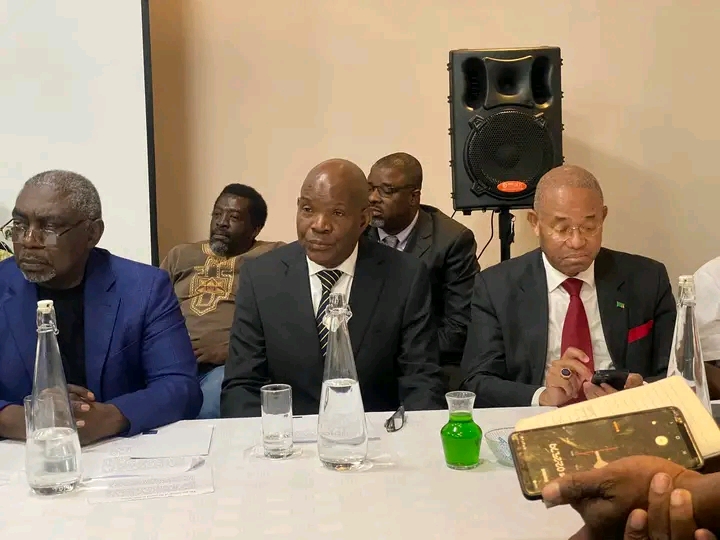

Joint Statement by Opposition Political Parties and Civil Society on the 2022 Census of Population and Housing
Protea Hotel, Lusaka, 2 March 2025
Good evening, ladies and gentlemen. You are welcome to this extraordinary press conference, called by the opposition political parties and civil society organisations represented here.
Ladies and gentlemen, the issue that has brought together these organisations is the unfolding crisis surrounding the government’s reaction to the dissemination of the 2022 census findings. The press as well as social media has over the past week reported about the negative, threatening, and outfight panicky reaction of the UPND government to the dissemination of the findings of the 2022 Census of Population and Housing that was conducted between 18 August and 21 September 2022.
It is standard practice to release a summary report of the main census report after completion of data cleaning and analysis. It was therefore commendable and nothing unusual that the Zambia Statistics Agency (ZamStats) released and presented the summary report of the 2022 census of population and housing at Mulungushi International Conference Centre on Tuesday last week. What was not standard was what happened on the day.
During the presentation of the summary report, a dispute erupted between senior officials of ZamStats and Ministry of Finance, on the one hand, and the chairperson of the Civil Service Commission, Dr Choolwe Beyani, on the other. According to the press reports and witnesses who attended the dissemination of the census report, Dr Beyani, a trained historian, disputed the census findings and questioned why ZamStats was in a hurry to release the census data. He scolded the ZamStats leaders, reserving his strongest rebuke for the board chairperson Mr Oliver Chinganya who until his government appointment was the Director of the Africa Centre for Statistics and Chief Statistician at the United Nations Economic Commission for Africa (UNECA).
It is the first time in Zambian history that government leaders are discrediting a census report conducted by the same administration. The issue at hand is immense, disruptive, and has the potential to fatally undermine the integrity of the 2022 census. It is worth noting that the 2022 report is the sixth census to be conducted since the achievement of independence in 1964 following the 1969, 1980, 1990, 2000, and 2010 census reports.
Accurate census data is essential to understanding the different populations in different parts of a country, the social and living conditions of citizens, the changing patterns of rural to urban movement, to planning for the adequate provision of social services such as housing, education, water, electricity, and health. Such data is also critical to understanding the demographics of the county including age, gender, and income, as well as the number of people who qualify to register as voters in each area and indeed the whole country. A census therefore also has a significant bearing on both general and occasional elections.

Like previous efforts, the 2022 census was a product of a huge collaborative effort of multidisciplinary teams. It is in light of the importance of census data to national planning and the concerning developments around the 2022 census report that we demand clear answers on three issues.
The pre-release of the report to State House
During the launch of the summary report at Mulungushi International Conference Centre, the chairperson of the Civil Service Commission, Dr Choolwe Beyani, disclosed that the report was first presented to the President of Zambia and the Civil Service Commission during a meeting held at State House on an undisclosed date.
Dr Beyani also stated that during this meeting, President Hakainde Hichilema expressed dissatisfaction with the report, alleging that the report had serious anomalies that needed correction. According to Dr Beyani, the President directed the ZamStats board to not proceed with the planned launch of the summary report until such a time when the alleged anomalies would have been corrected.
Arising from these revelations, and in the spirit of transparency – a constitutional value and principle – we demand answers to the following questions:
1. Why was the Census of Population and Housing Summary Report first given to President Hichilema and the Civil Service Commission when, according to the law, the ZamStats Agency which falls under the Ministry of Finance, is only answerable to its board of directors?
2. When was the State House meeting between President Hichilema, Dr Beyani, and the ZamStats board held?
3. Who asked for this State House meeting and why?
4. What criteria was used to identify and invite attendees to this meeting?
5. Can State House publish or furnish the public with the official record and minutes of the meeting, including the full list of the participants who attended it, the directives that President Hichilema issued to ZamStats in the meeting and the source of authority for issuing such directives?
6. Why was the State House meeting at which this summary report was discussed a closed-door event, hidden from the media and the wider public?
7. How many other meetings between the named parties have been held since the conclusion of the report, and why? Who attended such meetings, how were they identified, and are there records of the same?
The absence of critical information: ethnic composition and predominant language
The document that was launched on 25 February 2025 was dubbed as a Revised Summary of the whole report. A summary is just that: a brief account of the main points of something whole. When we read the summary report, we noted the glaring absence of critical information in the form of the widely used languages and the ethnic composition of the Zambian society.
Previous census reports including the most recent one in 2010 contain data on widely used languages of communication and ethnicity, presented by sex, rural/urban, province and by census year. Of course, the previous reports have made it clear that the predominant language of communication looks at the language use, and that the number of language users does not necessarily reflect the number of people that belong to an ethnic grouping. None of this vital information is to be found in the summary report.
Arising from this glaring omission, and in the spirit of transparency – a constitutional value and principle – we demand answers to the following questions:
1. What version of the report was presented at the State House meeting, the original or the revised? Why?
2. What information in the original report has been changed in the latest version to warrant the use of the word “Revised” report?
3. Given that what was launched on 25 February 2025 is a summary of the whole report, why doesn’t the 2022 Census of Population and Housing Summary Report contain data on language use and ethnicity?
4. Assuming that this information would be released separately, how was it decided that it should be left out of the summary report? Who decided this and why?
5. When exactly would this information on ethnic composition and language use be made publicly available?
6. What other critical information, if any, was omitted from the summary report, why was it left out, and when will the same be produced?
The uncalled-for attacks on ZamStats by the UPND
During the launch of the 2022 Census of Population and Housing Summary Report, Dr Beyani launched an astonishing attack on the report, describing it as illegal and therefore null and void. The chairperson of the Civil Service commission disputed the figures in the census report, contending that the statistics pertaining to 15 wards in Southern Province were false because they did not tally with the records of registered voters contained in the voters’ roll produced by the Electoral Commission of Zambia (ECZ).
Dr Beyani disclosed that one of the directives that President Hichilema made to ZamStats during the private meeting at State House was the correction of this alleged anomaly. Based on their failure to do so, Dr Beyani reprimanded the ZamStats officials for proceeding to launch the report against the directive of President Hichilema.
Arising from these developments, and in the spirit of transparency – a constitutional value and principle – we demand answers to the following questions:
1. Can the government confirm the capacity in which Dr Beyani attended the launch of the census report at Mulungushi international conference centre: in his capacity as chairperson of the Civil Service Commission or as Director of Research of the ruling party?
2. Can the Government confirm that the voters’ roll that Dr Beyani was referring to is the one that was used for the 2021 election?
3. Can the government confirm that three ZamStats directors – namely Mulenga Musepa, Chola Nakazwe, and Goodson Sinyenga – were dismissed from the agency last year?
4. If confirmed, can the government furnish the public the reasons that it gave for the dismissal of the trio?
5. Can the government confirm or deny reports that it previously blocked the launch of the summary report including in December 2024?
6. Can the government name the 15 wards in Southern Province that are said to have more voters than the people who were counted?
7. Can the government explain the correlation between the number of registered voters and those appearing in the census report in the said wards?
8. How were these people identified as belonging to 15 different wards when the census report does not contain names of wards nor those of the people who were counted?
9. Can the government confirm that there were no other anomalies that it found in the 2022 census report except those pertaining to Southern Province? If so, how was this outcome determined?
Free and fair elections form the heartbeat of any truly democratic process and should be sacredly guarded to prevent fraud or abuse.
On the face of it, this matter requires investigation. This must be undertaken impartially and should be in the interests of all stakeholders, not least the citizens of Zambia, to determine the true position on this matter.
We call for an independent investigation to be undertaken by a team of experts made up of or appointed on behalf of representatives of civil society, political parties, and representatives of the Church mother bodies.
Now, the concerns raised regarding the Census Report are a tip of the iceberg of a more fundamental problem that we, as Zambians, need to address urgently. This fundamental problem is simply the collapse of moral values in our country. How did we get to get to this dark space, sad space?
Critical government agencies such as the Zambia Statistics Agency, which feeds in the Ministry of Finance – Budgetting and Planning Department, as well the delimitation of constitutes and wards and polling stations – that is the whole electoral process are vital in ensuring the smooth running of these institutions.
In order to maintain confidence in our electoral and governance system, it is important that there is no political manipulation.
Good governance is non negotiable therefore integrity, transparency, and accountability should be the fulcrum to sustain the peace and unity we have lived to cherish since Independence.
Conclusion
The concerns we raise in this statement are very serious. The answers that we seek from the government have the potential to build or erode public trust, and to seriously affect the integrity and credibility of the 2026 general election. We therefore implore the Government to adequately respond to the questions we have posed here with sobriety and seriousness. We do not want to see Zambia burning come next year owing to potentially manipulated census and electoral data. One way of preventing such a possibility is for the government to show transparency in its conduct and engagements with the citizens.
Signed:
1. Dr Fred M’membe, President – Socialist Party
2. Mr Sakwiba Sikote, President – United Liberal Party
3. Mr Brebner Changala, Civil Rights Activist
4. Mr Sean Tembo, President – Patriots for Economic Progress
5. Ms Chishala Kateka, President – New Heritage Party
6. Ms Saboi Imboela, President – National Democratic Congress
7. Prof. Dan Pule, President – Christian Democratic Party
8. Hon. Given Lubinda, Vice President – Patriotic Front
9. Mr Ernest Mwansa, acting President – Zambia We Want
10. Bishop Trevor Mwamba, President – United National Independence Party
11. Mr Muhabi Lungu, Zambia We Want
12. Ms Exhildah Mwenya, President – New Era Democratic Party