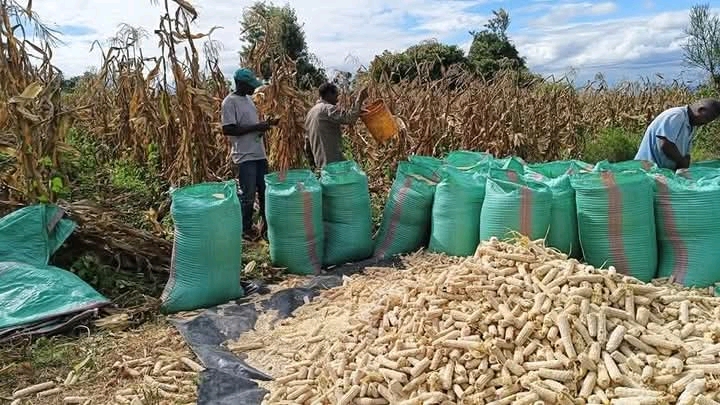

KUMWESU IN-DEPTH ANALYSIS; Zambia’s 2025–2026 Maize Production Forecast – Bumper Harvest or Political Mirage?
Zambia’s maize sector is once again at the center of political and economic debate following the UPND government’s announcement that maize production for the 2025–2026 farming season is projected at 3.6 million metric tonnes (Mt).
This projection comes on the heels of a devastating 2024–2025 drought season that saw production plummet to 1.5 million Mt, causing widespread food insecurity and economic strain.
While the government and its supporters are touting the projection as a major comeback and proof of effective leadership, critics argue that the celebration is premature and politically charged. To understand the full picture, one must analyze the historical trends, political context, data sources, and agronomic realities behind Zambia’s maize output.
1. Historical Context of Maize Production in Zambia
A retrospective analysis of maize production over the last 10 years illustrates the cyclical nature of agricultural yields, heavily influenced by rainfall patterns, policy implementation, and input availability.
Season Maize Production (Mt)Government in PowerKey Notes
2016–2017~2.9 million PF Average rains, fair policy implementation
2017–2018~2.4 million PF Fall armyworm outbreak and erratic rains
2018–2019~2.0 million PF Severe drought in Southern Province
2019–2020~3.4 millionPF Favorable weather, timely input delivery
2020–2021~3.6 million PF Record harvest, surplus of 1.6 million Mt
2021–2022~2.7 million PF/UPND (transition year)Political transition; old input model used
2022–2023~3.2 million UPND Recovery year; UPND’s reformed FISP
2023–2024~1.5 million UPND Drought year; food crisis emerged
2025–2026 (projected)3.6 million (target) UPNDBased on anticipated normal rains and input delivery
2. Dissecting the 3.6 Million Mt Projection
The projected output is being touted as a “record-breaking comeback”, but this deserves closer inspection.
a) Not a New Record
The 3.6 million Mt figure was already achieved in 2021, during the final full farming year under PF. This year also delivered a historic surplus of 1.6 million Mt, enough to supply domestic consumption and regional exports.
b) Current Projection vs. Actual Yield
The 2025–2026 figure is a projection, not an actual yield. It is based on:
Anticipated normal rainfall patterns (following the El Niño-induced drought).
Early and effective distribution of inputs under the revamped Farmer Input Support Programme.
Improved extension services and mechanization in targeted regions.
The USDA and other agro-meteorological models suggest a potentially better season, but they also warn of climate unpredictability.
c) Political Overtones
The projection has been widely publicized with images of President Hichilema, framing the figure as a personal and party achievement. Critics, however, view this as a politicization of agricultural statistics, arguing that it misleads the public into believing a projection is an achievement.
3. Who Deserves the Credit? A Shared Legacy
The 2021–2022 season is a politically ambiguous period:
PF planted the seeds of that harvest with the old Fertilizer Support Programme.
UPND reaped the political dividends but had not yet fully implemented their own agricultural reforms.
Similarly, the 2022–2023 and 2023–2024 seasons show mixed results under UPND. While the FISP was modernized to reduce corruption and improve targeting, implementation gaps, delayed deliveries, and regional droughts diluted potential benefits.
The drought-induced disaster of 2024–2025 is largely viewed as beyond the control of either party, but the slow disaster response and rising mealie-meal prices became political flashpoints.
4. Implications for Food Security and the Economy
a) Food Availability and Pricing
A real 3.6 million Mt harvest would mean a return to surplus, with national consumption needs at ~2.6 million Mt.
This could stabilize or reduce mealie-meal prices, currently around K450 per 25kg, especially if government manages strategic reserves effectively.
b) Trade and Export Potential
A surplus creates room for regional exports to countries like DRC, Zimbabwe, and Malawi a critical source of forex.
However, export policy inconsistencies (export bans vs. liberalization) could hinder this potential.
c) Rural Incomes
Increased production translates to better rural incomes only if the government supports market access, fair pricing, and timely payments through FRA and private buyers.
5. The Role of Climate and Technology
Zambia’s maize output is highly climate-sensitive. The 2024 drought is a cautionary tale. To safeguard future harvests, Zambia must:
Invest in irrigation and drought-resistant seeds
Expand access to climate-smart agriculture training
Reduce dependency on a single crop (maize monoculture)
Modernize farming practices and storage infrastructure
6. Progress Must Be Rooted in Policy, Not Propaganda
While the UPND’s projected harvest for 2025–2026 is encouraging, it must be measured against past performance and scientific forecasting. Rather than boast of a political victory, the government should focus on:
Delivering actual results, not inflated projections
Building resilience to climate shocks
Ensuring fair distribution of inputs and market equity
Prioritizing transparency and data integrity
Agriculture is too vital to Zambia’s future to be a football in partisan games. What the country needs is long-term, depoliticized, evidence-based agricultural governance.
Sources:
United States Department of Agriculture (USDA) Country Summary: Zambia
https://ipad.fas.usda.gov/countrysummary/default.aspx?id=ZA&crop=Corn
Zambia Ministry of Agriculture (Annual Crop Forecast Surveys)
Interviews with agricultural economists and extension officers
May 24, 2025
©️ KUMWESU