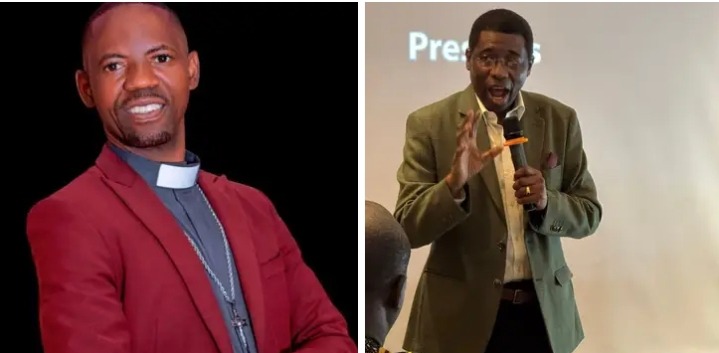

LEAVE BISHOP JOSHUA H.K. BANDA AND THE CHURCH MOTHER BODIES ALONE
By Rev. Youngson Nyirenda
A defence against the social-media attacks over the Mundubile–Makebi Zulu handover
There is something deeply troubling about the way social media has suddenly turned Bishop Professor Joshua H.K. Banda into a villain because of the recent events involving Hon. Brian Mundubile and Hon. Makebi Zulu.
Before we rush to condemn a man who has served the Church and the nation for decades, let us establish the facts.
Bishop Joshua H.K. Banda is not a stranger to Zambia’s national life. He is the Presiding Bishop of the Pentecostal Assemblies of God Zambia, President of the Pentecostal Assemblies of Africa, Senior Pastor of Northmead Assembly of God and a recognised voice in matters of faith, governance, peace and national development.
His ministry has extended beyond the pulpit into national and continental Christian leadership.
His public contribution to Zambia is not something that began yesterday.
He has previously served as Chairperson of the National AIDS Council of Zambia, and in 2015 he was appointed Chairperson of the Advisory Board for the construction of the National House of Prayer. He has also participated in national conversations on prayer, reconciliation, unity and peaceful coexistence.
His involvement in national affairs has also included mediation and reconciliation. During the political tensions surrounding the burial of former President Edgar Lungu, Bishop Banda was formally appointed alongside Archbishop Alick Banda as a co-mediator in the process.
His involvement was described as providing a pastoral and nationally trusted framework for dialogue.
More recently, he has continued to publicly advocate dialogue, forgiveness, national healing and reconciliation.
This is the man some people now want to condemn as though he woke up one morning and decided to become an agent of the State.
Let us be serious.
WHAT ACTUALLY HAPPENED WITH MUNDUBILE AND MAKEBI?
The facts available from the Church Mother Bodies are important.
Following the stay of Hon. Brian Mundubile and Hon. Makebi Zulu at the United Nations premises, the Eight Church Mother Bodies became involved as a neutral third party.
The Church bodies have stated that their role was limited to facilitating a safe, orderly and dignified transition from the UN premises to the politicians’ legal representatives, so that the relevant legal processes could proceed with access to counsel.
That is materially different from saying:
“The Church handed them over to the police.”
The Church itself has rejected that characterisation.
The eight Church Mother Bodies said explicitly that they did not determine the guilt or innocence of Mundubile and Zulu, did not interfere with lawful institutions and did not have a mandate to negotiate a political settlement.
They further said there was no political deal being negotiated by the Church and the UN.
The Church also appealed to the State to ensure that the two opposition leaders were treated humanely, with dignity and fairness, and that due process and the rule of law were respected.
SO WHY ATTACK BISHOP BANDA?
One may legitimately ask questions about the process. One may even disagree with the wisdom of the Church becoming involved.
But disagreement is not evidence of wrongdoing.
And criticism must not become character assassination.
If someone has credible evidence that Bishop Banda acted outside his mandate, let that evidence be presented. If there are questions concerning the process, let them be investigated and answered.
But social media cannot become a substitute for evidence.
We must also understand the difficult position occupied by the Church.
When politicians are in conflict, somebody must sometimes be willing to enter the uncomfortable space of dialogue.
When emotions are high, somebody must be willing to facilitate communication. When there is a danger of confrontation, somebody must sometimes help create a peaceful exit.
That is precisely why societies have churches, elders, mediators and other trusted institutions.
The Church cannot preach reconciliation on Sunday and then disappear when the nation needs reconciliation on Monday.
THE CHURCH IS NOT THE POLICE
This distinction must be maintained.
The Church does not prosecute.
The Church does not determine guilt.
The Church does not pass sentences.
The Church does not replace the courts.
The Church does not replace lawyers.
And the Church does not possess the authority to grant political immunity.
Its responsibility in such circumstances can be to mediate, facilitate, counsel, protect dignity and encourage due process.
That is what the Church Mother Bodies say they did.
BISHOP BANDA’S RECORD DESERVES FAIRNESS
You do not have to agree with everything Bishop Joshua Banda has ever said or done.
You can question his theology.
You can question his politics.
You can disagree with his approach to national issues.
You can even challenge the Church’s engagement with government and opposition politicians.
That is legitimate.
But do not erase decades of service because of one politically sensitive incident.
Bishop Banda has repeatedly occupied spaces where the Church intersects with national life. He has been involved in national prayer initiatives, public dialogue, reconciliation and Christian leadership.
His record includes engagement with successive administrations and national institutions, precisely because he has been regarded as someone capable of participating in conversations larger than partisan politics.
Academic work on Pentecostal civic engagement in Zambia has also documented his longstanding involvement in national affairs.
And that is the uncomfortable reality: a clergy who chooses to engage society will sometimes be misunderstood by both sides.
When he talks to Government, some will call him a government sympathiser.
When he talks to opposition leaders, others will call him an opposition sympathiser.
When he mediates, both sides may accuse him of betrayal.
But perhaps that is the price of being willing to stand in the middle.
LET US NOT PUNISH PEACEMAKERS FOR BEING PEACEMAKERS
Jesus said:
“Blessed are the peacemakers.” — Matthew 5:9
Peacemaking is not always glamorous.
Sometimes it means sitting with people you disagree with.
Sometimes it means facilitating an uncomfortable transition.
Sometimes it means receiving criticism from people who believe you should have taken their side.
And sometimes it means being misunderstood.
The Church Mother Bodies themselves grounded their intervention in the biblical ministry of peacemaking, reconciliation, justice and human dignity.
Therefore, leave Bishop Joshua H.K. Banda and the well-meaning Church Mother Bodies alone.
If there are genuine questions, ask them.
If there is evidence of wrongdoing, produce it.
If there are institutional concerns, investigate them.
But let us stop manufacturing guilt through social-media narratives.
Zambia needs clergy who can speak to Government and opposition.
Zambia needs clergy who can enter difficult rooms.
Zambia needs clergy who can facilitate dialogue when politicians cannot talk to each other.
Zambia needs clergy who will defend human dignity regardless of political affiliation.
And above all, Zambia needs a Church that can remain a moral voice, a bridge and an instrument of peace in moments of national crisis.
Do not confuse engagement with betrayal.
Do not confuse mediation with political allegiance.
Do not confuse facilitating a peaceful transition with surrendering people to the State.
And above all:
DO NOT CONDEMN A MAN ON SOCIAL MEDIA WITHOUT FIRST ESTABLISHING THE FACTS.
Leave Bishop Joshua H.K. Banda. Leave the Church Mother Bodies. Let them serve God and Zambia.
ZAMBIA NEEDS BRIDGES, NOT MORE BURNING OF BRIDGES
I can also turn this into a more scholarly/political opinion article, with a stronger theological argument around the prophetic role of the Church, mediation, human dignity and the separation between Church and State.
Is his brother still an Intelligence officer? That could be telling!