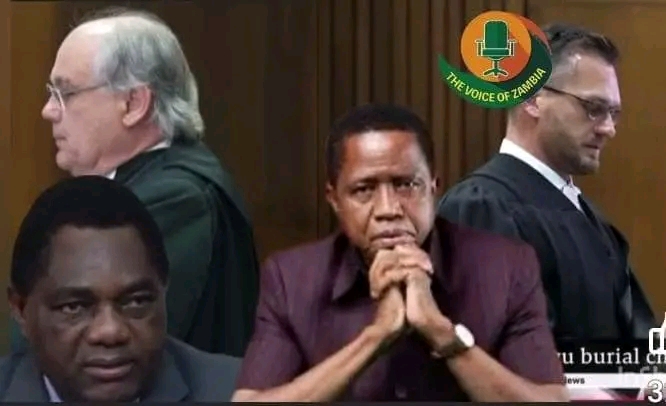

LUNGU BURIAL DISPUTE TESTS LIMITS OF STATE POWER AND FUNERAL RIGHTS IN SOUTH AFRICA
By Brian Matambo – Sandton, South Africa
PRETORIA, SOUTH AFRICA. In a tightly watched legal battle unfolding in the halls of the Gauteng High Court, the family of Zambia’s late former president Edgar Chagwa Lungu is fighting to keep his funeral private and to keep President Hakainde Hichilema far away from the proceedings.
The case, brought forward by the Zambian government, seeks to repatriate Lungu’s body to Zambia for a state funeral, despite fierce opposition from his widow and children. The family insists that the former president had made his wishes clear. Under no circumstances should his political rival preside over his funeral.
As the court deliberates over jurisdiction, precedent, and dignity, the proceedings have exposed the legal grey zones between diplomatic protocol, constitutional rights, and posthumous honour. At the heart of the matter is a single, burning question: who has the right to decide how a former head of state is buried when death meets exile and politics still haunt the casket?

*A PRESIDENT IN LIFE, A CITIZEN IN DEATH*
During oral arguments, Casper Welgemoed, counsel for the Lungu family, rejected the state’s framing of Lungu as a sitting dignitary entitled to government-mandated funeral honours. He pointed to Zambia’s own laws. “The Benefits of Former Presidents Act makes no provision for the reinstatement of benefits posthumously.”
Under that Act, a former president loses certain privileges such as housing, security, medical cover, and funeral expenses when he re-enters active politics. Lungu did just that in 2023. “There is no statute that magically restores state benefits at the moment of death,” Welgemoed argued. “To suggest otherwise is legal fiction.”
The state, represented by Zambia’s Attorney General and lawyers instructed from Pretoria, disagreed. They argued that Lungu’s death neutralized the political disqualification, and therefore his funeral should fall within the state’s constitutional responsibility. “The interpretation must be sensible,” said the state’s representative. “Upon death, the benefits resume, including state-funded burial.”
*NO AGREEMENT, NO CONSENSUS, NO TRUST*
The government also claimed that a burial agreement had been reached between Zambian authorities and the Lungu family prior to the legal action. But the court heard contradictory versions of this so-called agreement. One version included President Hichilema’s active participation. The other explicitly barred him from speaking or presiding.
Judge questions reflected concern over the lack of a meeting of the minds. Welgemoed pushed this point further, stating that an offer and counter-offer, never finalized, cannot be enforced like a binding contract, especially not when it concerns such a sensitive matter as a funeral.
The transcript revealed that even the supposed agreement documents, labelled EL16 and FIA7 in court, conflicted on core terms. “If those two do not speak to each other,” said Welgemoed, “there is no consensus. There can never be.”
*DIGNITY, NOT POLITICS*
The family’s legal argument centers on South Africa’s constitutional rights, specifically:
Section 10: The right to dignity, even in death.
Section 15: Freedom of religion and belief.
Sections 30 and 31: The right to cultural practices.
Section 12(2): Control over one’s body, including the deceased.
Welgemoed urged the court to consider the real issue, which is dignity. “It would be undignified to force the family to watch the man who persecuted their father, the same man who withdrew his benefits, threatened him with imprisonment, and barred him from public life, now preside over his burial.”
From exile to the grave, the late president’s wishes were clear, according to his family. He did not want to return to a nation that had, in his eyes, betrayed him.
*LESSONS FROM MANDELA, TUTU, AND MABUZA*
This is not the first time South African courts have wrestled with contested funerals.
In the 2013 Mandela vs Mandela case, a similar family dispute broke out over the relocation of Nelson Mandela’s children’s remains. The court ultimately ruled in favor of family authority and dignity, not political symbolism.
In 2021, Archbishop Desmond Tutu, another towering statesman, opted for a modest, eco-friendly aquamation and explicitly requested no elaborate state rituals. The government respected his wishes without conflict.
And more recently, the funeral of former deputy president David Mabuza was held privately. President Ramaphosa did not attend. No court was needed. No legal battle ensued.
These precedents, though not identical, reinforce a quiet South African tradition: respect the family and do not let power march into mourning.

*A JUDGMENT THAT WILL ECHO*
As the court prepares to deliver its ruling, the Lungu matter risks setting a dangerous precedent. If the state can override the express wishes of a deceased person and their family, even in a foreign jurisdiction, what remains of personal autonomy in death?
This case is about more than a body in legal limbo. It is about who owns legacy. The man, his family, or the state?
For now, Edgar Lungu lies in wait, not in peace. And the court must decide whether the final word belongs to a grieving family or to a state whose embrace he had long since rejected.
Brian Matambo
Sandton, South Africa
Given Lucinda go for body viewings, as for mama Esther, Tasila for all criminal activities you did in Zambia since you have proved to be foreigners chimbwakaila will be you home
The court case could have been avoided had the Lungus allowed the verification of the remains. I don’t think the government would have bothered where Lungu would be buried if there was transparency. The dynamics of the prevailing scenario are complicated by the cloud of secrecy surrounding the true identity of the remains.
We hear now that Lungu wanted to return to Zambia, but that Esther’s wish is that he be buried in South Africa. Lies have short legs!
It exposes the stupidity of your country. Leave SA sovereign domestic laws alone.