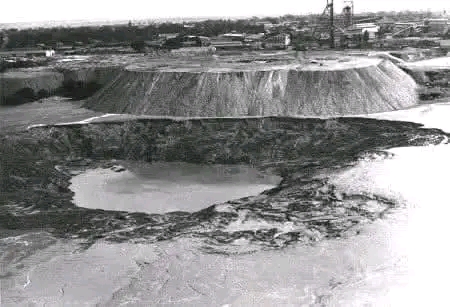

MUFULIRA MINE DISASTER – 56 YESRS AGO 😭
It was around 2:55am on 25 September 1970, when large quantities of mud entered the Peterson Section of the mine at various points between the 434-metre and 580-metre levels and flowed into the lower levels via the Peterson shaft system.
This historical event marking 56 years ago happened in only fifteen minutes or less and large sections of the eastern half of the mine were overwhelmed with mud, 1 500 miners were on duty at that mine. The proto rescue teams came from all the Copperbelt mines, led by Greg Phimister, the Mufulira Division’s ventilation engineer.
It was after 3 days when rescue operations were called off however 89 men were still missing and presumed to have been killed. Of the 89 men, 64 were employees of the Mufulira Division and 25 worked for Cementation Limited, a private contractor engaged to rehabilitate one of the shafts.
The total volume of sludge and mud which flowed into the working areas of the mine was estimated at 450 000m3. Many of the eyewitnesses reported that the initial mud rush was accompanied by an unusual noise, described in various terms as a “blasting sound”, “a shaking”, “an explosion”, and even as rumbling “thunder”.
The majority stated, however, that this noise was completely different from the very familiar sound of normal blasting operations.
The largest group of men were lost within the critical area of major flooding between the 533-metre and 580-metre levels.
Out of total gang strength of 60 working on these levels, 47 were killed. Another 9 men who belonged to other gangs (supervision, first aid, sampling, and Gang No. 5U551) were killed on the same levels, making a total of 56 victims.
It is also important to note that on the 580-metre level alone, 30 men were killed out of the 39 who were working there at the time of the disaster. This translates into a 77 percent fatality rate, and was the highest in the entire disaster area.
Survivors of the disaster gave various testimonies. Abel Musonda, a 24-year-old then, a crane driver, said from his hospital bed in Ronald Ross Hospital that he owed his life to a colleague who was also struggling to flee the terrifying rush of mud and slime. As he put it:
I got so tired that I had reached the point where I could go no further. The wet mud was flowing under me and I started shivering.
My chest was burning and I could hardly breathe. I’d almost given up hope, but I managed to pull myself up to another level where there was some water dripping. It was this water which gave me the power to carry on. But I had not gone very far before I was exhausted again. Then I noticed someone above me clinging to a pipe and he pulled me up to where he was.
Another survivor, Winnel Chishe, 38, a pump operator described how the shaft suddenly went dark as he and his colleagues heard a rushing sound coming towards where they were standing. He explained that they escaped death by holding onto a wire only as thick as a pencil.Forty-year-old Kenani Kabanda said “I first heard a violent noise and then saw muck and water flowing towards us.
Electrical cables snapped and ventilation fans stopped working. There was total darkness underground”. Another miner, James Kazembe, was working in a group of nine men in a cross cut at the 2150 feet level, when he saw mud and water rushing towards his group. He said, “we didn’t know what to do. The group split up and started running.
The rest of the men disappeared”. Another survivor said, “it was like being trapped in quicksand. I only managed to save myself by grabbing an electric cable and hauling myself up”.
The mud in the mine consisted mainly of floatation tailings; this contained variable proportions of fragments and boulders of various ore and hanging-wall rock types as well as soil and vegetation.
The tailings originated from a large pool of saturated or near-saturated slimes and tailings lying north of the Boise and Selkirk shafts in a hollow depression caused by subsidence over the entire mining area. A crater which appeared in this accumulation of tailings was first observed within 30 minutes of the mud inrush underground, but it probably developed at an earlier stage.
The tailings entered the mine through what is known as a sinkhole – a near circular chimney cavity, which developed beneath the surface accumulation of tailings. The sinkhole enabled mine waste to penetrate the caving hanging-wall and it entered the occupied workings via the stopes. The total volume of tailings missing from the surface crater was estimated to be 700 000m3 and the total volume of the mud in the working areas of the mine was estimated to be 450 000m3.
May those who lost their loved ones in this tragedy forever be comforted.
MUFULIRA VOLUMES (FOR EXTERNAL HISTORICAL SOURCES) – 24.02.2026
CREDIT: Mufulira Volumes
This is a disaster which shook the young nation (only about 6 years old) to the core. All attention was fixed on Mufulira as we followed updates from the mine.
It was very sad. The population of Zambia at that time was probably around 3 million and you can imagine the impact of losing 89 people in a single event.
I still vividly remember about that disaster because as we went to school in the morning, we were told to go back home after being told about the same. I was at a village school many miles away from Copperbelt and I was doing upper primary that time. It my first time to hear of a disaster of that magnitude and despite being young that time, we were all very touched and wept.
May their souls continue resting in peace