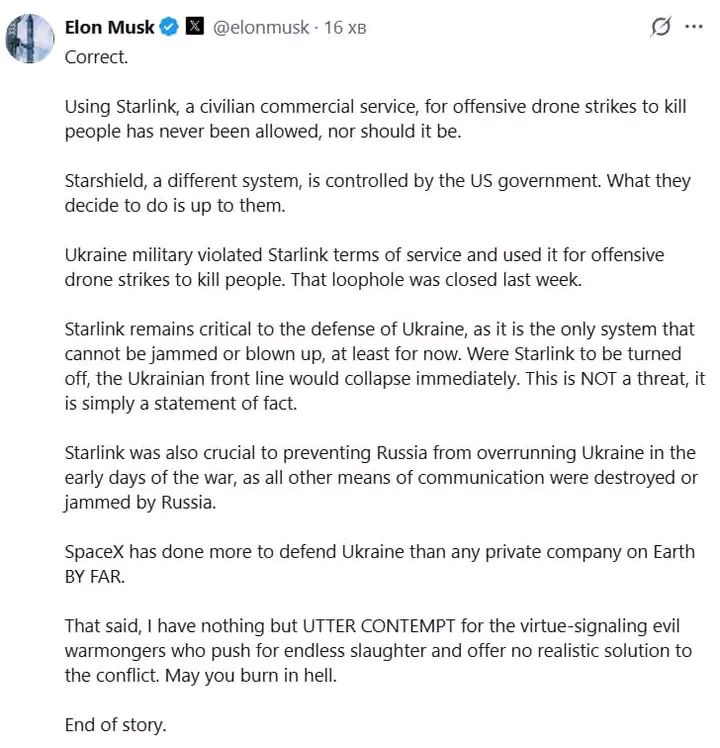
MUSK BLAMES UKRAINE OVER STARLINK—BUT WHERE IS HIS CONDEMNATION OF RUSSIA’S USE?
Elon Musk’s latest defense of restrictions on Ukraine’s satellite communications leaves a major question unanswered: why does his statement condemn Ukrainian military use of Starlink without condemning Russian forces that used the same commercial network to support their invasion?
Musk says Ukraine violated Starlink’s terms by using it for offensive drone strikes, describing a “loophole” that SpaceX closed. He distinguishes the commercial service from Starshield, which he says is controlled by the United States government.
That distinction matters—and so does applying it consistently. Reports about Russian military access concern Starlink terminals, not an authorized Russian Starshield service.
Ukrainian intelligence reported Russian troops obtaining Starlink terminals through third countries and using them in occupied Ukrainian territory. Ukrainian officials later identified Starlink equipment on Russian long-range attack drones. SpaceX has denied selling or shipping terminals to Russia or doing business with its military; Russian possession does not establish that the company supplied them.
There is also an important part of the record that should be acknowledged: SpaceX worked with Ukraine to block unauthorized Russian access. In February, Musk publicly said those measures appeared to have worked. It would therefore be inaccurate to claim he ignored Russian use entirely.
But his latest statement directs its accusation at Ukraine while leaving Russia’s use unaddressed. If offensive drone operations violate the commercial service’s rules, where is the equally explicit condemnation of Russia using that technology to attack Ukraine?
The consequences of the recent restrictions also extended beyond Ukrainian strikes against Russian targets. Ukrainian officials reported lost drone connections, interrupted missions and difficulties intercepting incoming Russian attack drones. Musk’s explanation about offensive use does not settle questions about restrictions affecting defensive operations, particularly those involving Starshield.
Ukraine has since reported restored connectivity, including stable connections on platforms traveling above 400 kilometers per hour. That figure describes movement speed, not internet download speed. Restoration is welcome, but it does not answer who authorized the disruption or how another interruption will be prevented.

Congressional scrutiny is already underway. In an October 23 letter, American senators and representatives asked Musk who ordered the restrictions and requested records of relevant communications involving Trump, Putin or their representatives. They also asked who controls future access. Those requests do not establish a joint criminal investigation or prove coordination with Moscow.
SpaceX has made a substantial contribution to Ukraine’s defense. Its importance makes accountability essential. Musk himself argues that losing Starlink would have catastrophic consequences for Ukraine’s front line—an acknowledgment of how much responsibility accompanies control of the network.
A social media statement cannot resolve those questions. Ukraine needs dependable communications, lawmakers need clear answers, and any condemnation of military misuse should confront the Russian army that brought this war onto Ukrainian soil.