
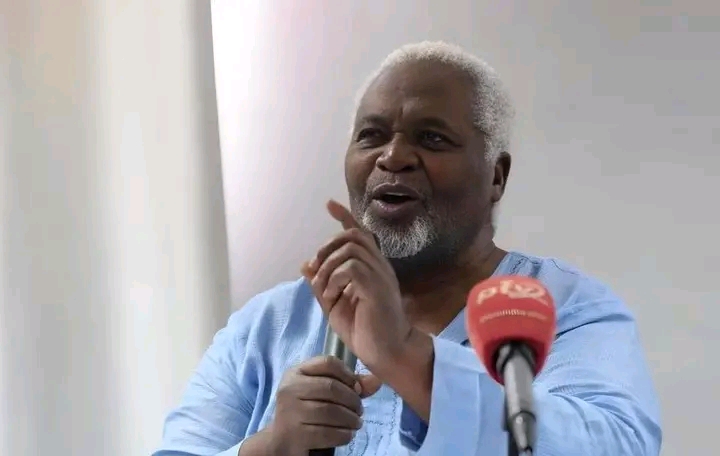
PRINCE AKASHAMBATWA PROMOTES THE NATIONAL CONFERENCE OF DEMOCRACY AND DEVELOPMENT
By Brian Matambo | 3 March, 2026
We are only 3 days away from the National Conference on Democracy and Development, and Prince Akashambatwa Mbikusita-Lewanika has been busy promoting the event that comes up on Friday, 6 March 2026. The question is, “Why does this programme matter, and why should Zambians pay attention to it, even if they are tired of politics, tired of alliances, and tired of speeches that end exactly where they began?”
On the Monday episode of EMV, Ambassador Emmanuel Mwamba hosted Honourable Prince Akashambatwa Mbikusita-Lewanika, political analyst, academic, founder member of the Movement for Multiparty Democracy, and Chairperson of the National Conference Planning Committee. The conversation moved quickly, but it was not casual. It was the kind of interview that carries a warning to the nation: that the democratic environment is narrowing, that fear has returned into public life, and that the 2026 election is starting to look less like a celebration of sovereignty and more like a contest of survival.
Before the conference agenda even came to the table, the programme opened with the news regarding the arrest of Dr Fred M’membe. Mwamba condemned it as the continued weaponisation of speech laws. He accused the Hakainde regime of merely relocating the spirit of criminal defamation into the new cyber laws. Whether one agrees with Mwamba or not, the point he was making was clear: a democracy that uses handcuffs to answer political commentary is a democracy with a sickness in its bloodstream.
Prince Akashambatwa did not dodge the matter. He described the arrest as sad and troubling, not simply because of the individual involved, but because of what it signals about the state of the Republic. He spoke of an environment where citizens increasingly live in uncertainty, uncertainty about freedom of movement, freedom of speech, and even freedom from institutional intimidation. Sixty-two years after independence, he said, it is a shame that civil liberties still feel conditional.
The National Conference on Democracy and Development is scheduled for 6 and 7 March 2026. According to Prince Akashambatwa, the planning committee is ready. But this is not being pitched as just another opposition summit or pre-election rally disguised as dialogue. He was deliberate in saying this is not merely about uniting opposition figures to defeat the ruling party. It is about uniting those who are genuinely committed to a democratic and developmental reset of Zambia.
Zambia has seen alliances before. We have seen grand declarations of unity that crumble the moment egos collide. What is being proposed here is something different in structure and ambition.
The conference, as currently structured, proposes a delegate composition of 55 per cent civil society and 45 per cent political parties, shared equally among participating formations. Civil society representation is expected to include traditional leaders, youth, and other civic actors, with gender considerations taken into account. The message embedded in that formula is simple: this process is not designed to be hijacked by party bosses alone. Citizens must sit in the room. Citizens must speak. Citizens must shape outcomes.
Prince Akashambatwa emphasised that the invitation remains open. Leaders who believe in the process can still come, even at the conference itself. But there is a condition that is quietly revolutionary in our political culture. Those who want to contest for top leadership positions must be prepared to accept the outcome and remain within the collective if they lose.
In Zambia, that is not a small request. Our politics has become intensely personalised. Leadership is treated as ownership. Losing is treated as humiliation. Winning is treated as a conquest. This proposed “team pledge” is an attempt to break that pattern. It is an attempt to say that leadership must be collective, that governance must outlive personalities, and that the country cannot continue to swing between extremes every five years.
The conference intends to debate and adopt what has been termed a minimum programme of change. In other words, unity must be rooted in policy, not ambition. Meanwhile, a social contract is expected to be tabled, one that binds political actors among themselves and binds them to the people of Zambia. The idea is to move away from campaign promises that dissolve into silence once power is secured.
But the most significant element of Prince Akashambatwa’s message is the concept of the Fourth Republic.
He outlined Zambia’s constitutional journey with clarity. The First Republic emerged at independence, built on a negotiated settlement and broad consensus. The Second Republic marked the shift to a one-party state, a fundamental departure from pluralism. The Third Republic restored multiparty elections in 1991, but, in his view, it never fully reconstructed the constitutional framework inherited from the one-party era. Instead, Zambia has lived with amendments layered on top of a structure that was never completely re-engineered.
The Fourth Republic, as he describes it, is not a minor amendment. It is a comprehensive reconstruction of the constitutional order. A people-driven constitution. A reset of the architecture of power. A system where decentralisation is real, not rhetorical. Where power is shared between the central and local governments. Where traditional authorities are recognised within a constitutional framework. Where communities have meaningful stewardship over land and resources.
He also raised concerns about development planning. Zambia’s history, he argued, has been one where national development plans were either externally influenced or crafted by narrow elites. The proposal now is for genuinely citizen-driven planning, short-term, medium-term, and long-term, free from donor dominance and aligned with national priorities rather than external prescriptions.
One may agree or disagree with his analysis. That is the privilege of a democracy. But one cannot dismiss the seriousness of the questions being raised.
Is our democratic space shrinking?
Are our institutions sufficiently independent?
Is our constitution fit for purpose?
Is our leadership culture too personalised?
Is our development agenda truly ours?
These are not campaign slogans. These are structural questions.
As the clock ticks toward 6 March, the significance of this conference lies not in the drama of who may emerge as a flagbearer, but in whether Zambia is willing to confront the unfinished business of its independence and its multiparty promise.
We can continue rotating personalities within the same constitutional cage. Or we can interrogate the cage itself.
Three days from now, we will see which path our political class is prepared to walk.