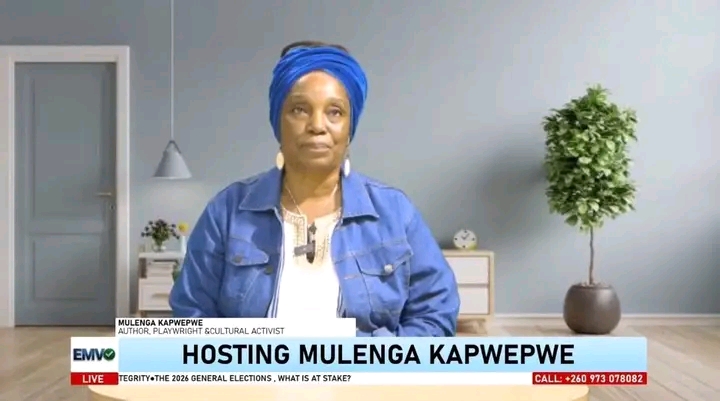

RESPECTED AUTHOR MULENGA KAPWEPWE GIVES VIEWS ON THE STATE OF THE NATION ON EMV
By Brian Matambo | 11 February, 2026
Respected author and daughter of the late Vice President in the UNIP government, Simon Mwansa Kapwepwe, Mulenga Kapwepwe featured on the popular evening livestream Emmanuel Mwamba Verified and spoke on a wide range of issues, offering her prognosis on the state of the nation.
Kapwepwe, a seasoned playwright, cultural activist, and firm defender of tradition, did not approach the discussion as a partisan figure. She spoke as a custodian of memory and values, grounded in Zambia’s founding ethos, yet clearly troubled by the present trajectory of the country.
From the outset, she described the current state of Zambia as “distressing” and “alarming.” Her concerns were not emotional outbursts but structured reflections rooted in governance, law, and institutional decay. She lamented what she sees as a blurring of lines between government and state institutions, warning that once the state becomes captured by partisan interests, the republic itself is weakened.
In a moment that has since drawn national attention, Kapwepwe addressed the legal cases involving the children of former President Edgar Chagwa Lungu. She referenced the property forfeiture involving Dalitso Lungu and acknowledged that while she had not read the full judgment, she was aware that an appeal was being pursued. However, her sharper criticism was directed at the Forfeiture of Proceeds of Crime Act itself.
She described the law as a “shishita law” – a shortcut that shifts the burden of proof from the state to the citizen. In her view, property should only be forfeited upon conviction, not on suspicion or speculation. She cautioned that laws that allow the state to seize property without meeting a high evidentiary threshold can easily be weaponized, and that when laws are unfair, they eventually “come for everyone.”
Her remarks were widely interpreted as a critique of what she termed a growing “politics of retribution” in Zambia. She expressed concern that institutions of the state, including the judiciary and law enforcement agencies, risk being drawn into partisan battles.
On the sensitive burial dispute involving late president Dr Edgar Chagwa Lungu, who has remained in a mortuary for months, Kapwepwe appealed to both law and humanity. Using a proverb, she stated, “You don’t fight over something that is not yours,” arguing that burial rights fundamentally belong to the family. She pointed out that even under South African legal principles, the order of burial preference rests with the spouse and children before others. She questioned what would be lost by allowing a family to bury their own, suggesting that humanity should guide such decisions.

Beyond the legal and political tensions, Kapwepwe also focused on the moral and institutional health of the nation. She expressed alarm at the erosion of professionalism in the civil service, arguing for a return to meritocracy rather than appointments based on loyalty or political contribution. In her assessment, Zambia is drifting toward what she described as a kakistocracy – a system where the least qualified occupy critical positions.
She also addressed the growing toxicity in public discourse, warning against tribal polarization and the normalization of hatred as part of the national lexicon. For Kapwepwe, Zambia’s diverse cultural heritage should be a source of pride and unity, not division.
On her own political future, she made a notable admission. She revealed that she has been approached “from every direction” with offers ranging from running mate to vice president and even president. While she stopped short of declaring political intentions, she emphasized that leadership is a “sacred covenant” rooted in service, not title. She acknowledged that politics is a “very dirty game,” yet posed a powerful question: “If we all sit back, who is going to fight for this country?”
Observers have noted that Kapwepwe is widely believed to be associated with leading 2026 presidential candidate Makebi Zulu, although she did not confirm any formal alignment. Her emphasis on constitutional order, institutional restoration, and ending political vengeance mirrors themes increasingly prominent in opposition discourse.
As a respected author and defender of culture, Kapwepwe’s voice carries weight beyond partisan lines. Her appearance on EMV was not merely commentary. It was a sober intervention by a figure rooted in Zambia’s founding tradition, now urging a return to principle, professionalism, and humanity.
Whether she ultimately enters the political arena remains to be seen. What is clear, however, is that her words have entered the national conversation at a time when the country stands at a crossroads.
Respected, by who? Non entity
This woman is nothing but a joker with no moral campus. Same as Nkandu Luo and Lombe Chibesakunda.
When someone asks you what colour the sky is…state the facts. Not some weird opinion that suggests the chip you have on your shoulder cause your father was someone.
What is your legacy? Quit riding on the name of your father and think that is you. Your sister is carvingn out her own legacy. What she was leave as having achieved is her legacy not yours nor your fathers.
As a said noteable person and god know what plays you have written (as the dont seem to stand out). Demonstrate a thinking that makes you stand out. The reason for standing up in the opposition is devoid of facts by exmplifies nothing but hate.
Tell us and I challenge using facts names place (that you know if challenged in court they will stand)…why you are against this regime? Otherwise you are just a morally bankrupt individual flaunting your father’s name and were appointed to NAC bases on that nothing else. If you were talented…there names like Kaonga who have attemped to breaking into the bigger market in acting than you. You tell us, what you have achieved apart being “Kapwepwe’s daughter?”
Cheap and old fashioned woman who thinks being a kapwepwe and bemba makes or gives them the right to the leaders. She thinks every leader must listen to her because the father was there. LOL!!! To hell with you madam. You not having anything assigned to be controlled by you doesnt mean Zambia has gotten worse. We actually are getting better as a country unlike before. Not even kaunda’s children are so ungrateful and full of themselves . This kapwepwe woman thinks we Zambians owe her. Why would Zambia be attracted to you? Fimba upoke uzalema weka.