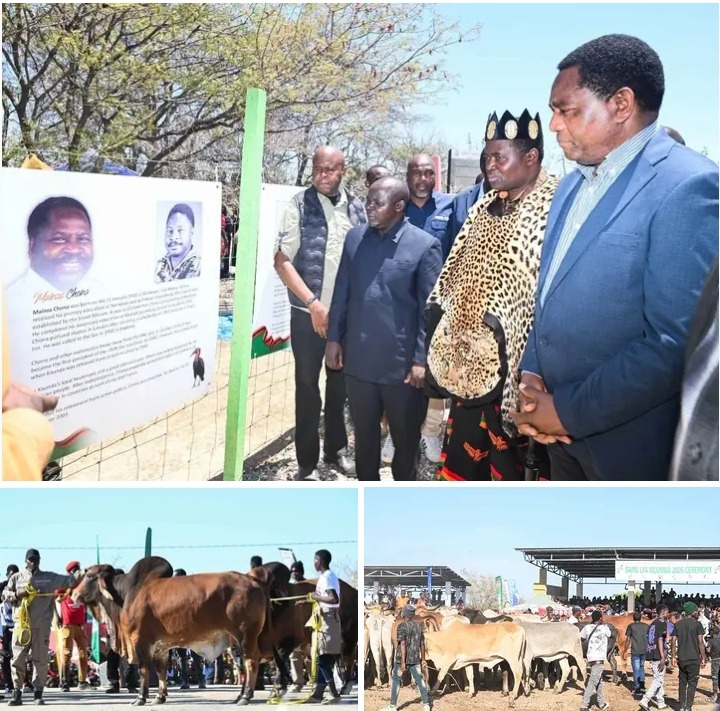

SAMU LYA MOOMBA AS A HERITAGE FOR ZAMBIA’S BIRTH: A NATION IS BUILT BY SACRIFICE, NOT POLITICAL SONGS
Some places preserve history. Others confront a nation with the question of what its people are still willing to sacrifice for it. Samu Lya Moomba is such a place. I am profoundly grateful to President Hakainde Hichilema for including me in the presidential delegation to this sacred ground of our independence story. I only became aware of this honour after coming back online following the High Holidays, during which my phones were completely switched off from sunset Friday through sunset Sunday in observance of Shabbat and Yom Tov, with their Sabbath like restrictions.
As I reflected on what happened at Samu Lya Moomba, ordinary people pooling their cattle and converting their own wealth into resources for the liberation of Zambia, I realised that this place does not only tell us where we came from, it challenges us to ask what sacrifice, unity and nation building demand of our generation today. As aptly put by President Hakainde Hichilema, our generation must be reminded that during Zambia’s struggle for independence, people in Southern Province pooled their cattle, which were sold to raise resources for the liberation struggle. I have written an article on this before.
This history is well established. Parliamentary records going back many years record Samu Lya Moomba in Bweengwa as a place where people gathered, contributed cattle and mobilised resources to enable freedom fighters, including Harry Mwaanga Nkumbula and Kenneth Kaunda, to advance the struggle for independence. Think carefully about what this means. Our forefathers understood something that Zambia must rediscover today that a national vision requires resources.
They had no sophisticated financial markets. They did not have mobile money, venture capital funds or development banks at their disposal, but they had cattle. Cattle represented wealth. Cattle represented production. Cattle represented savings and capital, and when the national cause demanded it, people were prepared to convert part of that wealth into the resources necessary to pursue freedom. That is the first lesson from Samu Lya Moomba.
Political speeches alone could not finance the liberation struggle. Someone had to produce something of value. Someone had to own an asset. Someone had to sacrifice that asset. Someone had to convert production into money, and money into action. The same principle applies today. If our generation wants to build a prosperous Zambia, we must produce.
The farmer must produce more maize, wheat, soybeans and livestock. The miner must produce more minerals and increasingly process them locally. The entrepreneur must build businesses. Our young people must create technology, manufacture products and develop services that can be sold beyond Zambia. Our councils must turn local economic potential into functioning markets and industries. The cattle of Samu Lya Moomba were not merely cattle. They were capital deployed towards a national objective. That is an extraordinary lesson in economic mobilisation.
The second lesson is collective sacrifice. Those people were not contributing cattle so that they could personally become ministers after independence. They were contributing towards something larger than themselves. They were investing in a Zambia they might never personally benefit from in proportion to what they had sacrificed. That mentality is indispensable in nation building. There comes a point when we must ask ourselves not simply, What will Zambia give me? but also, What am I contributing towards the Zambia I want to see?
The third lesson is unity of purpose. The liberation of Zambia was never the achievement of one tribe, one province, one political organisation or one individual. Men and women from different parts of this country made different contributions to the same national objective. Without resources, the struggle for independence would have remained far fetched.
There is a fourth lesson which speaks directly to President Hichilema’s Grow Zambia Agenda. Our forefathers mobilised the productive assets they possessed to achieve political independence. Our generation must now mobilise the productive assets we possess to achieve economic independence. We have copper. We have cobalt. We have manganese. We have agricultural land. We have livestock. We have water. We have forests. We have sunshine. We have human capital. We have a young population capable of mastering technology.
At Samu Lya Moomba, cattle helped finance the journey towards political freedom. More than sixty years later, perhaps the greatest tribute we can pay those men and women is to build the productive economy for which political independence created the opportunity. It is therefore significant that Government approved the declaration of the historic Samu Lya Moomba site as a National Monument in 2026. This is not merely about preserving a physical place. It is about preserving a national philosophy.
Our children should visit Samu Lya Moomba and learn that ordinary Africans, possessing what they had and giving what they could, helped finance their country’s freedom, and they should leave that place asking themselves one question, “What am I prepared to produce, build or sacrifice for Zambia?” That, to me, is the enduring lesson of Samu Lya Moomba.
The generation before independence mobilised for freedom. Our generation must mobilise for production, growth and prosperity. That is how we honour their sacrifice. That is how we Grow Zambia.
One Zambia. One Nation. One People.🇿🇲
Saviour Chishimba
Member
UPND Alliance Council of Presidents
President – UPP
Pictures Credit: President Hakainde Hichilema