
DR NEVERS MUMBA’S TESTIMONY:
… Sata Advised That I Just Drink Tea In The Office Because Levy Would Fire Me If I Continued Working So Hard
… But Levy Warned That He Would Fire Me Only If I Slowed Down Because He Never Hired Me To Drink Tea
… However, The Overloading In The Office Later Brought Problems For Me … And I Was Shocked When He Fired Me
Hey Folks,
After enjoying the excerpts touching on Rupiah Banda and Enoch Kavindele’s characterisation of their work relationship with President Levy Mwanawasa over the last couple of days, today it is Dr Nevers Mumba’s turn to share his experiences with the late president as excerpted from my book: Levy Patrick Mwanawasa: An Incentive For Posterity (2009), Pages 189 – 193.
Enjoy the read!
Amos Malupenga
Author
***
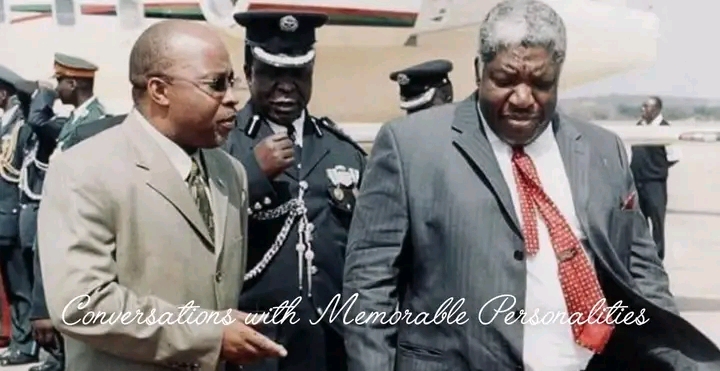
Picture caption: Vice-President Nevers Mumba (left) with President Mwanawasa circa 2004. Pic: Dr Nevers Mumba’s family album.
The excerpt:
Dr. Nevers Sekwila Mumba:
“My situation as Vice-President [was] a bit different, because when I joined government on May 28, 2003, at President Levy Mwanawasa’s invitation, he was already going through some situation and he needed some help from a Vice-President. So I actually became a Vice-President running.
Two days after my appointment, President Mwanawasa gave me the responsibility of opening the Copperbelt Mining and Agricultural Show which, up until that time, no Vice-President had ever been given the responsibility to do so
This was my first assignment and I flew over to Kitwe to execute that assignment. Shortly after that, many national issues had arisen. Unionised workers wanted to go on strike, demanding increased housing allowance. I remember the President phoning me saying, ‘I want to shift this issue to your office so you can deal with it.’ So that kept me very busy. I had heated meetings with union leaders almost every week until we resolved that issue.
I also remember that during the same time, we had problems with the churches – the three mother bodies: the Evangelical Fellowship of Zambia, Zambia Episcopal Conference and the Christian Council of Zambia.
In saying this, I am trying to mention the projects that President Mwanawasa gave me
to pursue when I got into office. So I dealt with the church leaders and the issue was rested. President Mwanawasa was happy that I could do that.
There were many other assignments he gave me which I cannot mention. I felt privileged because President Mwanawasa had been Vice-President before. And my understanding was that he understood the difficulties of the Office of the Vice-President.
For that I reason, I do not consider myself to have faced the same situation he faced as Vice-President under President Frederick Chiluba.
When I was appointed Vice-President, I was taken to the office and I sat behind the table. There was nothing on the table except a letter that was left by my predecessor Enoch Kavindele. All he said in that letter is, ‘I congratulate you and wish you the best.’
There was no instruction of what I needed to do in running the office until later on when
I sought help. The Secretary to the Cabinet came, [along] with the permanent secretary, and they tried to help me in that regard.
I studied the Constitution to find out the role of the Vice-President. In the Constitution, I found that the Vice-President was the leader of the government business in the House or Parliament, so I devoted a lot of time to study parliamentary procedures in order to acquaint myself with the process.
I was also in charge of disaster management, so I studied the policy regarding that.
So my hands were full [of] what I have referred to above. I was going to the office as early as 07:30 and I didn’t come [back home] until 20:00 and I still couldn’t finish the work.

Also President Mwanawasa had indicated to me that if I received any invitation to officiate at any function within Lusaka, I was free to use my discretion whether to accept it or not. There were many invitations but I limited the invitations to three per week. The point I am trying to make is that there is a lot of work for the Vice-President.
And when I tried to work hard, I would hear Mr Michael Sata say on Radio Phoenix, ‘There is no Vice-President who works like this one. He would be fired. He should just stay there and drink tea.’
So that same night, I drove to Nkwazi House [the President’s official residence] and I said to the President, ‘Your Excellency, you heard what Mr Michael Sata said on radio this morning. Am I working too hard so I can slow down?’
But the President said, ‘The choice is yours; if you want, you can listen to Mr Sata and start to drink tea and before long you will be fired because you were never hired to drink tea.’
That gave me courage. I thought I was invited to serve the nation and to serve him. In that case, I can say that I had a different experience as Vice-President compared to Mr Mwanawasa’s time. In fact, I had too much work to do.
I asked the President if he could give me one hour per week, which I called the ‘Presidential Brief’. The President was gracious enough to accept my proposal so we met every Wednesday from 09:00 to 10:00. Within that hour, I was able to read his mind, feel what was important to him and be able to implement that on his behalf.
So I used the Wednesday meetings to check my boundaries. When he didn’t agree with me, he would tell me to my face. He would say, ‘I didn’t like what you did.’ President Mwanawasa does not go round [beating the bush]. If he doesn’t like something, he says it as it is. So that was helpful to me.
Regarding the issue…of being sidelined as Vice-President, I think the Vice-Presidency is a very complicated position. It is complicated because a President has line ministers whom he can deal with all the time. If he wants to deal with an issue on energy, he will call the minister in charge of energy. If it is an issue to do with finance, he will call the Minister of Finance.
The only time he contacts the Vice-President is when he wants something to be done on his behalf when he is not able to do that. And that does not happen all the time.
And so there was a time I started to feel that ministers knew more than I did, and rightly so, because they were owners of those portfolios.
I was considered an outsider, so when I was appointed Vice-President, I found that the President already had a team he was working with. This team sometimes did not help. They only gave me information which they thought I should know.
Sometimes I wouldn’t even know where the President was. I would just see on television that he was in Kafue.
So those things sometimes got to me. I would ask, ‘Is it deliberate, or is it just a schedule?’ But again, I thought this was neither here nor there because the President didn’t monitor my movements in Lusaka.
But at several times, I felt that there were some ministers who were closer to the President than I was, although I never allowed that to stand in the way of my job.
Sometimes the President would be in London or New York and I had no clue about how I could contact him. I would contact the Ministry of Foreign Affairs and they would say, ‘We will get back to you, sir’, and that was it. They never got back to me.
But there was one minister I could phone and he would give me his room and phone numbers. I just had to accept that. I thought probably he had known this minister much longer than he had known me. Or probably, the President assumed that the system had
given me his contact details in case there was an emergency.
Sometimes I felt I was not that close to the President but I couldn’t do anything about
it… So I just concentrated on doing my job.
Unlike Mr Mwanawasa, I was overloaded as Vice-President. And I think it was the overloading that brought problems for me.
For me, President Mwanawasa was nice working with. I thought that he probably respected me as a pastor. I heard many stories that he was short-tempered and shouted at people in the office. But I really never had an experience like that with him.
Even when he was upset with me, he found a way to talk to me. I found him to be totally engrossed in work, in details.
He was only communicative through letters. As an individual, I didn’t find him communicative. I would count how many times the President phoned me. Even when he phoned, he was brief. Everything was communicated through letters. And because of that, I didn’t converse with him much except for my Wednesday meetings with him.
These meetings enabled me to know the President more and better. But he was pleasant to work with because he didn’t interfere with what he asked me to do. That gave me a lot of confidence.
So I would be lying if I said I had a lot of head butts with him. But I had a lot of head butts with the people around him.
If he had issues with me, then he never told me. That is why, when he dismissed me, I said I was shocked because, indeed, I was shocked.
Based on the relationship I had with him, I never saw where a thing like that would develop…What happened was unfortunate but I can’t use that to say he was a bad boss to me.”
***
Want to read more incredible behind-the-scenes in Zambia’s political history?
Levy Patrick Mwanawasa: An Incentive For Posterity, and Conversations with Memorable Personalities, Parts 1 & 2, are available for purchase from Bookworld or directly from the author.
Call or WhatsApp: 0977 788 200
#ConversationsWithMemorablePersonalities #ZambianHistory #LevyMwanawasa #NeversMumba #StateHouse #VicePresident #ZambianLiterature