
🇿🇲 VIEWPOINT | The Copper Rush is Back, But Zambia Wants More Than Pit-to-Port Future
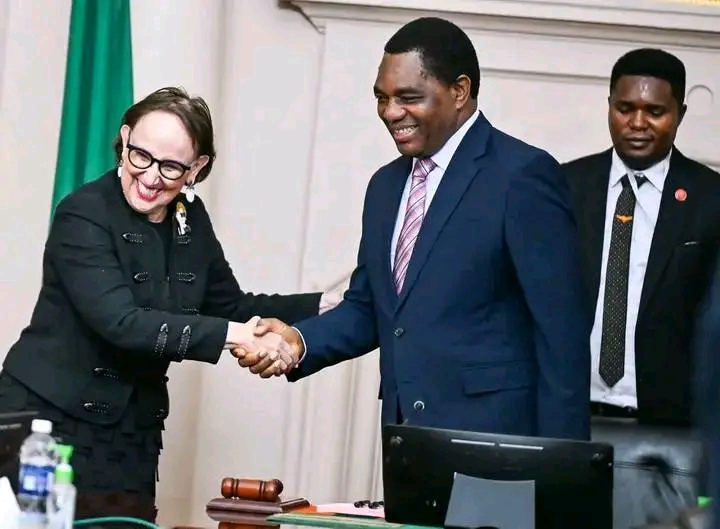
Tuesday’s meeting between President Hakainde Hichilema and UNCTAD Secretary General Rebeca Grynspan was more than routine diplomacy. It was a timely intervention into one of the defining economic questions of this decade: as the world enters a new copper rush driven by artificial intelligence, electric vehicles, and green grids, will Africa remain a supplier of raw wealth or become a producer of industrial value?
President Hichilema’s message was unusually direct. “We cannot continue exporting raw materials for centuries,” he said, stressing that African leaders are now “speaking one language.” The emphasis was clear: the era of simply digging and shipping is politically exhausted. Zambia, sitting at the centre of a global scramble for critical minerals, wants discussions “that will lead us into responsible resource extraction, processing, value addition.” In other words, copper must translate into factories, jobs, and fiscal strength, not just export figures.
This is not abstract rhetoric. Zambia is one of Africa’s major copper producers, and global demand is accelerating as data centres expand and AI systems reshape industrial economies. Copper is no longer just a commodity. It is strategic infrastructure. Countries that control supply chains will shape the next phase of global power, and Zambia is now being treated less as a peripheral producer and more as a contested economic hub.
UNCTAD’s Rebeca Grynspan captured this shift bluntly. “Zambia is a country that we have been following very carefully,” she said, calling it “a strategic regional hub.” Her framing is significant because it places Zambia in a different category: not merely landlocked, but “land-linked,” serving as a transit and energy corridor for COMESA, SADC, and the African Continental Free Trade Area. That is the language of connectivity, logistics, and regional leverage.
But Zambia’s core challenge remains historical. Copper has powered export earnings for decades, but too often it has failed to industrialise the domestic economy. The colonial-era model of extraction without transformation still casts a long shadow. Value addition is therefore not a slogan. It is a break with a century-old structure where wealth leaves the ground but development does not stay in the community.
This is why the President’s focus on institutions and delivery matters. He called for partnerships with UNCTAD to move “beyond traditional” arrangements, pushing for “harmonisation and rationalisation” so that international support produces measurable outcomes. “We have to deliver in a way that will make the economy function,” he said. In an election year, that is a governing standard, not a campaign flourish.
The meeting also highlighted an underappreciated part of the economic story: trade systems. Hichilema pointed to ASYCUDA, UNCTAD’s customs automation platform used in over 100 countries, arguing that digital commerce must take root because it “cuts out delays and negative vices.” His logic is straightforward: efficiency reduces corruption opportunities, speeds up trade, and ultimately “enhance[s] treasury incomes.” Modern economies are built not only on minerals, but on systems.

The copper rush offers Zambia an opening, but it also carries risk. The world is not competing for Zambia’s prosperity. It is competing for Zambia’s copper. Without strong governance, processing capacity, and domestic industrial policy, the boom could repeat old patterns: elite enrichment, environmental damage, and export dependence dressed up as partnership.
Tuesday’s State House engagement therefore reads as both a warning and a declaration. Zambia wants to be more than a supplier nation. The President is signalling that the new bargain must be different: extraction with processing, investment with jobs, trade with integrity, and minerals with measurable national uplift.
The question now is whether Zambia can convert global urgency into domestic transformation.
Copper is back at the centre of the world economy. The real test is whether this time, Zambia stays at the centre of its own.
© The People’s Brief | Ollus R. Ndomu