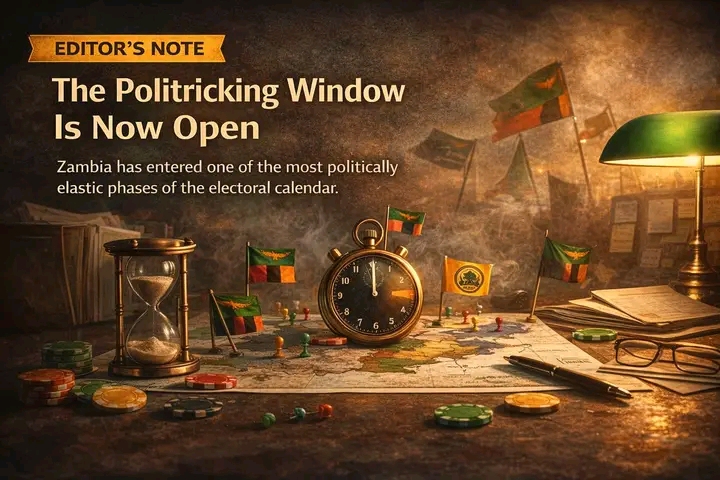

🇿🇲 EDITOR’S NOTE | The Politricking Window is Now Open
Zambia has entered one of the most politically elastic phases of the electoral calendar.
With roughly 179 days to the August 13 general election, the constitutional and electoral threshold that normally triggers parliamentary by-elections has effectively closed. In simple terms, MPs can now switch political camps, join new formations, or reposition themselves without automatically forcing a fresh vote in their constituencies.
This is not a technical footnote. It is a political opening.
And it is the season where manoeuvre often becomes louder than message.
What this period creates is a marketplace of political brokerage. Alliances will be tested. Loyalties will be traded. Smaller parties will become negotiating platforms rather than ideological homes. The opposition, already fragmented, will likely see more crossings, more quarrels, and more competing claims of legitimacy.
Zambia has seen this movie before. When the cost of defection disappears, the incentive to defect rises.
The Patriotic Front’s current internal disorder is the clearest example. Multiple factions continue to fight over leadership, legacy, and control, even as the electoral clock runs down. Instead of building a coherent national alternative, much of the opposition space remains trapped in succession battles, court disputes, and personality-driven mobilisation.
The ruling UPND, meanwhile, faces its own generational tension.
The party was formed in late 1990s and spent almost 23 years in opposition before winning power in 2021. Many of its senior MPs and long-serving figures view their continued presence as earned sacrifice, the old guard that held the line through years of political drought.
But younger aspirants are increasingly restless. They see a party now in government, with opportunities finally available, and they want their turn. Adoption disputes, constituency rivalries, and internal competition are likely to intensify as the campaign season approaches full heat.
This is the underlying risk of the non-by-election window: it amplifies internal instability at precisely the moment parties should be consolidating.

For the country, the danger is broader than party politics. When politics becomes dominated by crossings and factional arithmetic, the national conversation shifts away from policy, development, and governance. Voters are left watching musical chairs while the economy, jobs, energy, and public services remain the real ballot issues.
The Electoral Commission of Zambia’s regulations and the electoral code will matter more than ever in this period. Political actors will test boundaries. Institutions must hold the line.
This window is open. The politricking will accelerate.
The question is whether Zambia’s parties will use this season to clarify their vision or simply to reshuffle their ambitions.
© The People’s Brief | The Editor