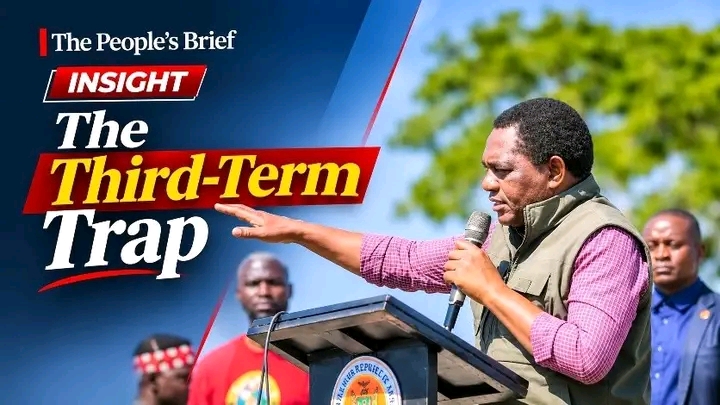

INSIGHT | The Third-Term Trap
President Hakainde Hichilema once questioned why any leader would need more than ten years in office. Five years later, his supporters are campaigning to remove the very constitutional restriction he defended, while State House insists he has nothing to do with the debate. The contradiction is becoming increasingly difficult to ignore. For a President beginning his second term, the greater danger may not be the failure of the campaign, but the political divisions it could leave behind.
Economic Front leader Wynter Kabimba has challenged the argument that Zambia cannot afford to lose a good President because of term limits. “You can’t make law for one man and law is not made for good and bad,” he argued on Prime Television’s Matters Arising. His reasoning goes beyond Hichilema. A Constitution amended because one leader is considered effective would also govern future presidents, including those whose conduct might be entirely different.
Consider a situation where the law is changed and Hichilema subsequently leaves office through retirement, illness or another unforeseen circumstance. His successor would inherit a presidency without the existing two-term restriction. Zambia would have surrendered a constitutional safeguard for the perceived benefit of a leader who might no longer occupy State House. The central question is whether confidence in one individual provides sufficient justification for changing rules intended to protect an entire Republic.
Former Justice Minister Given Lubinda has demanded that Hichilema publicly reject the campaign and has called for a referendum. “The presidency is a temporary mandate. The Republic is permanent,” he declared. The Law Association of Zambia has taken a similarly firm position, warning that removing term limits could weaken democratic accountability and encourage the concentration of executive power.
“Constitutional reform must be informed by the national interest and the collective aspirations of the Zambian people, and not by the interests of particular individuals or political formations,” LAZ stated on November 16. The association has reserved the right to pursue legal action to defend Article 106(3). Its position draws on decades of constitutional review, including the Chona, Mvunga and Mwanakatwe commissions, which supported limits on presidential tenure.
Meanwhile, the Zambia Police Service has stopped both demonstrations planned for November 25, one supporting removal of term limits and another defending the existing provision. Police Public Relations Officer Chipo Kaitisha cited intelligence information and the prevailing national security situation.
“We therefore urge the organisers of the planned processions and public assemblies not to go ahead with the processions,” the police statement said.
Civil society organisations opposing removal have challenged the decision, demanding specific reasons and alternative arrangements. Their dispute with police introduces another constitutional question: whether public order restrictions are being applied consistently with the right to peaceful assembly. Both groups have expressed opposing views on presidential tenure, but neither should lose constitutional protection merely because its position is unpopular with those exercising State authority.

State House Chief Communications Specialist Clayson Hamasaka has argued that Hichilema should not be dragged into a campaign he neither initiated nor influenced. But the explanation leaves an important question unanswered. Hichilema publicly rejected third-term politics after his 2021 election victory, asking: “What do you want to do beyond 10 years, which you could not do in 10 years?”
Why should reaffirming the same principle now be difficult? The President has every right to allow citizens to debate constitutional reform, but exercising his own freedom to state a position would not amount to suppressing theirs.
Critics, including Socialist Party president Fred M’membe, have alleged that the campaign is being promoted through political surrogates. Such allegations remain contested, and State House denies presidential involvement. Nevertheless, denying responsibility for initiating a campaign is different from rejecting its objective. Hichilema’s personal position matters because the proposals are being justified publicly through claims about his leadership and the need to retain him beyond the existing constitutional limit.
The political environment also deserves attention. Zambia emerged from the August elections with Hichilema securing another mandate, but opposition forces demonstrated considerable support despite organisational divisions. The electoral contest exposed regional and urban political differences, including competition across Lusaka, the Copperbelt and the northern provinces. Allegations of electoral irregularities continue to circulate among some opposition supporters, although such claims do not themselves invalidate the declared result. The country is therefore far from politically unanimous on questions concerning the presidency.
UPND’s strength in Parliament gives the governing party considerable legislative influence. However, constitutional change is not simply an exercise in counting parliamentary seats. A legally sufficient majority may pass an amendment, but broad public acceptance is a separate political consideration. The growing objections from opposition parties, churches, lawyers and civil society organisations demonstrate why the two should not be confused.
Zambia has confronted this problem before. Frederick Chiluba’s failed third-term campaign in 2001 divided the ruling MMD, with senior figures breaking ranks and rival political formations emerging. The dispute revealed how quickly loyalty can change when a leader’s continued tenure begins to conflict with the political ambitions of those around him.
A similar revolt within the UPND cannot be assumed, but the possibility deserves consideration. Political parties contain competing ambitions, including among those who publicly defend their leaders. Should opposition to removing term limits deepen, some ruling-party figures may begin calculating whether continued support serves their political futures. The people encouraging a President to remain in office may not necessarily stand beside him when the political costs become difficult to bear.
Hichilema has a more consequential opportunity before him. His second term could be devoted to consolidating economic reforms, improving livelihoods, strengthening institutions and preparing the UPND for leadership beyond his presidency. Orderly succession remains one of the weaknesses of Zambian party politics, where organisations frequently revolve around individuals rather than durable institutions. Grooming capable successors would demonstrate that a political programme can survive its principal architect.
Ultimately, the danger of the third-term campaign is not confined to whether Parliament removes Article 106(3). It lies in the possibility of consuming valuable political time, widening divisions and leaving Hichilema defending a controversy he says he never initiated. Chiluba’s experience remains a reminder that political allies can become opponents when circumstances change.
For Hichilema, the enduring legacy may depend less on how long he remains President than on what he achieves, the institutions he strengthens and the leadership he leaves behind.
The People’s Brief | Ollus R. Ndomu
18 November 2026