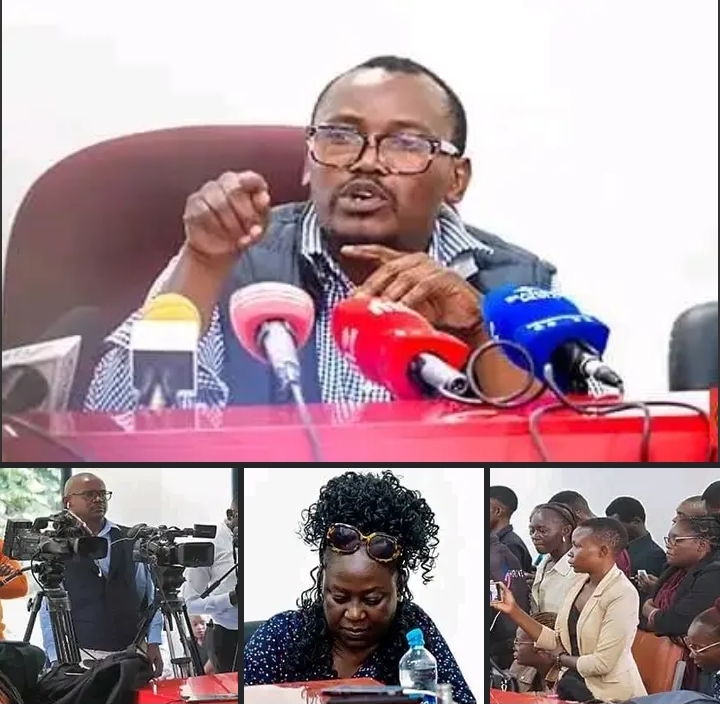

BRIEFING | UPND Hardens Position as CSO Leaders, Faith Groups Teem at State House
The ruling United Party for National Development has moved decisively to defend Constitutional Amendment Bill No. 7, framing it as a targeted intervention designed to avert future constitutional instability.
Speaking at the Anderson Mazoka Secretariat in Lusaka, UPND Media Director Mark Simuuwe said critics of the Bill had “lost the debate” because their objections lacked legal grounding and practical alternatives.
Simuuwe argued that civil society organisations had been “accommodated at every turn,” noting that the Bill was deferred at their request and that the Law Association of Zambia submitted six names to the Technical Committee.
“The President listened,” he said. “Government responded, but some groups chose to mislead the public. Their petition was dismissed for being frivolous.”
The ruling party also condemned clergy who have taken overt political positions during the Bill 7 campaign. Simuuwe said congregants were “raising concerns of religious capture,” adding that churches are free to participate in governance but should not hide political commentary behind the pulpit.
UPND maintains that Bill 7 is targeted, citing its limited scope of 13 amendments. Simuuwe contrasted it with the former Patriotic Front government’s Bill 10, which he described as “a near overhaul” containing 117 amendments.
He listed what he called “dangerous proposals” under Bill 10, including the attempt to alter Zambia’s Christian character in the Preamble, abolish service commissions, weaken oversight on public borrowing and merge policing functions under one political authority.

On delimitation, Simuuwe emphasised that the Constitution already requires a boundary review every ten years. “This process began in 2019,” he said. “To proceed, the clause fixing constituencies at 156 must be amended. This is not an opinion. It is a constitutional requirement.”
Simuuwe added that new constituencies do not increase voter numbers and therefore do not change presidential outcomes.
The ruling party insists the Bill addresses a real constitutional risk under Article 52, which currently allows unlimited withdrawal and refiling of nominations.
According to Simuuwe, this loophole could enable an incumbent to extend time in office during an election.
“It is a potential constitutional crisis,” he said.
Meanwhile, pro-Bill CSOs and church leaders from across the country have gathered at State House, calling Oasis Forum an “urban elite group” and urging government to respect the submissions made through the Technical Committee.
Their message is that no single church or CSO “is more Zambian than the rest.”
This mobilisation follows a turbulent weekend. Government suspended dialogue with the Oasis Forum after accusing it of arriving with a fixed position rather than specific clauses or alternative proposals.
The Forum countered with a detailed letter outlining constitutional concerns, referencing the Mukandila and Zulu judgment and insisting that any reform must begin with a fresh, people-driven process.
The confrontation has created two parallel narratives. Anti-Bill voices claim the amendment process lacks legitimacy and transparency. Pro-Bill actors argue that Parliament alone has the constitutional mandate to amend the law and that national consultations cannot be subordinated to CSOs holding prayer rallies with largely elite attendance.
Simuuwe said the ruling party backs the government’s decision to close structured dialogue.
“We agree to disagree,” he said.
“Even if Oasis Forum rejects the process, Parliament will proceed.”
State House engagements are continuing this afternoon, with the President currently meeting organisations that support the reform process.
The People’s Brief will publish a full explainer after the public engagements conclude. Stay with us.
© The People’s Brief | Goran Handya and Mwape Nthegwa
Check mate. We are at a time when organisations meant to speak for the people they represent can be used to advocate on matters where they people themselves are divided on the matters at hand.
For instance, how did the oasis forum obtain the consent of the all the Zambians for them to demand for the discontinuation of the process at hand. Did they go around the whole country to obtain submissions from the general public on their total dissatisfaction of the process at hand?
I don’t think so, unless someone can give me a report. I for one missed this invitation. what I hear repeated is what most opposition members have stated. They sound like an opposition group who want to stop everything without giving any consensus on agreeable issues. This is very concerning. If you are objective you can not disagree with everything.
What about the rights of those CSO, Traditional leaders and ordinary Zambians who believe in the process. Are you honestly going to deny them their rights just because you feel your grouping is more important than others. If all is not agreed to as in other cases there is recourse in courts of law.
It will be a shame if now the same organisations will not trust the courts of law. One will ask the question as to way they allowed the system to be untrustworthy under their watch. Their job was to advocate for transparency from the past to now.
Well said! I like how you exposed their hypocrisy. It’s inspiring to read such insightful analysis.