
WHAT IS THE DIFFERENCE BETWEEN A DIOCESE AND AN ARCHDIOCESE? WHAT ABOUT A BISHOP AND AN ARCHBISHOP? MORESO, WHAT IS THE DIFFERENCE BETWEEN A METROPOLITAN SEE AND A SUFFRAGAN DIOCESE?
Note: LONG READ BUT WORTH THE ATTEMPT
Our Lord established for His Church a structure of leadership based on the apostles, which is known as the hierarchy. As with any organization, each leader in the Church has a particular area of responsibility and jurisdiction. While this answer will speak of leadership, responsibilities, and jurisdiction, we must always be mindful that leadership in the Church must reflect the image of the Good Shepherd, who lays down his life for his sheep (John 10:1-18).
The Holy Father, the Pope, as successor of St. Peter, has full, supreme, and universal authority over the whole Church. He exercises this power unhindered. Therefore, the Dogmatic Constitution on the Church of Vatican Council II stated that the Pope “is the perpetual and visible source and foundation of the unity both of the bishops and of the whole company of the faithful” (#23). Keep in mind that one of the official titles of the Holy Father, originating with Pope St. Gregory I (d. 604), is “Servant of the servants of God,” reminding him that he is called to serve others.
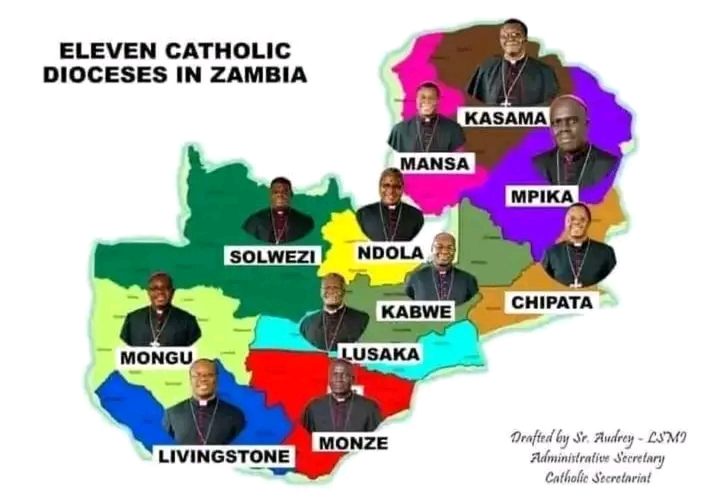
In union with the Holy Father are the bishops. Each bishop is appointed to exercise authority over a particular territory called a diocese. For example, the Holy Father is the Bishop of the Diocese of Rome, and Bishop Edwin Mulandu is the Bishop of the Diocese of Mpika. While the Pope has full, supreme, and universal authority over the whole Church, “the power which [bishops] exercise personally in the name of Christ, is proper, ordinary, and immediate, although its exercise is ultimately controlled by the supreme authority of the Church” (Dogmatic Constitution, #27).
Each bishop is truly to act as a shepherd for his diocese. With the assistance of priests and deacons, he exercises his pastoral office over the portion of the People of God assigned to him, regardless of age, condition, or nationality, or whether permanently or temporarily residing in the diocese. Care must also be extended to those who have special needs (e.g. the homebound or disabled) and those who have fallen away from the Church. The bishop must also foster good ecumenical relations, acting with kindness and charity toward those who are not in full communion with the Church. (Confer Code of Canon Law, #383).
In overseeing his diocese, the bishop must insure the authentic teaching of the Catholic faith, the proper and regular celebration of the sacraments and other acts of devotion, the fostering of vocations to the priesthood and religious life, and the governing of the diocese with loyalty to the Holy Father. To accomplish these tasks, the bishop extends his authority to his priests, particularly his pastors, each of whom is responsible for a parish, a territorial subdivision of the diocese. Moreover, the bishop also makes an AD LIMINA visit every FIVE years to the Holy Father to report on the life of the diocesan church. Therefore, the Bishop is the visible source and foundation for the unity within his diocese as well as for the unity of the diocese with the universal church.
With the basic structure of leadership and organization in mind, what then about an ARCHDIOCESE? Simply, an archdiocese is a very large diocese in terms of Catholic population, and it is usually based in a large metropolitan area. For example, compare the Diocese of Mpika with the Archdiocese of Ndola: The Archdiocese, headed by His Grace, Dr. Benjamin Phiri, JCD, has more parishes, served by more priests (diocesan and religious), with a lot of religious brothers and sisters in various apostolates; the Archdiocese also has a larger Catholic population. On the other hand, the Diocese of Mpika, headed by Bishop Mulandu, has fewer parishes, served by a lesser number of priests (diocesan and religious), with fewer religious brothers and sisters in various apostolates; the Diocese of Mpika has a lesser Catholic population. Note that while the Diocese of Mpika encompasses more square metres than the Archdiocese of Ndola, the Archdiocese is significantly larger in Catholic population, the number of priests and religious, and the number of parishes.
An archdiocese also is called a METROPOLITAN SEE or the “head” diocese of an ECCLESIASTICAL PROVINCE. For example, in Zambia, the Archdiocese of Kasama is the Metropolitan See for the Province of Kasama, which includes the Archdiocese itself and the SUFFRAGAN Dioceses of Mpika and Mansa; the Province of Lusaka has Lusaka Archdiocese itself and the SUFFRAGAN Dioceses of Chipata, Monze, Livingstone and Mongu; the Province of Ndola includes Ndola Archdiocese itself and SUFFRAGAN Dioceses of Solwezi and Kabwe. (The term suffragan simply refers to those dioceses of a province under the leadership of the archdiocese.) The purpose of forming such a province is to foster cooperation and common pastoral action within a region (Code of Canon Law, #434).
The archbishop, while clearly holding an office with great prestige, has immediate jurisdiction only over his own diocese. However, as the METROPOLITAN ARCHBISHOP, he has several important duties:
(1) to ensure that his suffragan dioceses are vigilant in the faith and ecclesiastical discipline;
(2) to inform the Holy Father in the case of any abuse or neglect in another diocese, and with his permission to conduct a formal visitation to the suffragan bishop;
(3) to appoint a diocesan administrator when the suffragan diocese has no bishop;
(4) to install a newly appointed bishop for the suffragan diocese; and
(5) to perform other special duties as circumstances warrant (Code of Canon Law, #464).
The archbishop also meets with the suffragan bishops in a provincial council to discuss matters of importance to the region. Finally, in regard to juridical matters, the Metropolitan Tribunal would be the first court of appeal for cases adjudicated in the local diocesan Tribunal.
While this answer may seem somewhat complicated (and the particulars of Canon Law make it seem more so), the structure of leadership and organization is very basic: The Successor of St. Peter who is the shepherd of the whole Church, followed by the Bishop who is the shepherd of a diocese, followed by the pastor who is the shepherd of a parish.
SOURCE: ST Daniels Cathedral Parish – Sokwezi FB page