
When Cameras Become Crimes
……….Why Zambia Must Rethink Its Treatment of Journalists
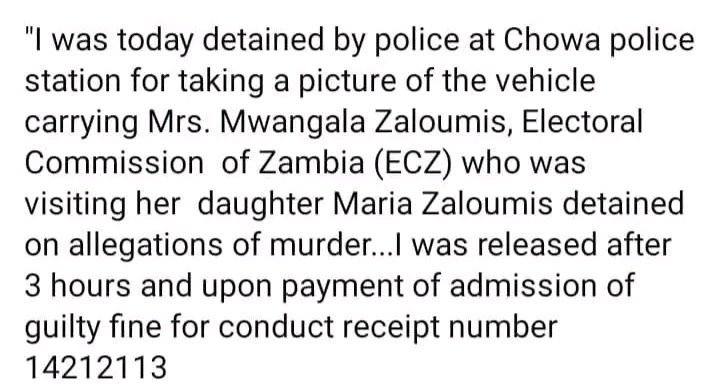
The arrest and detention of The Mast journalist, Thandizo Banda, today at Chowa Police Station is more than an isolated incident, it is a telling moment for Zambia’s media landscape. His “crime”? Taking a photograph of a vehicle carrying Electoral Commission of Zambia (ECZ) Chairperson Mwangala Zaloumis, who was visiting her daughter, Maria Zaloumis, currently detained on allegations of murder.
Banda was detained for three hours and later released after paying an admission of guilt fine, receipt number 14212113. While this may seem routine, the implications run much deeper. This was not merely about “conduct.” It was about the fundamental question: Do journalists in Zambia still have the freedom to do their work without fear of harassment or intimidation?
Photography in a public space is not a crime. If it suddenly becomes one depending on who is photographed then media freedoms are under siege. Zambia’s Constitution guarantees freedom of expression and press freedom, but the treatment of Banda tells a different story: that those rights are conditional, fragile, and at the mercy of political or institutional sensitivities.
This incident must not be dismissed as a minor confrontation between police and the press. It speaks directly to the state of media valuations in Zambia, how we as a country perceive, respect, or diminish the role of journalists in holding power accountable. When a journalist is treated like a criminal for doing his job, the message is clear: truth is tolerated only when it is convenient.
The irony here is painful. ECZ, an institution tasked with protecting democracy, is indirectly at the centre of an act that undermines democratic values. The credibility of elections rests on transparency and accountability, both of which cannot exist without a free press. The same cameras that capture voters casting ballots must be free to capture public figures when they appear in sensitive, even controversial, situations.

It is worth noting that Banda’s detention did not just silence one man; it sent a chilling signal across the profession. Many journalists may now think twice before taking a picture, recording a video, or publishing a story that involves powerful figures. This is how self-censorship begins, and once it takes root, democracy withers quietly.
Our leaders often proclaim Zambia as a “beacon of democracy” and a “Christian nation.” Yet, democracy is not measured by speeches, but by how it treats its dissenters and defenders of truth. Journalists are not enemies of the state. They are mirrors of society, sometimes showing reflections we would rather not see. But breaking the mirror does not erase the truth.
If we truly value democracy, then media freedoms must not only exist on paper but also in practice. Police must be trained to understand the role of journalists, and institutions must refrain from using intimidation as a tool of control. Respect for the press is respect for the people’s right to know.
Today it was Thandizo Banda. Tomorrow, it could be any journalist, and by extension, any citizen with a phone camera. Zambia must decide whether it will nurture a culture of transparency or one of fear.
At Kumwesu, we believe the answer is clear: a nation that values its media values its democracy.
©️ KUMWESU | August 24, 2025
This story makes very sad reading…
Why are Police Overzealous like this…
What was his crime…