
Why Last Place at Grade 9 Becomes First at Grade 12
Something strange is happening in Zambia’s education system, and the 2025 examination results have exposed a paradox that defies logic.
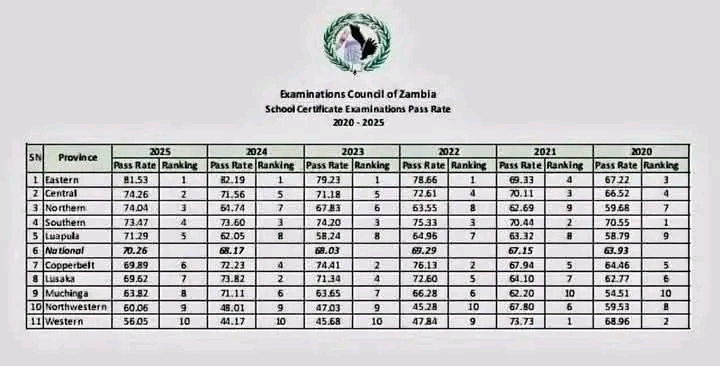
Eastern Province just claimed its fifth consecutive victory in Grade 12 examinations with a commanding 81.53% pass rate. Here’s the twist: the same province finished dead last at Grade 9 with just 45.39%.
How do the worst-performing junior secondary students in the country transform into the nation’s best just three years later?
The Rankings That Don’t Make Sense
Grade 12 Champions (2025):
1. Eastern Province – 81.53%
2. Central Province – 74.26%
3. Northern Province – 74.04%
—
National Average – 70.26%
—
8. Lusaka Province – 69.62%
9. Northwestern Province – 60.06%
10. Western Province – 56.05%
But at Grade 9 (same year):
1. Copperbelt Province – 61.44%
2. Lusaka Province – 60.15%
—
9. Eastern Province – 45.39% ⚠️
10. Southern Province – 45.37%
It gets stranger. Western Province sits comfortably at 5th place in Grade 9 (56.27%), then crashes to last place by Grade 12 (56.05%). The urban powerhouses Lusaka and Copperbelt lead at Grade 9 but fall below the national average by Grade 12.
The entire system appears to be running backwards.
The Eastern Province Secret: It’s Not Magic, It’s Selection
After five years of dominance, Eastern Province’s “secret” is finally
and it’s not what you’d expect.
The province isn’t transforming weak students into stars. It’s simply not letting weak students advance.
That brutal 45% Grade 9 pass rate? It’s a filter. Only the strongest, most capable students make it to senior secondary, where they encounter something most Zambian provinces lack: world-class technical education infrastructure.
Chizongwe Technical Secondary School in Chipata has built a reputation as one of the finest government schools in the country, specializing in STEM subjects with a laser focus on examination excellence.
But the real game-changer came in March 2019, when Edgar Lungu Technical Secondary School opened in Petauke. Built by ZESCO as “the most expensive technical school in Petauke,” this state-of-the-art STEM facility launched just before Eastern Province began its five-year winning streak in 2022.
Coincidence? Unlikely.
Add Impact Network’s 10 e-learning schools using innovative technology to overcome rural resource constraints, and you have a formula: ruthless selection + exceptional technical schools + STEM focus = five consecutive championships.
Eastern Province isn’t educating everyone well. It’s educating the select few exceptionally.
Western Province: The Collapse of a Former Champion
Western Province’s story breaks your heart. This was once a top-performing province. Today, it sits at the bottom, seemingly unable to climb out.
The problems are visceral and immediate:
Geography is destiny. The Barotse Floodplain dominates Western Province. From December to June, flooding isolates communities, closes schools, and fractures the academic calendar. Students walk impossible distances. Teachers commute from towns rather than live at rural schools, gaming the housing allowance system.
Visit a Western Province school and you’ll find dilapidated buildings, pit latrines that don’t function, students sitting on dirt floors because there aren’t enough desks, and classrooms with one textbook shared among seven children.
The province has an overall literacy rate of 61.6%—nearly 10 percentage points below the national average. With 86% of the population rural and scattered across Zambia’s largest province, the infrastructure simply cannot keep up.
Western Province doesn’t lack effort or talent. It lacks everything else.
The Urban Catastrophe: When Free Education Breaks the System
Here’s an irony that should alarm policymakers: Zambia’s richest, most developed provinces Lusaka and Copperbelt are performing below the national average at Grade 12.
Since 2021’s free education policy, two million additional children flooded into schools. Access soared. Quality collapsed.
In Lusaka schools, teacher-to-pupil ratios have hit 1:200 compared to the ideal 1:45. Teachers describe classrooms so packed that they “can’t manage them all.” Parents pull children back to private schools after watching them languish in overcrowded chaos.
Some Eastern Province classes have 100+ students sharing six textbooks. Urban schools face similar nightmares, except their students came expecting better.
Lusaka also has the country’s highest number of out-of-school children: 43,376. Free education didn’t solve poverty it just exposed how many families still can’t afford uniforms, materials, and transportation.
Urban provinces are drowning in their own success.
The Gender Earthquake
Buried in the statistics is a revolution: girls are now outperforming boys.
This represents a complete reversal of historical patterns. Reduced child marriage, better menstrual hygiene facilities, and programs like Girls2030 have kept girls in school and focused on achievement.
But what about the boys? They’re falling behind, disengaged, distracted, and increasingly seeing less value in academic credentials. If this trend continues, Zambia risks creating an educated female majority and an undereducated male underclass.
That’s a recipe for social instability.
The Questions No One Wants to Answer
Can Eastern Province’s model be replicated?
Yes and no. Building expensive technical schools takes money and political will. The Edgar Lungu Technical School cost far more than standard schools, but it produces results. Western Province needs similar investments but first, it needs basic infrastructure: desks, toilets, teacher housing, and roads that don’t flood.
Why does Western Province keep failing?
Because you can’t educate children who can’t reach school, sit in crumbling buildings, and learn from exhausted teachers who commute hours daily. Western’s problems aren’t pedagogical, they’re infrastructural and geographic.
Why are urban provinces underperforming?
Because free education without capacity expansion is a policy failure. You can’t pack 200 students in a room and expect quality outcomes. Lusaka and Copperbelt need hundreds of new schools, thousands of new teachers, and mass-produced furniture and materials.
The Uncomfortable Truth
Zambia doesn’t have one education system. It has ten different systems operating at wildly different levels of effectiveness.
Eastern Province has built a high-performing system through strategic investment and selective advancement. Western Province operates
system hamstrung by geography and neglect. Urban provinces run systems overwhelmed by demand they cannot meet.
After five years of Eastern’s dominance, the lesson should be clear: infrastructure investment drives results. The Edgar Lungu Technical School opened in 2019; Eastern Province topped the nation by 2022. The causation is hard to miss.
Western Province needs that same commitment not to technical schools (yet), but to basic functionality: roads, housing, desks, toilets, and teacher retention.
Lusaka and Copperbelt need capacity expansion on an unprecedented scale or the shift system that doubles school usage.
The good news? Eastern Province proves that rural Zambia can outperform urban centers when properly resourced. The bad news? We’ve known this for five years and Western Province is still last.
The question isn’t whether Zambia knows how to fix education. It’s whether anyone will actually do it.
You keep talking about one school in Eastern as if it solves problems for all other schools, flawed
Very true I remember when I was in grade in eastern province if you fail grade 9 pipo where subjected to write a test if they fail they go back to grade 8 only those who pass will repeat in grade 9 I don’t know if they are still doing it
Very true I remember when I was in grade 9 in eastern province if you fail grade 9 pipo where subjected to write a test if they fail they go back to grade 8 only those who pass will repeat in grade 9 I don’t know if they are still doing it