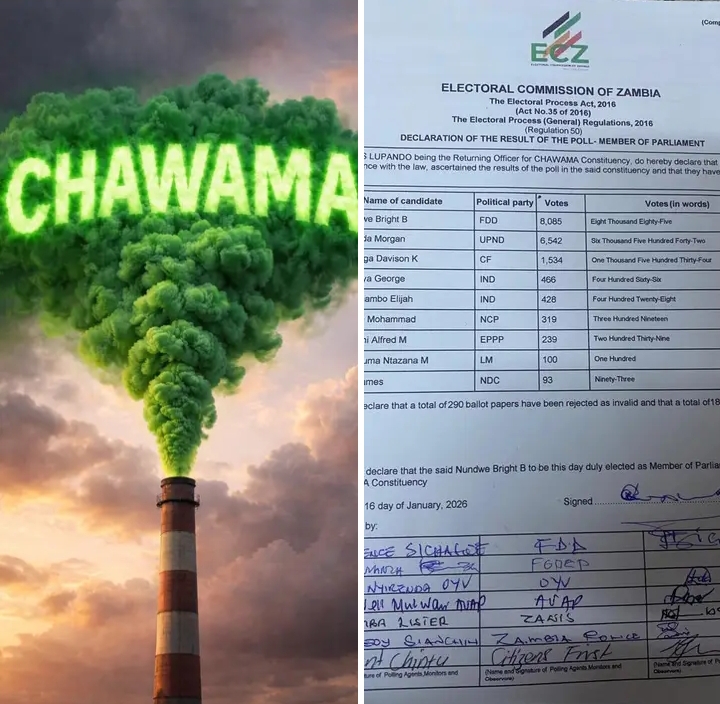
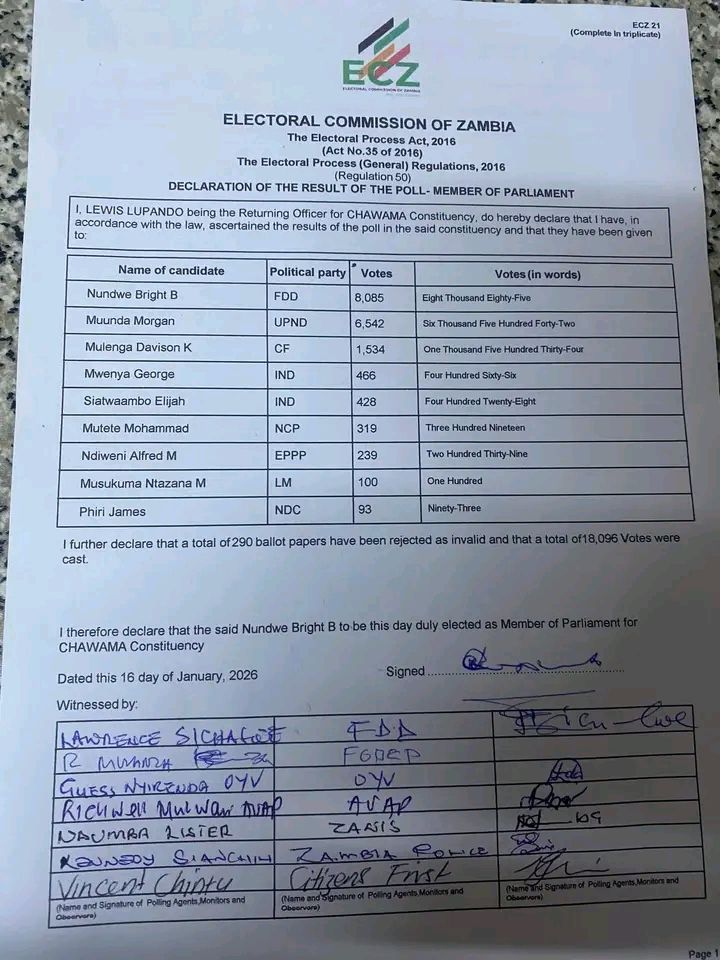
WHY WE LOST CHAWAMA, THE BITTER TRUTH
By: Dr Larry Mweetwa
It is critical for us to conduct a post election strategic review and conduct an institutional assessment of chawama by-elections.
“He who refuses to look at his footprint cannot know where the road bent.”
This review sets out a candid, structured, and non-adversarial assessment of the factors that materially contributed to the loss of the Chawama Parliamentary By-Election. The objective is corrective governance, not retrospective blame.
Here are the 10 reasons why we lost Kabwata.
- Weaponisation of Collective Emotion by Opponents
PF and FDD successfully prosecuted a campaign grounded not in policy alternatives or developmental propositions, but in emotive symbolism, leveraging the image and memory of a late Head of State as a mobilising device.
“Emotion often defeats reason where reason fails to speak loudly.”
While legally permissible, this strategy exposed a vulnerability: where our message did not sufficiently counter sentiment with substance, emotion prevailed. No alternative policy framework was offered by our opponents yet sentiment saying Tulelosha bane ( we are mourning) filled the vacuum.
- Strategic Under-Resourcing of a High-Risk Constituency
Chawama constitutes a historically sensitive and politically symbolic constituency for PF and ECL Legacy. The deployment of limited financial, logistical, and human resources into such terrain amounted to strategic miscalculation. You can not go to bweengwa as an opposition political party with a just a K100 and expect to win an election in a stronghold of UPND.
“You do not send a canoe to cross a river known for crocodiles.”
Political realism dictates that strongholds of former leadership require over-investment, not austerity.
- Candidate Selection Misalignment
The principle of community proximity was insufficiently weighted. We need a resident of Chawama like the way Potipher Tembo was a house hold name in Kabwata . Constituencies of dense social networks, such as Chawama, respond strongly to residential familiarity and lived experience.
“The drum sounds sweetest in the village where it was carved.” You can’t import a candidate from somewhere and PF and FDD all they lied the electrolates is that don’t vote for someone from Garden Compound.
Future selection frameworks must privilege residency, local legitimacy, and organic social capital.
- Inadequacy of Campaign Materials
Campaign visibility was compromised by insufficient branding, messaging collateral, and ground-level materials. Elections are fought not only in speeches, but in symbols, colours, and repetition of messages of what you want to do for the people .
“What the eye does not see, the heart does not follow.”
- Demotivation of Foot Soldiers
Foot soldiers constitute the operational spine of any campaign. Inadequate logistical support, food, transport stipends, and morale-boosting incentives resulted in visible fatigue and disengagement of our people . There was no money.
“An army that marches hungry will retreat before the enemy appears.”
- Absence of a Clear, Localised Campaign Narrative
Messaging failed to sufficiently crystallise around specific, lived challenges in Chawama, including:
• Overcrowding and informal settlements
• Housing insecurity
• Youth unemployment
• Survival-level economic pressures on the urban poor
“A man drowning does not need a lecture on swimming; he needs a rope.” We failed to give Chawama people a rope.
Policy achievements at national level must be translated into ward-level relevance.
- Leadership Apathy and Strategic Absences
The absence of senior party figures and recognised mobilisers weakened momentum and voter confidence.
“When elders stay away from the fire, the children assume the house is cold.” Where was ba Garry Nkombo? His absence pained us.
Visible leadership presence is not ceremonial it is electoral currency.
- Logistical Failures on Polling Day
Inadequate coordination of voter transportation and mobilisation on polling day materially suppressed turnout among known supporters.
“Winning the argument means nothing if your supporters never reach the ballot box.”
- Underestimation of Structurally Weak Opponents
The defeat by a party with minimal organisational structures underscores a critical lesson: structure does not always defeat sentiment.
“A man without a spear can still kill if the opponent sleeps.”
FDD our opponents offered no manifesto, no development plan only a message of exclusion and emotional appeal. That message was not sufficiently countered.
- Insufficient High-Level Political Reinforcement
Given the symbolic weight of the constituency, strategic deployment of top executive leadership including the President and Vice-President may have altered perceptions, turnout, and momentum.
“When the lion roars, even the forest listens.”
CONCLUDING OBSERVATION
This outcome does not reflect rejection of governance performance, but a failure of campaign translation, coordination, and emotional counter-narrative.
“Elections are not lost at the ballot box; they are lost in planning rooms.”
The lesson is clear: emotion must be met with empathy, strategy with resources, and leadership with presence.
The road ahead demands recalibration not despair.


Very well analysed
I used to see this type of writing from Dr Mwelwa .. Great prose , spiced with occasional verse or some English idioms, a nice literal flow as he navigates through his Topic. Genius Writing.
But now I have started seeing the same type of writing from Dr Larry Mweetwa.. looks more like copy cat, or plagiarism to me.
It’s fine to adopt a system of writing, but not the same way, same every thing , same flow, same use of idioms.. Difficult to tell whether it’s written by Dr Mwelwa or Dr Mweetwa.
We will start doubting some of these PhDs..
Dr Mwelwa has even stopped posting his articles.. Very nice articles with good English. Am sure he is in shock!