
🇿🇲 VIEWPOINT | Zambia’s Kwacha Strength Signals Structural Progress, Not Luck
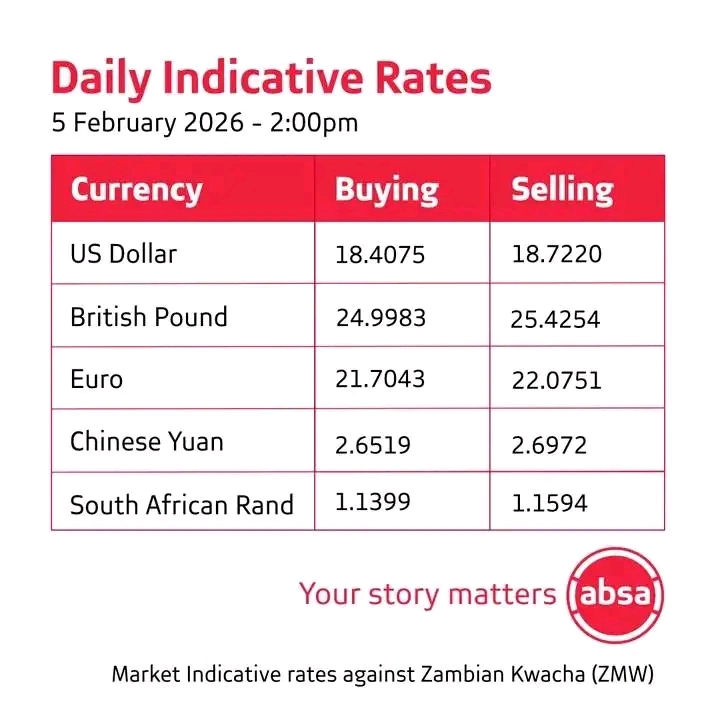
At a time when many emerging market currencies are wobbling under inflation pressures and geopolitical risk, the Zambian kwacha has quietly stood out. As of 5 February 2026, the kwacha was quoted around ZMW 18.40 to 18.72 per US dollar, a level that underscores a broader shift in Zambia’s macroeconomic trajectory.
This is not a short-lived currency blip. It reflects a confluence of fundamentals including rising commodity prices, monetary discipline, external support, and improved confidence among investors and traders.
The kwacha is also showing resilience beyond the dollar story. It has held firm against regional peers such as the South African rand, the Kenyan shilling, and even smaller frontier currencies like the Rwandan franc. In a continent where exchange rate instability remains one of the clearest signals of economic stress, Zambia’s relative strength is becoming a regional outlier.
Here is why the kwacha’s momentum matters, and why it appears grounded in real economic change rather than fleeting sentiment.
Copper: Zambia’s Anchor Commodity Goes Global
Copper remains Zambia’s most important export, accounting for more than 70 percent of export earnings. The metal’s price has climbed to multiyear highs on global demand, driven by electrification, renewable energy infrastructure, and electric vehicle supply chains. Analysts on international markets routinely point to copper as a green transition metal, whose demand trajectory is expected to remain strong.
Stronger copper export receipts mean more foreign exchange flowing into Zambia’s economy. That inflow supports the balance of payments and reduces pressure on importers needing dollars, both of which underpin currency strength.
Zambia’s macro narrative this year has been one of stabilisation first, growth second. The recent performance of copper has fast-tracked parts of that process.
IMF Programme Completed, Credibility Restored Under Hichilema
In late 2025, Zambia completed its Extended Credit Facility with the International Monetary Fund, unlocking about US$190 million in final disbursement and bringing total programme support to approximately US$1.7 billion since August 2022.
Completion matters far more than the final cheque. It signifies policy discipline across fiscal, monetary, and structural fronts, from fiscal consolidation to debt transparency and tighter public financial management.
For currency markets, IMF completion is a stamp of credibility. It tells investors that Zambia is managing its books, restructuring debt responsibly, and reducing the risk of sudden policy shocks.
This is a central part of President Hakainde Hichilema’s economic governance strategy. The kwacha’s stability is one of the clearest market signals that the reform path under his administration is being priced in.
Reserves and Liquidity: Pillars Under Construction
Parallel to currency strengthening, Zambia’s foreign reserves have recovered from historic lows during the debt crisis. While exact up-to-date reserve figures vary across reports, the broad trajectory from crisis-era volatility to multi-billion-dollar buffers has restored confidence among importers and market makers.
Reserve buffers matter because they help central banks intervene when needed, smooth volatile capital flows, and reduce dependency on short-term external borrowing.
In a region where many currencies remain exposed due to weak reserve cover, Zambia’s rebuilding of buffers is a meaningful stabiliser.
Inflation and Monetary Discipline
The Bank of Zambia has maintained a tighter monetary stance relative to past cycles, aiming to anchor inflation expectations. Although inflation remains a concern across many emerging markets, a consistent policy approach, when paired with stronger export earnings, supports the currency.
Markets reward predictability, and the kwacha is benefiting from that signal.
Regional Context
Across Africa, currency pressure remains widespread. The South African rand continues to swing with global risk sentiment. The Kenyan shilling faces external financing pressures. Several frontier currencies remain strained by import dependence and dollar shortages.
Zambia’s kwacha, by contrast, is showing resilience not only against the dollar but also across this regional currency map. Even modest appreciation against currencies such as the Rwandan franc reinforces the view that Zambia’s strength is structural, not accidental.
© The People’s Brief | Ollus R. Ndomu