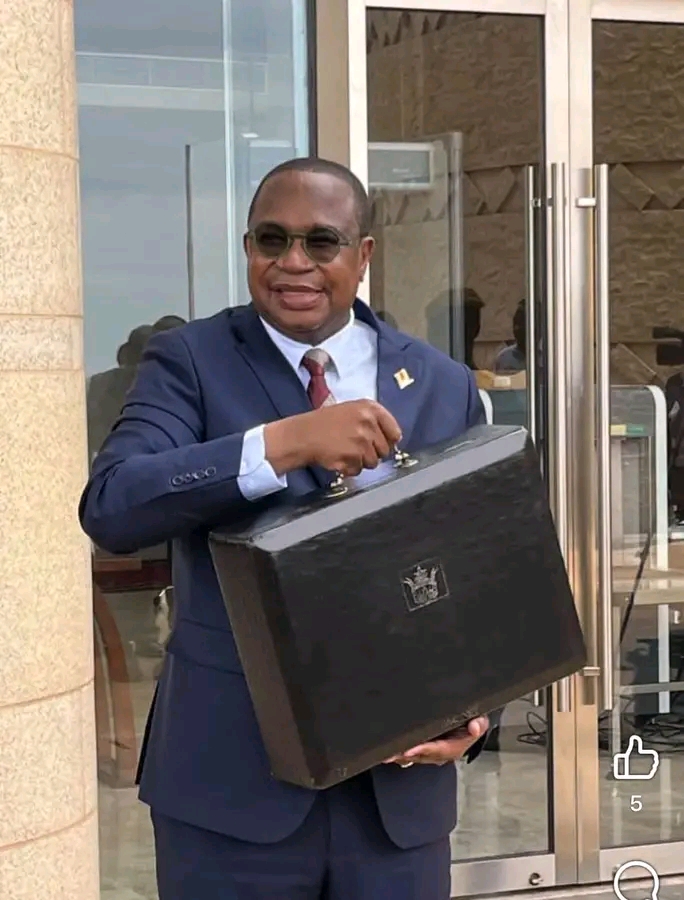

Ncube Presents US$9.5 Billion 2026 Budget, Bets On Stability, Mining And Tighter Tax Net
HARARE — Finance, Economic Development and Investment Promotion Minister Professor Mthuli Ncube presented a ZiG290.9 billion 2026 National Budget, equivalent to US$9.5 billion, under the theme “Enhancing Drivers of Economic Growth and Transformation Towards Vision 2030,” telling Parliament the plan was designed to sustain macroeconomic stability as Zimbabwe enters National Development Strategy 2 (NDS2).
Ncube projected the economy would grow by 5.0 percent in 2026, following an estimated 6.6 percent expansion in 2025 after 8.8 percent growth in the first half of that year, with mining expected to be the largest contributor to growth at 0.9 percentage points, followed by finance and insurance at 0.7 percentage points, while agriculture and manufacturing were each projected to contribute 0.6 percentage points. He said favourable weather conditions were expected to bolster agricultural production, while higher investment in manufacturing was expected to drive industrial output, with agriculture projected to grow by 5.4 percent, mining and quarrying by 6.3 percent, manufacturing by 3.7 percent, electricity generation by 6.5 percent, and wholesale and retail trade by 7.4 percent.
The budget is anchored on projected revenue of ZiG288 billion, or US$9.4 billion, representing 16.9 percent of GDP, against expenditure of ZiG290.9 billion, or 17.1 percent of GDP, leaving a narrow deficit of ZiG3.2 billion, equivalent to US$105 million or 0.2 percent of GDP. Ncube said ministries, departments and agencies had submitted bids totalling more than ZiG828.5 billion during consultations, more than three times the available capacity, forcing Treasury to prioritise. “The overall projected revenue envelope for 2026, coupled with the Government’s borrowing capacity, provides for an overall expenditure amount of ZiG290.9 billion (US$9.5 billion), which translates to 17 percent of GDP,” he said.
Education, health and social protection dominate the spending plan, taking up about 50 percent of the allocation. Primary and Secondary Education received ZiG47.4 billion, Higher and Tertiary Education ZiG10.3 billion, Health and Child Care ZiG30.4 billion, and Social Protection ZiG12.7 billion. Agriculture received ZiG26.8 billion for irrigation, dam projects, livestock programmes and grain reserves, while Peace and Security — Defence plus Home Affairs — was allocated ZiG46.8 billion. Ncube said the 2026 budget broadly reflects Government’s policy thrust under NDS2, Zimbabwe’s blueprint to accelerate transformation towards Vision 2030, to become a prosperous and empowered upper-middle-income society by 2030.
On tax, Ncube offered limited relief and new revenue measures. He cut the Intermediated Money Transfer Tax (IMTT) on ZiG transactions from 2 percent to 1.5 percent to promote use of the local currency and lower transaction costs, while leaving IMTT on US dollar transactions unchanged at 2 percent and making IMTT a tax-deductible expense for Corporate Income Tax purposes. To partly compensate for revenue forgone, he increased Value Added Tax by 0.5 percentage points to 15.5 percent, effective 1 January 2026. “As a quid pro quo to the above concession and to partially compensate for the revenue forgone arising from the IMTT rate reduction and deductibility measures, I propose to increase the Value Added Tax rate by 0.5 percent to 15.5 percent, effective 1 January 2026,” Ncube said.
He also introduced a 15 percent digital services withholding tax targeting global technology firms such as Google, YouTube and satellite internet provider Starlink, removed the revenue threshold for the 5 percent electronic commerce operators’ tax, reintroduced a 15 percent Non-Residents Tax on Interest, and proposed a 10 percent tax on landlords renting out properties for business purposes. Customs duty on electric public service buses was suspended in full from 25 percent to 0 percent, while duty on conventional public service buses was reduced to 10 percent, and the COMESA Simplified Trade Regime threshold was increased from US$1,000 to US$2,000.
The most aggressive changes were reserved for mining, which contributes about 12 percent to GDP and over 60 percent of export earnings, with mineral exports estimated at US$6.5 billion in 2025 and projected to surpass US$7 billion in 2026. Ncube said mining’s effective tax rate had been stuck at just 14 percent, with gross revenues of US$5.495 billion in 2024 yielding only US$747 million in taxes, and the 2026 budget seeks to close that gap. From 1 January 2026, all mineral exports will be valued using the Quoted Price Method, using publicly quoted international benchmark prices from platforms like the London Metal Exchange, Metal Bulletin and Shanghai Metals Market as the primary transfer pricing rule. Gold royalties were standardised on a tiered basis: 3 percent on prices up to US$1,200 per ounce, 5 percent between US$1,201 and US$2,500, and 10 percent above US$2,501. The budget also caps loss carry-forwards, revises deductibility of capital expenditure, imposes export taxes on un-beneficiated lithium, antimony, black granite and chrome, and introduces a new Corporate Social Responsibility Levy on coal.
In a historic liberalisation buried in the same package, Ncube ended the 44-year state monopoly on gold by legalising private ownership and free trading of certified refined gold bars for all citizens, opening the door to gold-backed savings accounts, exchange-traded gold receipts and small-denomination bars of 10g to 100g, a move analysts described as the single most market-friendly measure in an otherwise punitive mining package.
On inflation, Ncube said ZiG annual inflation stood at 32.7 percent in October 2025, down from 95.8 percent in July 2025, and Treasury expects it to fall to single-digit levels in 2026 on anchored expectations, currency stability and stronger monetary-fiscal coordination. He said foreign currency receipts had reached US$12 billion in the first nine months of 2025, with a current account surplus of US$961 million, while remittances were expected to reach US$2.7 billion in 2025 and US$2.8 billion in 2026. He also set aside US$30 million to compensate former white commercial farmers in 2026, and allocated ZiG841.4 million to Sport, Recreation, Arts and Culture and ZiG1.7 billion to Youth Empowerment, Development and Vocational Training, after naming Job Creation, Youth Entrepreneurship and Development, Creative Industry and Culture as one of ten NDS2 priorities.
The budget drew an immediate backlash from business and civic groups. The Parliamentary Portfolio Committee on Budget submitted an adverse report warning that the tax measures were burdensome to both businesses and taxpayers, while ZimRights said the plan prioritised state security over human security, noting that Peace and Security received ZiG46.8 billion, nearly 50 percent more than Health’s ZiG30.4 billion, which falls short of the 15 percent Abuja Declaration target. Zanu-PF MPs later said they were pressured into rubber-stamping the plan after being told it would not be altered, a claim Chief Whip Pupurai Togarepi denied, insisting parliamentary procedures were followed.
By mid-2026, Ncube told Parliament in his Mid-Term Budget and Economic Review on 30 July 2026 that the approved budget remained adequate without a supplementary budget, after Government collected ZiG137.8 billion in the first six months against expenditure of ZiG123.6 billion, generating savings used to service public debt and clear arrears.
He maintained the 5 percent growth forecast, said annual inflation had averaged 4.2 percent in the first seven months of 2026 — the first sustained single-digit inflation in over 30 years — and said public and publicly guaranteed debt stood at ZiG580.9 billion, equivalent to US$21.7 billion, at end-June.
Looking ahead to 2027, Ncube told the pre-budget seminar in Bulawayo that Government was seeking its first balanced budget, with 2026 revenue projected at ZiG287.64 billion against expenditure of ZiG290.88 billion, but warned 2027 growth could moderate to 3.5 percent, weighed by a Super El Niño with high chances of drought.