

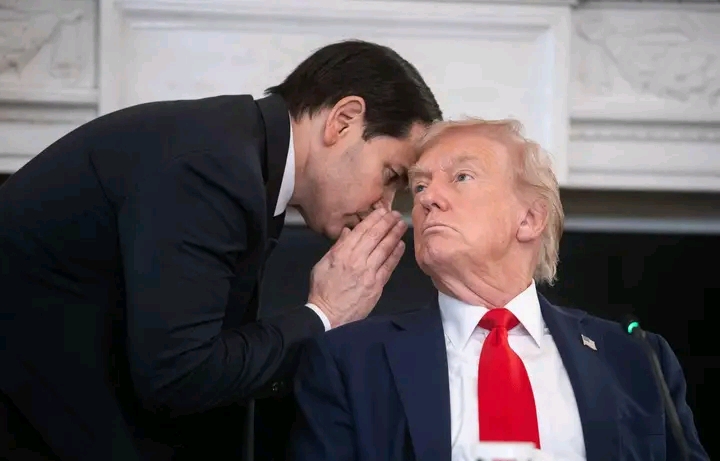
USA SENATE REJECTS HEALTH AID PROPOSAL LINKED TO RARE EARTH MINERALS IN ZAMBIA
United States of America Senate has urged the Trump administration in Washington DC to backdown and reject the proposed health aid linked to rare earth minerals in Zambia, insisting that the pursuit of commercial diplomacy is not an effective long-term strategy.
United States Senate
WASHINGTON, DC 20510
April 16, 2026
The Honorable Marco Rubio
Secretary of State
Department of State
2201 C Street NW
Washington, DC 20520-0099
Dear Secretary Rubio,
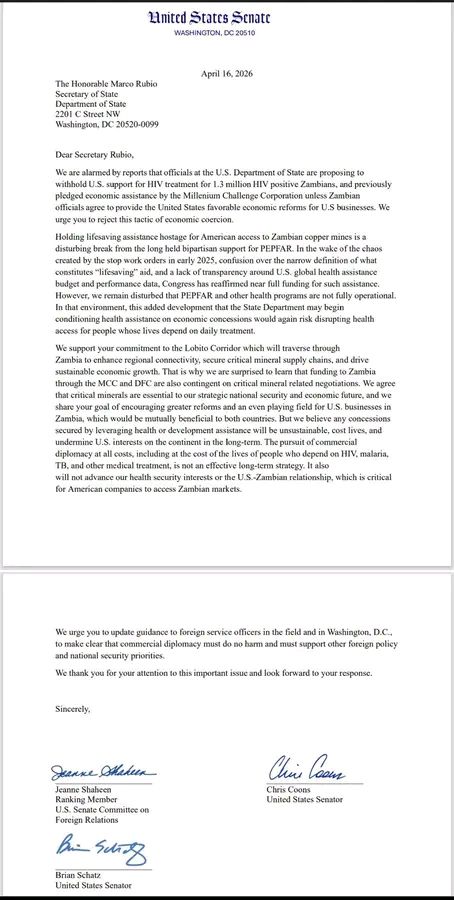
We are alarmed by reports that officials at the U.S. Department of State are proposing to withhold U.S. support for HIV treatment for 1.3 million HIV positive Zambians, and previously pledged economic assistance by the Millennium Challenge Corporation unless Zambian officials agree to provide the United States favorable economic reforms for U.S. businesses. We urge you to reject this tactic of economic coercion.
Holding lifesaving assistance hostage for American access to Zambian copper mines is a disturbing break from the long held bipartisan support for PEPFAR. In the wake of the chaos created by the stop work orders in early 2025, confusion over the narrow definition of what constitutes “lifesaving” aid, and a lack of transparency around U.S. global health assistance budget and performance data, Congress has reaffirmed near full funding for such assistance. However, we remain disturbed that PEPFAR and other health programs are not fully operational. In that environment, this added development that the State Department may begin conditioning health assistance on economic concessions would again risk disrupting health access for people whose lives depend on daily treatment.
We support your commitment to the Lobito Corridor which will traverse through Zambia to enhance regional connectivity, secure critical mineral supply chains, and drive sustainable economic growth. That is why we are surprised to learn that funding to Zambia through the MCC and DFC are also contingent on critical mineral related negotiations.
We agree that critical minerals are essential to our strategic national security and economic future, and we share your goal of encouraging greater reforms and an even playing field for U.S. businesses in Zambia, which would be mutually beneficial to both countries. But we believe any concessions secured by leveraging health or development assistance will be unsustainable, cost lives, and undermine U.S. interests on the continent in the long-term.
The pursuit of commercial diplomacy at all costs, including at the cost of the lives of people who depend on HIV, malaria, TB, and other medical treatment, is not an effective long-term strategy. It also will not advance our health security interests or the U.S.-Zambian relationship, which is critical for American companies to access Zambian markets.
We urge you to update guidance to foreign service officers in the field and in Washington, D.C., to make clear that commercial diplomacy must do no harm and must support other foreign policy and national security priorities.
We thank you for your attention to this important issue and look forward to your response.
Sincerely,
Jeanne Shaheen
Ranking Member
U.S. Senate Committee on Foreign Relations
Chris Coons
United States Senator
Brian Schatz
United States Senator
Very wise counsel.The madness of Trump and his administration must be tamed for the safety of global humanity