

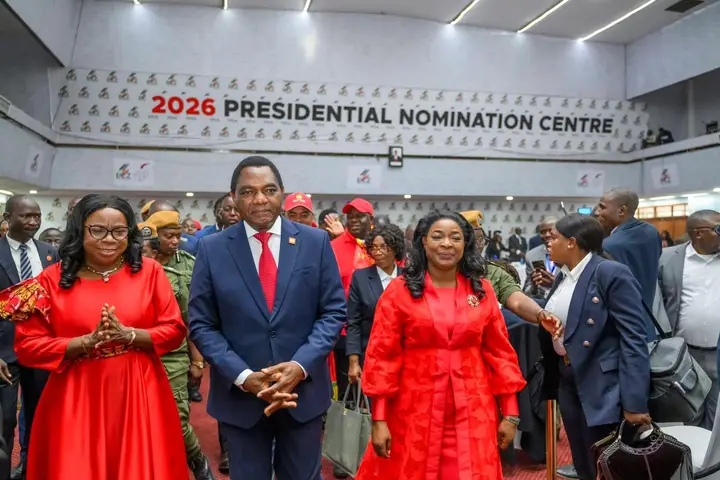
TRANSIENCE OF POWER: THE SYSTEM IS NOW IN-CHARGE NOT PRESIDENT HICHILEMA
On Friday, May 22, 2026, President Hakainde Hichilema and his running mate, Mutale Nalumango, were duly nominated.
The moment the nomination was declared valid, the administrative reins of government were effectively transferred to the governance system, with President Hichilema becoming a figurehead.
This immediate consequence was not a diminution of his personal status but a redefinition of his operational role.
This constitutional provision, designed to ensure continuity and impartiality during election periods, underscores a profound lesson: power is not an inherent attribute of an individual but a delegated authority, subject to the will of the people and the established legal framework.
The transition of presidential power to the system upon President Hichilema’s nomination is a fundamental aspect of democratic governance.
It signifies that the office of the president, while embodied by an individual, derives its legitimacy and operational capacity from established institutions and constitutional mandates.
The executive machinery of the state, from policy implementation to day-to-day governance, continues to function under the established protocols of the system.
President Hichilema, in this interim period, is a symbolic leader, his ultimate authority contingent upon the outcome of the upcoming August 13 elections.
It highlights that the power vested in the presidency is not absolute or permanent; it is a trust, granted by the people and administered through a defined governmental structure.
This dynamic underscores the transient nature of political power, a lesson frequently learned, often harshly, by those who occupy high office.
The system, in essence, will be acting as a perpetual custodian of power, intervening as President Hichilema’s mandate is being re-evaluated by the electorate.
The transient nature of power, as exemplified by President Hichilema’s situation, offers a crucial lesson for all leaders: to be good to the people while in power.
The system’s assumption of governmental control serves as a stark reminder that the authority wielded by a president is not self-generating but a grant from the citizenry.
This grant is conditional and subject to renewal or revocation through democratic processes.
This inherent impermanence should foster a sense of humility and encourage a focus on genuine service rather than self-aggrandizement.
When presidents understand that their position is a temporary stewardship, they are more likely to govern with integrity, to prioritize the welfare of their constituents, and to engage in acts of service that benefit the broader community.
For when the campaign ends and the votes are counted, President Hichilema’s legacy will be judged not by the power he once wielded but by the manner in which he used it.
By Given Mutinta