

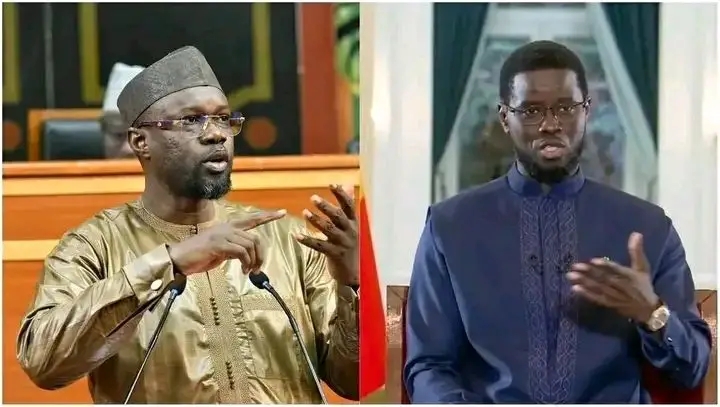
Checkmate: Ousmane Sonko Just Boxed President Faye Into a Political Corner
_____
Ousmane Sonko is expected to assume the presidency of National Assembly of Senegal, where his PASTEF party commands a strong majority, in a direct challenge to President Bassirou Diomaye Faye.
Deputies have been summoned to a full session of the assembly on Tuesday morning to reinstate Sonko as a member of parliament and vote for a new President of the Assembly.
El Malick Ndiaye, a close ally of Sonko, resigned on Sunday.
This move further complicates reform efforts by President Faye, who sacked Sonko on Friday after months of growing tensions between the two men who once campaigned side by side as symbols of anti-establishment change in Senegal.
Now Faye must nominate another Prime Minister to replace Sonko, but that nominee will still need approval from a National Assembly dominated by Sonko’s allies within three months of the nomination.
At the same time, President Faye cannot dissolve parliament until November, two years after the last parliamentary elections, limiting his room for political maneuvering.
To make matters even more explosive, a recent reform of the electoral code approved by parliament now makes Sonko eligible to run for the presidency himself.
The balance of power in Senegal is shifting rapidly. Faye may hold the presidency, but Sonko is positioning himself to control the political machinery, parliament, party structure, and potentially the future presidential race itself.
___
Dig deeper
In Senegal, the President of the National Assembly is not appointed by the President of the country.
The President of the National Assembly is elected by the members of parliament themselves — the deputies of the National Assembly vote to choose their parliamentary leader.
In Senegal’s current situation, if Ousmane Sonko becomes President of the National Assembly while Bassirou Diomaye Faye remains president of the country, Senegal could effectively end up with two competing centers of power inside the same ruling movement.
____
Dissolution of Parliament
Under Senegal’s Constitution, the President has the power to dissolve the National Assembly of Senegal, but there are constitutional limits and procedures that must be followed.
The main requirements are:
1. The President must consult:
* the Prime Minister
* the President of the National Assembly
The consultation is required before issuing the decree of dissolution.
2. Parliament cannot be dissolved during its first two years.
Article 87 of the Constitution explicitly states that dissolution “may not intervene during the first two years of legislature.
____
If Ousmane Sonko became President of the National Assembly of Senegal and then President Bassirou Diomaye Faye dissolved parliament, several major political consequences could follow especially because both men come from the same ruling movement, PASTEF.
Legally, once parliament is dissolved:
* the National Assembly ceases functioning,
* Sonko would immediately lose the position of President of the National Assembly,
* all parliamentary seats would be vacated pending new elections,
* and Senegal would organize new legislative elections within the constitutional timeframe.
But politically, the situation becomes far more dangerous and complicated.
If Faye dissolves a parliament dominated by Sonko’s allies inside the same party, many people could interpret it not as a move against the opposition, but as an internal political war inside PASTEF itself.
Several things could happen:
1. PASTEF could split into rival factions
One faction may remain loyal to Faye as head of state, while another stays loyal to Sonko as the movement’s original political force and grassroots mobilizer.
2. Sonko could portray himself as the victim of institutional betrayal
Especially because many supporters still see Sonko as the ideological engine behind the movement that brought Faye to power.
3. Legislative elections could become a referendum on who truly controls PASTEF
The elections would no longer just be about parliament. They would become a direct political battle:
* Faye’s institutional presidency
vs
* Sonko’s grassroots influence and party machinery.
4. Faye risks looking like Macky Sall politically
If he uses constitutional powers aggressively against Sonko, critics could accuse him of becoming the same type of leader PASTEF originally fought against.
5. The state could enter institutional paralysis
If both camps fight openly:
* government appointments become harder,
* reforms stall,
* party unity collapses,
* and the opposition benefits from the chaos.
At that point, the real question would no longer be who is legally president. The question would become: Who controls the movement, the streets, the party base, and the future electoral machinery of Senegal?