

By Kellys Kaunda
CHUNGU “THREATENS” NATIONAL SECURITY
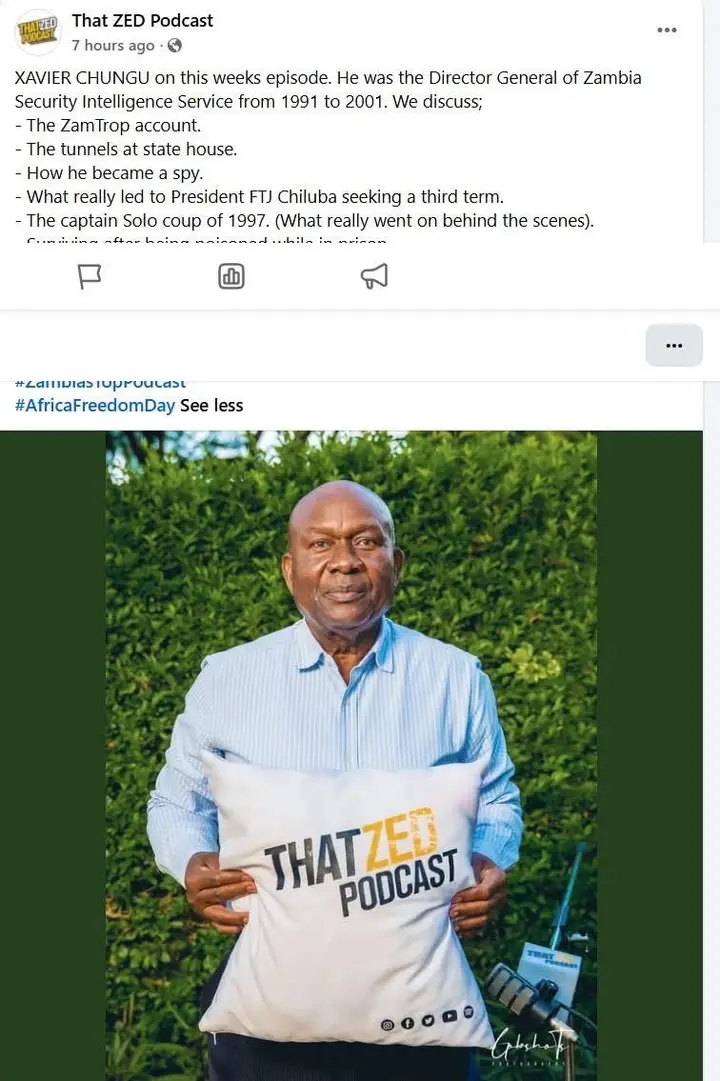
The Zed Podcast advertised the following as topics Xavier Chungu, the former spy chief, and now Presidential candidate, was to discuss: the Zamtrop account; State House Tunnels, the coup by Captain “Solo”, how he became a spy and what went on behind the scenes in the third term bid.
These topics have unsettled some people who believe they constitute a threat to national security.
I beg to differ. These are declassified matters. The moment President Frederick Chiluba revealed the existence of the tunnels, they became a public matter. The same goes for the Zamtrop account.
The coup by Captain Solo and the third term bid are all a matter of public record. Any further comment or additional information is immaterial. The information that really mattered was made public by Presidents Chiluba and Mwanawasa while in the case of Captain Solo they were revealed in court.
How does information get securitized? Information gets securitized by an authority such as the President. If the President reveals it to the public, the security veil has been lifted. Any additional information is neither here nor there.
Other than satisfying curiosity, there’s nothing Chungu will add to these stories which will breach national security.
Before the nation knew about State House tunnels, it was regarded a threat to national security to discuss them in public. But since they were exposed, what threats to national security has Zambia suffered?
Since the public got to know about the Zamtrop account, what threats to national security has Zambia suffered?
None! None because securitization is a political/social construct. Often, there is no real danger or imminent threat to prevent.
Think of securitization this way: nuclear weapons in the hands of North Korea is a threat to the US national security but not so in the hands of the UK or France.
Why? Because the concept of national security is a perception. It is artificially constructed. It is therefore debatable and challengeable in a court of law.
The question that may be asked in the case of the topics Chungu was meant to discuss on the podcast is: what public interest is to be served should Chungu discuss these topics? I don’t know of any beyond just having additional information if I don’t have it already.
Perhaps, the public interest is that former public servants must be obliged to share the inner workings of their former institutions to prepare others intelligently who may one day seek employment in the same institutions.
In other instances, their experiences may provide points of reference for those still in service. We also need to desist from the thinking that discussing one’s former experiences with a particular employer is in and of itself a forbidden activity. This might explain why the Zambian public knows very little about the inner workings of their government, ironically, a public institution they created by voting for it!
The sharp reaction to Xavier Chungu’s anticipated interview is as a result of the country’s collective poor conceptualization of what constitutes a threat to national security. Discussing history is none of it. Discussing an ongoing investigation is. But Chungu won’t discuss that on a podcast if he knew of any.