

CHINA IS PLAYING THE LONG GAME — AND RUSSIA SHOULD BE PAYING ATTENTION
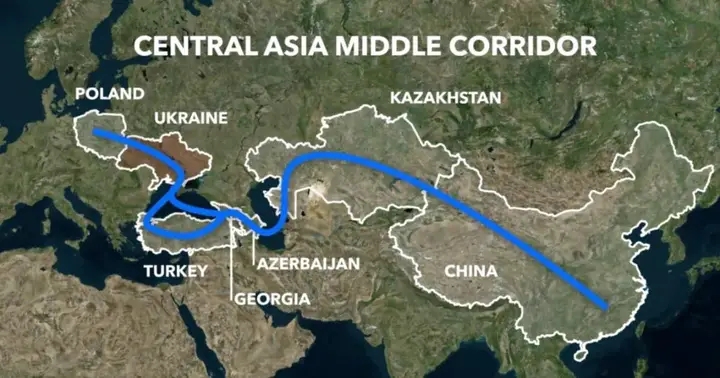
China and Kazakhstan are accelerating development of the Trans-Caspian “Middle Corridor,” a trade route linking China to Europe through Kazakhstan, the Caspian Sea, Azerbaijan, Georgia, and Turkey while bypassing Russian territory entirely.
Today, the route remains smaller and more complicated than traditional transit routes through Russia.
But Beijing is not thinking about today.
It is thinking about the next decade.
China’s strategy has always been built around reducing vulnerabilities and creating alternatives. The more routes available to Chinese exports, the less dependent Beijing becomes on any single country, crisis, or geopolitical dispute.
That includes Russia.
The corridor’s capacity is expected to grow significantly by 2030, while Kazakhstan continues investing heavily in rail, port, and logistics infrastructure. At the same time, Astana is gradually diversifying its economic partnerships and reducing dependence on Russian contractors in several sectors.
The immediate impact on Russia is limited.
The long-term implications are much more significant.
For decades, Russia benefited from its position as one of the primary land bridges between Europe and Asia. Transit fees, infrastructure, influence, and leverage all came with that role..
But every new railway, port expansion, and logistics hub built along the Middle Corridor slowly chips away at that advantage.
This is not an anti-Russian alliance.
It is something Moscow may find even more concerning.
It is countries quietly preparing for a future in which Russia is no longer essential.
If current trends continue, China will eventually possess multiple reliable trade routes to Europe, allowing Beijing to choose whichever path best serves its interests.
And when that day comes, Russia’s geographic leverage over Eurasian trade will be far weaker than it is today.
China is not confronting Russia.
China is positioning itself so it won’t need Russia.
That is the long game.
This is how a serious leadership should think. Create alternatives to reduce the impact of tomorrow’s crisis.
It is called risk management.