

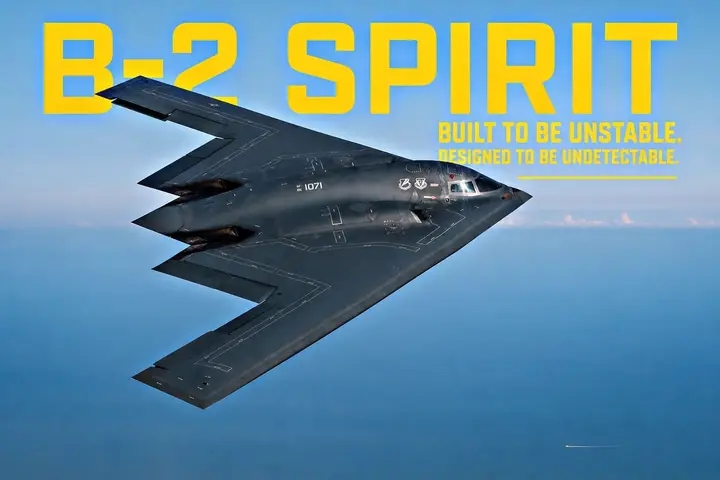
The B-2 Spirit Can’t Fly Without a Computer, and That’s by Design
Most people assume a $2 billion stealth bomber is built to be rock-solid stable. The reality is the opposite. The B-2 Spirit is intentionally designed to be aerodynamically unstable. Without its fly-by-wire computers making thousands of corrections every second, the aircraft would lose control in fractions of a second. No human pilot is fast enough to compensate manually.
The reason comes down to physics and stealth. A conventional tail keeps a plane stable but also creates a strong radar reflection. The B-2 has no tail. That flying wing shape is a nightmare to stabilize naturally, but it dramatically shrinks the radar signature. So engineers made a calculated trade: accept the instability, let computers handle it, and gain a bomber that can fly deep into defended airspace largely undetected.
The pilots are not flying the plane in the traditional sense. They are managing the mission. The computers are flying the plane.
This same principle applies to the F-16 and F-117 as well, but the pure flying wing design of the B-2 makes it one of the most extreme examples of controlled instability in aviation history.