

🇿🇲 MORNING WIRE | From Campus Cheers to Coalition Muscle: Hichilema Signals Campaign Shift
Wednesday may be remembered as the day President Hakainde Hichilema finally stepped fully onto the 2026 campaign battlefield.
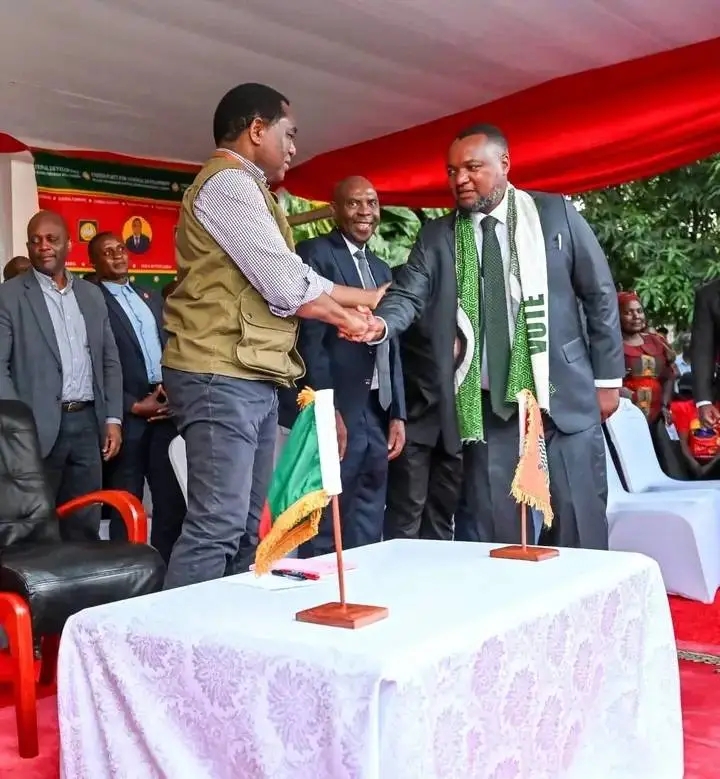
Hours after drawing enthusiastic crowds at Mulungushi University in Central Province, where students packed the grounds waving placards and chanting campaign slogans, Hichilema returned to Lusaka and headed straight to Anderson Kambela House, the UPND headquarters in Rhodes Park. Waiting for him was a different audience. Not students. Not voters. Political allies.
Inside the party secretariat, leaders from an expanding coalition of alliance partners gathered to publicly reaffirm their support for the President’s re-election bid, transforming what began as a provincial engagement into a display of national political organisation.
The optics mattered.
For weeks, opposition figures have attempted to portray Hichilema as reluctant to campaign, arguing his limited presence on the ground reflected political weakness. But Wednesday offered a competing narrative. First came the crowds in Central Province. Then came the coalition machinery in Lusaka.
Together, the events projected a campaign moving from preparation into mobilisation.
Addressing alliance leaders and party officials, Hichilema struck a familiar message of unity and continuity.
“Our call remains that of peace, unity and love for Zambia. A divided people cannot build a nation,” the President said, thanking alliance partners and ordinary citizens who have publicly backed his candidature ahead of the August 13 general election
The gathering also underlined a political reality becoming increasingly difficult to ignore. While opposition parties remain fragmented across multiple alliances, court battles and competing candidacies, the ruling party continues consolidating support under a broader coalition framework.
Alliance chairperson Charles Milupi announced the addition of five more political parties, bringing the UPND Alliance to 15 members.
Numbers alone do not win elections. Organisation does.
Coalitions serve a strategic purpose beyond symbolism. They provide structures in districts, wards and constituencies. They create campaign networks. They broaden messaging platforms. Most importantly, they reduce political isolation.
Several alliance leaders used the occasion to defend the government’s record and justify their decision to align with Hichilema.
United Prosperous and Peaceful Zambia president Charles Chanda argued that achievements recorded over the last four years deserved protection. New Congress Party leader Peter Chanda described Hichilema as a listening leader willing to engage citizens across political divides. UNIP leader Lieutenant Colonel Henry Miyoba pointed to social programmes such as free education as evidence of policy direction.
The President’s appearance at Anderson Kambela House came less than 24 hours before the launch of the UPND manifesto, a document expected to become the central campaign blueprint for the ruling party.
Political campaigns often pass through distinct phases. First comes recovery. Then comes positioning. Finally comes persuasion.
The UPND now appears determined to enter that final phase.
After spending much of its first term defending difficult economic reforms, restructuring debt and navigating an energy crisis, the party’s campaign message is increasingly shifting toward outcomes: lower inflation, a stronger kwacha, expanded social spending, rising mining investment and large-scale infrastructure targets.
Whether voters ultimately accept that argument remains the central question of the election.
What became clear on Wednesday is that Hichilema is no longer allowing others to carry that message alone.
President Hichilema has entered the arena. And Zambia’s election season may have just found its momentum.
This is the Morning Wire giving you a bird’s view of the day.
© The People’s Brief | Ollus R. Ndomu
Verified. Contextual. Independent