

EXCLUSIVE | 7 Targets, 1 Argument: Hichilema Asks Zambia for 5 More Years
The red sea arrived long before the President.
By mid-morning, the vast auditorium of the Mulungushi International Conference Centre had transformed into a political amphitheatre. Party regalia flooded the aisles. Alliance flags swayed from balconies. Delegates filled every available seat while late arrivals crowded entrances and corridors.
Campaign songs echoed beneath the iconic curved roof as supporters chanted, waved placards and waited for the man at the centre of Zambia’s most consequential political proposition.
When President Hakainde Hichilema finally stepped onto the stage on Thursday afternoon, he was not launching a campaign from scratch.
He was launching a case for renewal.
The UPND Alliance’s revised 2026–2031 manifesto arrives after one of the most turbulent governing periods in Zambia’s recent history. The administration entered office in 2021 facing a sovereign debt default, a weakening currency, high inflation, mounting investor uncertainty and a public treasury under severe strain. Four years later, the ruling party is asking voters to judge it not only on promises made, but on whether the foundations laid since 2021 justify another five-year mandate.
The message unveiled at Mulungushi was clear: recovery is over. Expansion begins now.
Standing before party officials, alliance leaders, diplomats, business representatives and thousands of supporters, Hichilema described the manifesto as a national development blueprint shaped through consultations with citizens across the country.
“The people of Zambia are at the centre of development,” he told delegates. “This document reflects their aspirations and expectations.”
The atmosphere inside the conference centre reflected a party increasingly shifting from defence to offence.
For much of its first term, the UPND found itself explaining difficult decisions: debt restructuring, fiscal discipline, subsidy reforms and navigating a devastating drought that triggered the worst power crisis in decades. Thursday’s gathering carried a different tone. Instead of defending the past, the ruling party spent the afternoon projecting the future.
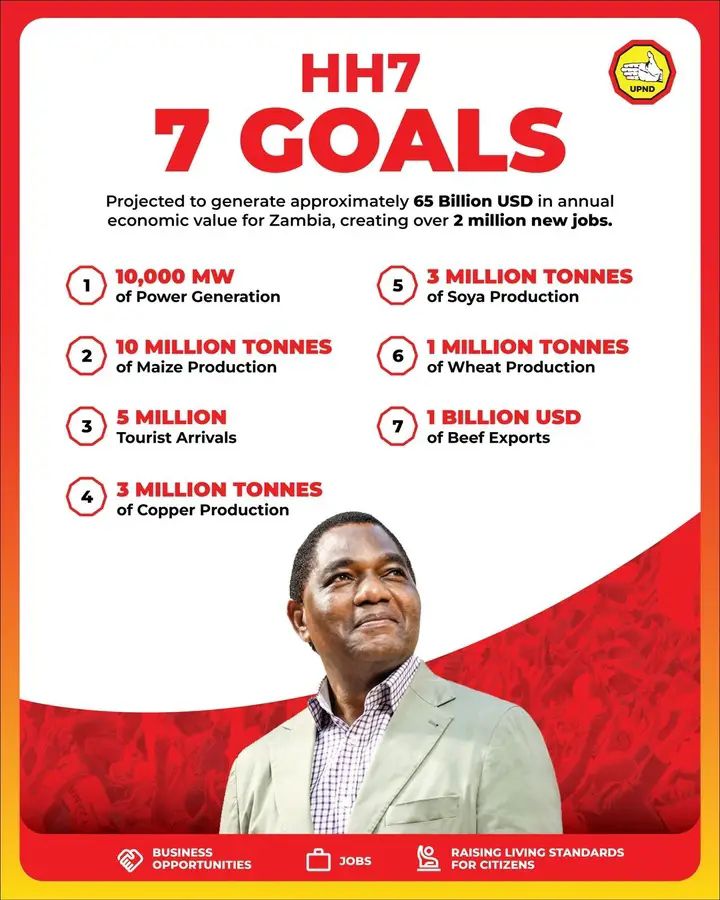
At the centre of the manifesto sits what the President calls the “HH7” agenda — seven headline targets intended to reshape the scale of Zambia’s economy over the next five years.
The figures are ambitious.
UPND wants Zambia to generate 10,000 megawatts of electricity, produce 10 million tonnes of maize annually, attract 5 million tourist arrivals, raise copper production to 3 million tonnes, increase soya production to 3 million tonnes, expand wheat output to 1 million tonnes and grow beef exports to US$1 billion.
According to the manifesto, achieving those targets could generate approximately US$65 billion in annual economic value and create more than two million jobs.
Those are not ordinary campaign pledges. They are economic scale targets.
Each goal touches a strategic sector of the economy: mining, agriculture, tourism, energy and exports. Collectively, they reveal how the ruling party sees Zambia’s future. Less dependent on a single industry. More diversified. More export-driven. More integrated into regional and global markets.
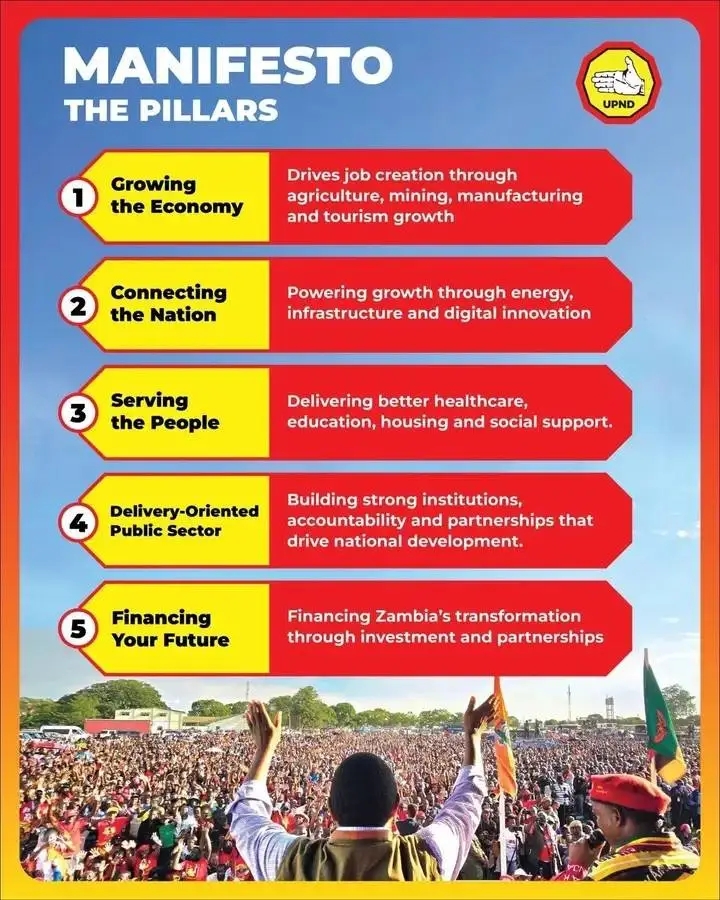
The manifesto itself is built around five broad pillars: growing the economy, connecting the nation through infrastructure and energy, improving public services, strengthening institutions and financing long-term national transformation through investment and partnerships.
Underlying almost every pledge was a recurring argument from the President: Zambia cannot discuss where it is going without first acknowledging where it came from.
Hichilema revisited the debt crisis inherited in 2021, arguing that successful debt restructuring had fundamentally altered the country’s trajectory. According to the President, the restructuring process is saving Zambia approximately US$1.4 billion annually, resources government says can now be redirected toward development priorities.
For the ruling party, debt restructuring is more than a financial achievement. It is becoming a political argument.
The administration increasingly presents it as the event that separated recovery from growth. Without restoring fiscal credibility, officials argue, many of the ambitions contained in the manifesto would remain impossible.
Thursday’s launch therefore served two purposes simultaneously.
First, it was a policy event. Second, it was a campaign statement.
The UPND is effectively telling voters that the first term was about stabilising a country in crisis. The proposed second term would be about scaling production, attracting investment and accelerating growth.
Whether voters accept that argument remains the defining question of the August 13 election.
Opposition parties are expected to challenge both the targets and the government’s record, particularly on the cost of living, unemployment and the lingering effects of prolonged load-shedding experienced over the past year. They will almost certainly ask whether the benefits of macroeconomic recovery have reached ordinary households quickly.
But inside Mulungushi on Thursday, the ruling party was not speaking the language of crisis.
It was speaking the language of ambition.
The launch also carried broader political significance. Coming just a day after Hichilema’s highly publicised engagement with students and supporters in Central Province, the manifesto unveiling reinforced signs that the President’s campaign is now moving into a more visible phase after months of relatively limited ground mobilisation.
The images told their own story.
Packed balconies. Overflowing aisles. Alliance leaders sharing one platform. Young supporters holding “Vote HH” placards aloft. Delegates waving flags beneath bright red campaign branding carrying a simple slogan: Zambia Forward Together.
Campaigns are ultimately won at the ballot box, not at manifesto launches.
But manifesto launches reveal how parties see themselves.
Thursday’s event revealed a ruling party seeking re-election not on revolutionary promises, but on continuity. Not on disruption, but on expansion. Not on what it hopes to start, but on what it argues it has already begun.
The election campaign now enters a new stage. The governing party has placed its blueprint before the country.
The opposition will respond, voters will decide.
Over the coming days, our team will continue analysing the UPND Alliance manifesto, separating ambition from implementation and helping readers understand what the promises, targets and projections could mean for their lives, communities and Zambia’s future. We invite readers, economists, students, entrepreneurs and policy experts to share their views and questions as we unpack one of the most consequential campaign documents of the 2026 election.
© The People’s Brief | Ollus R. Ndomu
Verified. Contextual. Independent.
Now the Opposition will spend the rest of their time to 13 August tearing apart the UPND’s Manifesto instead of selling their Manifestos (assuming they have) to the Voters. Watch the Space.
HH7 is very ambition targets. Possible success will be determined by the momentum towards targets else failure will be knocking if no attempt towards targets is made.