

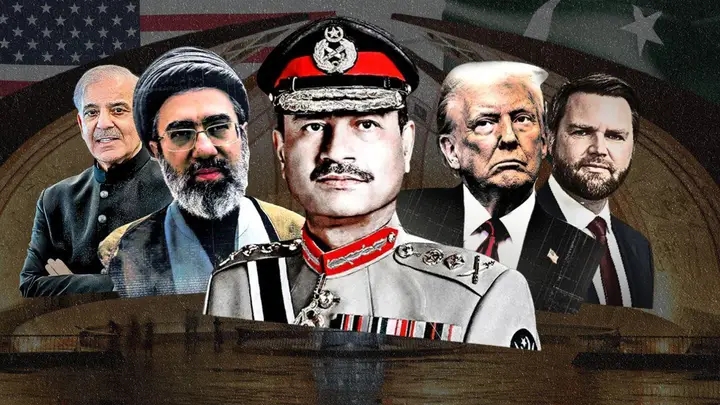
The Currency of Power: How Pakistan Became the World’s Indispensable Nation — And What It Teaches Us About Prestige in the Multipolar Age
By Lim Tean
The Great Game: Geopolitics for the Masses
I. Disraeli at Berlin — and What Bismarck Saw
In the summer of 1878, the great powers of Europe gathered in Berlin to settle the Eastern Question — the disposition of Ottoman territories following Russia’s decisive victory over the Porte. It was the most consequential diplomatic congress of the nineteenth century, attended by the towering figures of the age: Bismarck as host, Gorchakov representing Russia, Andrássy for Austria-Hungary.
And then there was Benjamin Disraeli — seventy-three years old, racked by gout and bronchitis, representing a Britain that many on the continent had begun to regard as a declining force. He arrived in Berlin and proceeded to dominate the congress utterly. He threatened to walk out. He held his positions with iron composure. He extracted concessions that no one had thought obtainable.
Bismarck — the Iron Chancellor, the supreme political intelligence of his era — watched all of this and rendered his verdict in six words: “Der alte Jude, das ist der Mann.” The old Jew — he is the man.
It was perhaps the greatest tribute one statesman ever paid another. And what Bismarck was recognising was not merely tactical brilliance. He was recognising prestige — that quality which Disraeli himself had identified as the true currency of international relations. Not armies. Not GDP. Not formal alliances. But the settled, unspoken acknowledgment by other serious men that this figure, in this room, is someone who must be reckoned with.
So overcome with delight at what her beloved Disraeli had achieved at the Congress of Berlin, Queen Victoria broke with all precedent and struck a personal medal in his honour — a gesture without parallel in the modern relationship between a British sovereign and her Prime Minister.
Prestige, Disraeli understood, is simultaneously the most powerful and the most fragile of diplomatic assets. It cannot be manufactured. It cannot be purchased. It can only be earned — through demonstrated judgment, strategic courage, and the willingness to act with authority at critical moments.
It is by this standard that we must measure the remarkable transformation currently underway in the global order — and the equally remarkable story of which nation has emerged, against all expectation, as its most consequential diplomatic actor.
II. Lee Kuan Yew — The Small State That Commanded the Room
Before examining Pakistan’s extraordinary ascendancy, we must first recall what genuine prestige diplomacy looks like — and for that, history offers us no finer modern exemplar than Lee Kuan Yew of Singapore.
Singapore is a city-state of fewer than six million people, with no strategic depth, no natural resources, and no military weight commensurate with great power attention. By every conventional metric of international relations, it should be a footnote — a well-administered port, consulted by no one on matters of consequence.
And yet for four decades, Lee Kuan Yew was among the most sought-after interlocutors on earth. Richard Nixon, not a man given to false flattery, considered him one of the two or three most impressive leaders he had ever encountered. Henry Kissinger — architect of the most consequential geopolitical realignment of the twentieth century — consulted him regularly and treated his assessments of Asian affairs as authoritative. Deng Xiaoping studied the Singapore model and dispatched delegations to learn from it. Margaret Thatcher valued his counsel. So profound was her admiration for Lee Kuan Yew’s mastery of statecraft that Thatcher once confessed she hung on every word he uttered on international affairs — recognising in him a strategic mind whose grasp of global power realities was unmatched by any other leader of his generation Every American president from Nixon to Obama made a point of engaging him seriously.
How did a leader of a tiny island command such attention from titans?
The answer is precisely Disraeli’s currency. Lee Kuan Yew possessed prestige in its purest form. He was known to speak uncomfortable truths without hedging. His strategic assessments were forensically precise and demonstrably accurate. He had no agenda beyond Singapore’s survival and prosperity, which gave his analysis a clarity unclouded by ideological performance. And he understood the great powers — their interests, their vanities, their constraints — with an unsentimental lucidity that they found both rare and invaluable.
He did not ask to be consulted. He made himself indispensable through the quality of his mind and the integrity of his judgments. When Lee Kuan Yew spoke about Southeast Asia, about China’s trajectory, about American credibility in the Pacific, the most powerful men in the world listened — not out of courtesy, but because they knew he was likely to be right.
That is the gold standard of small-state diplomacy. That is prestige as strategic capital.
III. Pakistan’s Extraordinary Ascendancy
Against that standard, consider what Pakistan has just achieved.
For two decades, Pakistan occupied a peculiar and largely uncomfortable position in Western strategic consciousness — simultaneously indispensable and suspect. The ISI’s alleged double-dealing during the AfPak years. The IMF dependency cycle that seemed perpetual. The domestic instability that made each government appear more precarious than the last. Pakistan was a country that serious Western analysts wrote about primarily as a problem to be managed — a nuclear-armed state whose dysfunction posed risks that had to be contained.
And then came the US-Iran negotiations — arguably the most consequential diplomatic settlement of this decade. When Washington and Tehran needed a bridge, when the accumulated mistrust of four decades required a mediator of genuine credibility, the call did not go to Brussels. It did not go to Delhi. It did not go to any of the self-appointed custodians of the international rules-based order.
It went to Islamabad.
Pakistan’s successful mediation between the United States and Iran represents one of the most dramatic transformations of a nation’s international standing in recent diplomatic history. Almost overnight, a country that had been patronised, lectured and financially bailed out emerged as the indispensable connector in the most watched negotiation on earth.
Pakistan possessed something that no other candidate mediator could replicate — a unique combination of access, credibility and incentive alignment with both parties simultaneously.
With Iran, Pakistan shares a long border, a deep civilisational connection rooted in Persian cultural heritage, a substantial Shia population, and decades of complex but genuine bilateral engagement that survived even the most difficult periods of regional tension. Tehran did not regard Islamabad as a Western proxy. That non-alignment credibility — the sense that Pakistan was not delivering messages on Washington’s behalf — was essential to Iran’s willingness to engage through this channel.
With Washington, Pakistan maintained the military-to-military relationships forged across decades of security cooperation, however strained. American interlocutors understood that Islamabad had its own independent reasons for wanting a settlement — the stabilisation of its western border, the economic connectivity promised by the China-Pakistan Economic Corridor, the relief from a regional environment that had constrained Pakistani development for a generation.
Critically, both sides could trust that Pakistan wanted a deal for its own reasons — not as a favour to either party. That structural non-alignment is the rarest and most valuable of diplomatic assets. It is what transforms a messenger into a mediator.
And Pakistan is not merely a middle power in the conventional sense. It is the world’s only Muslim-majority nuclear state — a fact that confers a baseline of strategic respect that cannot be ignored by any serious actor. It sits at the intersection of Chinese, Iranian, Central Asian and Gulf strategic interests simultaneously. It is, in the language of geopolitics, a connector state — and the US-Iran mediation has now formally inaugurated Pakistan in that role before the entire world.
Bismarck would have recognised what just happened. Pakistan walked into the room and commanded it. That is prestige. That is the old Jew — he is the man.
IV. India’s Sidelining — The Vishwaguru That Wasn’t
The Pakistan story becomes even more striking when set against the simultaneous sidelining of India — because by every conventional expectation, India should have been the natural mediator.
India has a centuries-deep civilisational relationship with Iran, predating Islam itself. It has the world’s second-largest Muslim population. It has carefully cultivated strategic relationships with Washington while publicly maintaining non-alignment. Under Narendra Modi, it has constructed an entire foreign policy architecture around the concept of Vishwaguru — India as the world teacher, the voice of the Global South, the indispensable civilisational power whose moment has arrived.
Modi’s India hosted the G20 with theatrical grandeur. It proclaimed itself the voice of the developing world. It positioned itself at every multilateral forum as the natural leader of a new non-Western international order.
And yet when the most consequential diplomatic opportunity of the decade presented itself — when genuine Vishwaguru leadership was available for the taking — India was simply not in the room.
Why?
The answer is that Modi’s foreign policy has confused performance with substance — and sophisticated powers, Iran among them, are not deceived by the confusion.
Modi’s increasingly visible alignment with Israel has been devastating for India’s credibility across the Islamic world. India’s voting record on Gaza at the United Nations registered in Tehran with crystalline clarity. You cannot present yourself as an honest broker in a negotiation involving Iran while being seen across the Muslim world as Israel’s silent partner.
Beyond Gaza, India’s relationship with Iran has quietly deteriorated beneath the surface of diplomatic pleasantries. Washington’s sanctions pressure has constrained Indian-Iranian economic engagement far more than Delhi publicly acknowledges. The Chabahar port project, endlessly cited as evidence of Indian strategic depth in the region, has advanced at a pace that reveals hesitation rather than commitment.
Most fundamentally, India’s foreign policy under Modi has become increasingly bilateral and transactional — oriented toward managing relationships with great powers rather than exercising genuinely independent judgment. Strategic autonomy has become a slogan rather than a practice. And Iran, with its acute sensitivity to authenticity born of four decades of surviving maximum pressure, read that perfectly.
The gap between Vishwaguru ambition and actual strategic delivery is the defining story of Indian foreign policy in this period. Prestige, as Disraeli understood, cannot be self-proclaimed. It must be recognised by others — at moments of genuine consequence. India was not recognised. Pakistan was.
That inversion — the perpetually troubled neighbour executing the diplomatic masterstroke while the self-proclaimed world teacher watches from the margins — is one of the most striking geopolitical reversals of our time. It deserves far more analytical attention than it has received.
V. The Lesson for the Multipolar Age
What does Pakistan’s ascendancy and India’s sidelining teach us about the emerging multipolar order?
The unipolar moment — America’s three-decade dominance following the Cold War — created a particular kind of international relations in which prestige was largely derivative of proximity to Washington. Nations that aligned with American preferences, spoke American diplomatic language, and participated in American-led institutions accumulated standing almost automatically.
That world is over. The multipolar order now crystallising — with the US-Iran settlement as one of its defining early moments — operates by different rules. In a world of multiple great power centres, the states that accumulate prestige are not those closest to any single hegemon. They are those that can bridge between competing centres of power precisely because they are not captured by any of them.
Non-alignment credibility — genuine, structural, demonstrated non-alignment, not merely rhetorical — has become the scarcest and most valuable currency in international relations.
Pakistan understood this, perhaps instinctively. Its unique position at the intersection of Chinese, American, Iranian and Gulf interests, far from being a source of weakness as Western analysts long argued, has become its greatest strategic asset. The connector state, in a multipolar world, is the indispensable state.
This is the lesson that Lee Kuan Yew grasped before almost anyone else. Singapore’s miracle was not merely economic. It was strategic. LKY understood that a small state survives and thrives not by attaching itself to a great power, but by making itself useful to all of them simultaneously — by being the node through which understanding flows, the interlocutor whose assessments are trusted across divides.
Pakistan has now claimed that role at a far larger scale. And in doing so, it has taught every serious student of international relations something that Disraeli knew and Bismarck recognised — that in the great game of nations, prestige is not given. It is seized, by those with the judgment to see the moment and the courage to act in it.
Das ist der Mann.