
SHOULD A DOCTOR SAVE A JEHOVAH’S WITNESS’S LIFE… OR RESPECT THEIR DECISION TO REFUSE A BLOOD TRANSFUSION?
Intro.:
Last week, I had a lively chat with a friend about blood transfusions, patient consent, and the right to life. He said, “If a doctor can save your life, surely he should just do it.”
I smiled and replied, “My good sir, the law and life are rarely that simple.
Not every problem is solved by saying one plus one equals two.” The law has a habit of complicating what seems obvious. It asks one stubborn question: Who has the final say over your body: the doctor holding the blood bag or the patient who already said, “No, thank you”?
Picture this:
An elderly Zambian man knows exactly what he believes. As a devoted Jehovah’s Witness, he tells his family, his friends, and even his doctors, “If one day I become unconscious, please don’t give me blood.” He doesn’t stop there.
He signs an official legal document: a Durable Power of Attorney for Health Care, clearly stating that under no circumstances should he receive a blood transfusion. He makes this decision while fully awake, of sound mind, and knowing exactly what it could cost him. He does it so that nobody can later say, “We didn’t know what he wanted.”
Then one day, he falls seriously ill.
At the hospital, the doctor examines him and nearly drops his stethoscope. “This man needs blood immediately,” he says. “Without it, he may not survive.”
The family quickly pulls out the signed document.
“Doctor,” they say, “these were his wishes. He chose this long before today, while he was thinking clearly. Please respect them.”
Now imagine the poor doctor. He’s standing like a referee at a heated football match at Heroes Stadium. Blow the whistle one way, someone gets angry. Blow it the other way, someone still gets angry. Even the nurses are probably looking at him as if to ask, “Ba Doc, what’s the game plan?”
If he respects the man’s wishes, the patient could die.
If he ignores them and gives the blood, he might save the man’s life, but could he also be breaking the law?
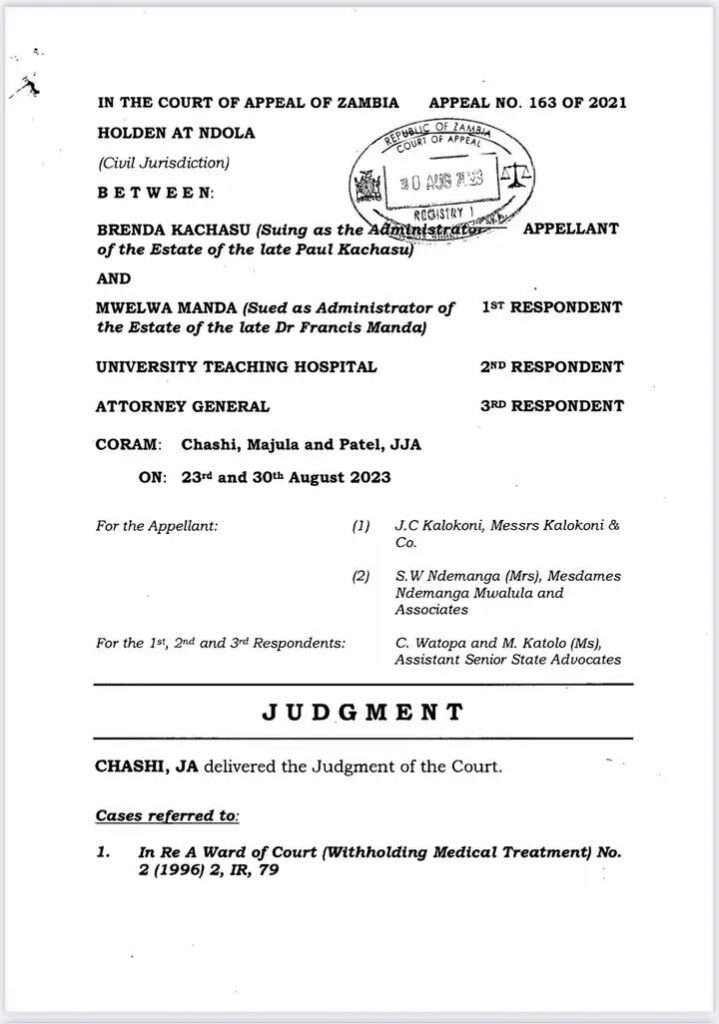
That was the real question before the court.
The judges were not deciding whether blood transfusions save lives. Everyone accepts that they often do. Instead, they were wrestling with a much deeper question: Who has the final say over your body, you or your doctor?
The court had to determine whether a doctor can simply put aside a patient’s clear written instructions because he honestly believes he knows what is medically best. Put differently, can good intentions replace consent? Can saving a life justify ignoring a competent person’s lawful decision?
WHAT DOES THIS MEAN TO ORDINARY CITIZENS?
For every ordinary Zambian, this decision matters. It reminds us that our rights do not disappear the moment we enter a hospital. If a competent adult clearly and lawfully decides in advance what medical treatment he or she will accept or refuse that decision carries legal weight. Doctors have enormous responsibility, but they are not given unlimited power over another person’s body simply because they wear a white coat.
The moral of the story?
A doctor’s duty is to save lives, but your rights also say your body is your kingdom. Even the noblest intention cannot become a licence to ignore a competent person’s lawful choice. After all, in a free country, respect for people’s rights is just as important as respect for life itself.
Disclaimer:
My commentary on this decision is no more a legal critique than a campfire tale is a treatise on thermodynamics. It is, rather, a dramatized retelling, a lively reenactment if you will, of the judicial clash, unburdened by the solemn drudgery of analysis and delivered with the unapologetic zest of a storyteller who knows a good duel when he sees one.
A doctor has professional ethics to observe. To a doctor, saving life comes before any religious belief.