

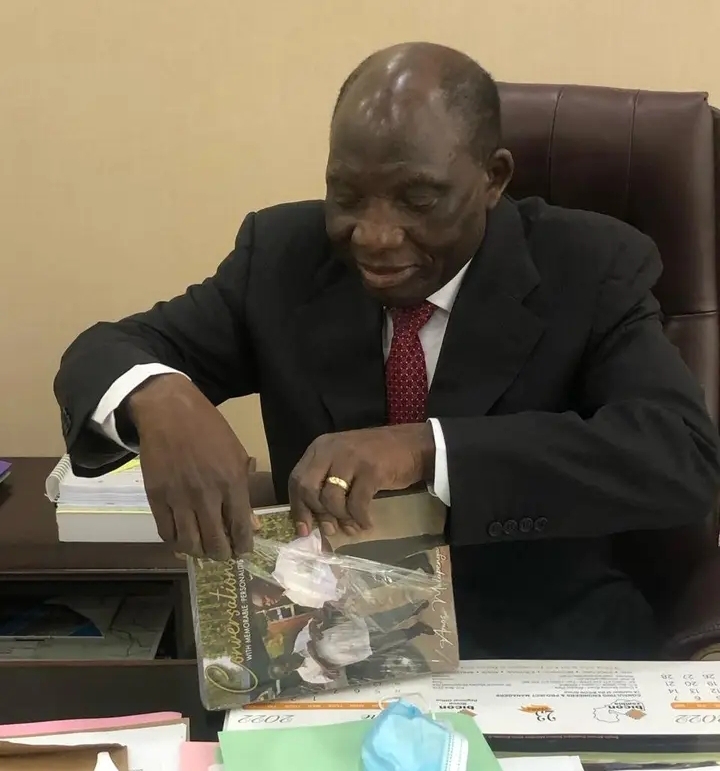
CHARLES MILUPI:
THE CATTLE BOY FROM MONGU WHO CONQUERED CARDIFF
Did you know that before navigating major engineering systems and national leadership, Hon. Eng. Charles Milupi was just a young boy herding cattle in rural Western Province?
Details in the exercept from the book: Conversations with Memorable Personalities (2022), Pages 620 – 621.
***
Amos Malupenga: Who is Charles Milupi?
My full names are Charles Lubasi Milupi. I was born on the 25th of April, 1954 in Lutongo village in Mongu district of Western Province. My father was Milupi Mulelekwa and my mother was Inonge Mwangala Milupi. Both my parents came from Mongu district.
I grew up in the village because by the time, my father had retired and had gone back
into the village. His last job was that of being a clerk of the local court system. As you know, we had the Barotse Native Government so he was a clerk within that system. So, I grew up in the village doing the sort of things that children in Western Province do. I was herding cattle.
I went to school at the age of seven. But before I went to school, I was very proficient
in herding cattle. I remember receiving praises from various elders for herding cattle
proficiently.
I went to a local primary school. By then it only went up to standard two. Then I went to sub-standard A in 1961 at a primary school called Makuku. At the end of that year, my elder brother had become a teacher at Siole Primary School, west of Kalabo. He took me and other brothers to live with him. This is where I did sub-standard B in 1962. In 1963 and 1964, I did standards one and two.
When we were going into standard three in 1964, that is when this country changed from standards to grades. By then my brother had been transferred to another lower primary school in the same locality. We were the first to open what was then grade five. In 1966, I did grade six.
In 1967, I came back to Siole but now in boarding school because my brother by then had stopped teaching. He had joined the local government system at Kalabo rural council. At the end of that year, we sat for examinations to go into secondary school.
And as remote as Siole was, I was one of those that were nationally selected to come to Lusaka at David Kaunda Technical Secondary School. It was the only of its kind. The system then was to select those they considered as bright pupils, especially those that had a leaning towards science subjects, to go to David Kaunda.
That’s how I found myself in Lusaka in 1968 to do form one, form two, form three, form four and form five. In 1972, I sat for my O’level examinations.
And whilst waiting for my results, in those days many companies used to go round
schools looking for potential employees. In spite of the many companies, I decided to join the mining industry.
Therefore, in January 1973 I was taken on in a group of about 90 other
school leavers in a program run by the mines to basically identify people for further training.
We were based in Mufulira where we stayed up to September. When the O’level results came out, I had done extremely well and the mining industry decided to make me as one of the 12 people that were sent to the United Kingdom to study A’levels leading to a degree program. I was 18 years at the time. So, we proceeded to the UK and studied A’levels in Physics, Chemistry and Mathematics at Bath Technical College for two years and qualified in June 1975. I ended up at Cardiff University College in Wales where I enrolled to study electrical and electronics engineering. I was at this university from September 1975 to June 1978 when I graduated with honours.
All this time, I was sponsored by the mines. By then the mines had a very effective
development program. Because I was an electrical engineer, when I came back I was sent to what was called Power Division of the mines where I started my development program. Copperbelt Power Company [CPC] at that time was jointly owned by NCCM [Nchanga Consolidated Copper Mines] and RCM [Roan Consolidated Mines]. That is where I was sent because their role was to supply electricity to the whole of the mining industry on the Copperbelt.
In no time, I had finished my development program and began to rise. In 1979, as young as I was, I rose to a position of section engineer and then to assistant head of department.
In 1983, I was a very forceful person as an engineer. I didn’t tolerate any shoddy work from anybody, including expatriates. That’s how I came into conflict with an expatriate who was not very good.
But unknown to me, because of the way I was rising as young as I was, I was perceived as a threat by the same expatriate including the general manager – the famous Arthur Davies.
So, in 1983, an incident happened at Luano sub-station near Chingola. I was now in charge of the Northern area which was supplying electricity to Nchanga, Chambishi, Solwezi, Chililabombwe and Mufulira. I was also virtually in charge of all the emergency power generation capacity of the mining industry. All the emergency generators except one small one at Luanshya, were under my control. These were very highly technical things but I was very effective in running them.
My effectiveness threatened some of the expatriates. So, one day in 1983, we had an issue that resulted in Arthur Davies terminating my employment.
Amos Malupenga: What was the issue?
Charles Milupi: It was a non-issue actually. One of the circuit breakers at one of our stations had blown up. … [To be continued].