

🇿🇲 EXCLUSIVE | “Only the Weather Will Change”: Inside Hichilema’s Student Moment at State House
With 11 days remaining before Zambia goes to the polls, President Hakainde Hichilema may have received one of the most politically symbolic endorsements of his re-election campaign not from a campaign rally, but from the country’s oldest and most influential university.
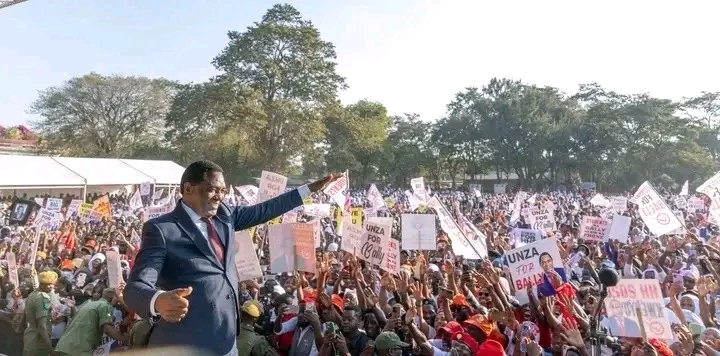
On Saturday afternoon, thousands of University of Zambia (UNZA) students marched from the Great East Road and Ridgeway campuses to State House, transforming the presidential grounds into a sea of white “Students for Bally” T-shirts, handwritten placards and youthful chants. The atmosphere was electric. It was less a conventional political rally than a meeting between a sitting President and a generation that has historically helped shape Zambia’s political direction.
For decades, UNZA students have been associated with resistance, protest and demands for political change. Student movements played visible roles during the closing years of the UNIP era, remained vocal throughout successive governments and have often acted as an early barometer of public dissatisfaction.
Saturday’s gathering therefore stood in sharp contrast to that history. Instead of marching against government, thousands marched to State House to express appreciation for improvements in student welfare while asking for further support.
The engagement produced an immediate policy announcement. President Hichilema increased the annual student accommodation allowance from K3,900 to K5,850, describing the move as part of Government’s broader commitment to higher education. .
He told the students his administration had reintroduced free education, restored meal allowances, resolved the long-running sanitation crisis at the Great East Road campus and would continue constructing student hostels while addressing concerns affecting university lecturers.
“We reintroduced free education. We restored meal allowances. Today we increased accommodation allowances, and the construction of hostels will continue,” the President told the gathering.
“We are also addressing the challenges affecting your lecturers because a great university needs supported students and supported staff.”
The President also urged students to safeguard the newly rehabilitated sanitation infrastructure completed by the Zambia National Service, reminding them that responsibility extends beyond Government investment.
Hichilema said the facilities should serve not only current students but future generations, calling on the university community to preserve the improvements that have restored one of Zambia’s most important public institutions.
Away from the podium, however, The People’s Brief spoke to several students whose views offered a revealing snapshot of political sentiment within sections of the university community. Duncan Bwalya, a law student, dismissed suggestions that Zambia was heading for a change of government.
“The only thing changing after August 13 is the weather,” he said. “Government is not changing. No right-thinking Zambian would want to change government. I listen carefully to the manifestos, and I can safely say this President knows what he is doing.”
Another student, Boyd Shaaba, from the School of Education argued that the principal opposition had failed to convince young voters it represented a genuine alternative.
“The alliance is just a collection of the same people we dislodged from power in 2021,” he said. “They have simply changed the name. Today they are asking Zambians to finance their campaign. That tells you something. Government is not changing.”
Rhoda Daka, another student who attended the engagement, pointed directly to Government’s education policies.
“The UPND has been the best government for student welfare,” she said. “As young people, it is our responsibility to encourage our friends and families to vote so this work continues.”
Those views represent the opinions of the students interviewed rather than the position of every UNZA student. Universities remain politically diverse spaces where competing ideas coexist. Even so, the symbolism of Saturday’s gathering is difficult to ignore.
Less than two weeks before polling day, one of Zambia’s most politically influential student communities voluntarily assembled at State House, placing education, student welfare and continuity at the centre of its engagement with the Head of State.
Whether that mood translates into votes will only become clear when ballots are counted on August 13. History suggests student politics can influence national conversations, but elections are decided by the broader electorate, not by any single institution.
Still, in a campaign increasingly defined by competing narratives about change and continuity, Saturday’s scenes at State House provided another reminder that Zambia’s youngest voters are becoming an increasingly important part of the electoral equation.
© The People’s Brief | Ollus R. Ndomu
The move is pragmatic and the amount is notional compared to some of the promises the opposition is making….
HH is a political genius, he doesn’t eat alone, he eats with everyone. The students cannot withhold their support and joy, in HH they have found the best parent who cares for them.
If they have no money to run campaigns now, it will not be long if in power, before they start saying ‘akasaka ka ndalama kali na ba Mundubile’ when they start stealing from the treasury. Never elect poor people without integrity.