

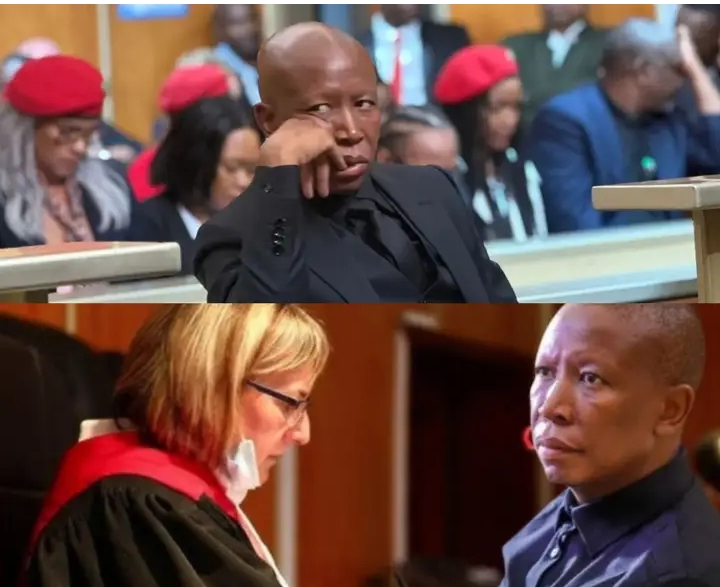
Julius malema is caught in the ropes again after civil society groups have taken to court demanding his removal from parliament’s Judicial Services Commission (JSC).
EFF Leader, Julius Malema, has found himself in yet another battle, but this time, it is about his seat in parliament’s JSC. The Helen Suzman foundation, freedom under Law and others, have taken to court to demand that parliament review Julius Malema’s fitness to be in the JSC. They argue that Julius Malema’s conduct towards judges in his political and private life and judgement on his firearm case, make him unfit to be one of the people tasked with the responsibility to select judges.
In their court papers to the cape town high court in May, the Helen Suzman foundation has argued that a person convicted of a crime and sentenced to a jail term like Julius malema, cannot continue to serve in parliament’s Judicial Services Commission. They argue that the conviction and jail time sentence thereof disqualify Malema from being a person with the required moral standing to select judges who are supposed to deliver justice in south africa’s courts. In addition, his public remarks agaist judges in general have been scrutinized and seen as disrespect towards the judicial state organ in general.
The Helen Suzman foundation has filed this partition in the Cape Town high court agaist the speaker of parliament who had previously argued that she does not possess the constitional powers to remove Julius malema as member of the JSC.
In the course of his firearm court case, Julius Malema made remarks in public agaist the judge in the case, calling her slow, incompetent and “a racist of note”. He told his supporters at a rally that the judge was driven by racism towards him because he is black and said she refuses to recognize his innocence because she is racist. In another similar case of Julius Malema’s bad blood with judges, in 2021, Malema got into a heated and confrontational argument with Judge Elias Matojane in a JSC session. In what was supposed to be a simple presentation for the selection of a new Judge, Malema turned the session into an interrogation of Matojane about a judgement he made agaist EFF in 2019 where he ordered the EFF to pay R500 000 in damages to Trevor Manuel after losing a defamation case in which the EFF Leader had accused Manuel of corruption.
The argument of suitability to be a member of the JSC based on a person’s personal standing is not being heard for the first time in south Africa’s parliament. A similar case was heard in 2024 after parament speaker had accepted the MK party’s candidate, John Hlophe, for JSC commissioner position. The democratic alliance and other parties in parliament rejected his candidacy in the JSC. They argued that it would be unethical and agaist any moral standard for the former judge who was found to be guilty of gross misconduct, to be selecting judges in the JSC.
The matter of Hlophe’s suitability for JSC was escalated further up to the Western Cape high couth by the DA after parliament failed to remove hlophe because of lack of specific legislation to the matter. In 2025, the high court granted in favor of the democratic alliance. The court found that it was unconstitutional for Hlophe as a disgraced former judge, to sit in the commission which select judges. The court ordered parliament to remove his name from the commission. At that time, hlophe had already removed himself already in 2024.
After the Hlophe vs DA ruling in 2025, you’d think it would be easier this time for parliament to just toss Julius malema off the JSC, given the similarities in the maters. However, it may not be as simple as that with Julius malema because some technicalities can still be argued in his case. The hlophe case was a direct matter of a former judge found guilty of gross misconduct and was thereafter, removed from the banch. Such a person is not suitable to be a judge and if they are too bad a person to be a judgedge, it would naturally follow that they cannot preside over the selection of judges. The malema case is still a matter of a convicted person who is yet to serve their sentence and definitely should not be in parliament, even according to parliament legislation.
Section 47(1) of the Constitution prevents a convicted person from being a member of Parliament if they have not completed at least 5 years after their conviction jail sentence has lapsed. This is the law that prevented Jacob Zuma from becoming a member of Parliament after his party won seats in parliament. Nevertheless, this law may not apply to Julius malema (pending a court judgement) because, even though sentenced to 5 years in prison on his firearm case, he was granted leave to appeal the sentence. Bearing in mind that section 47 (1) is not what the Helen Suzman foundation is arguing at the cape town high court, they are only arguing that he should not serve in the JSC commission in parliament.
The technicalities in Malema’s firearm case and his perceived public disrespect towards judges, may be a little too thin to topple Malema in the JSC in terms of law. However, with the same measure, the same technicalities may be the grounds for the cape town high court to order parliament to remove Malema from the JSC because his case is not so different from that of John Hlophe and, if section 47 (1) of the constition is invoked, even his membership in parliament in general may fall under the hammer.