

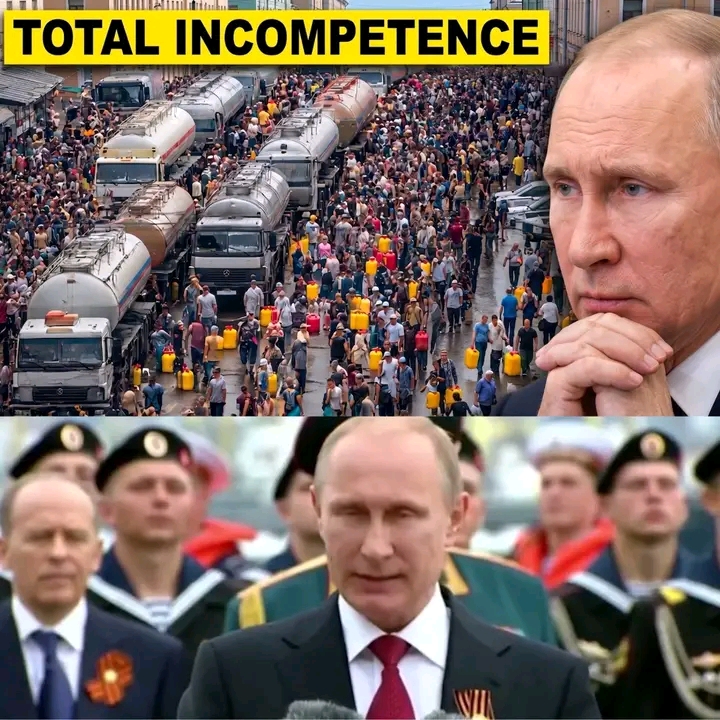
The Situation in Russia is CRAZY Right Now… Russians Run for Water
Russia’s Water Crisis: How War, Drought, and Failing Infrastructure Are Creating a New Front for Putin
Russia is running short of something more fundamental than ammunition, fuel, or money: water.
Across Siberia, Crimea, the occupied Donbas, and Russia’s own border regions, increasingly desperate scenes are emerging. Residents wait for tanker trucks with empty buckets. Taps run dry, or worse, produce water with an unbearable smell. Entire communities are forced to ration what should be one of the most basic services of modern life.
For the Kremlin, this is more than an infrastructure problem.
It is a warning.
Because when a country as vast and resource-rich as Russia begins struggling to deliver clean water to its own population, the problem is no longer simply about pipes, pumps, reservoirs, or rainfall. It becomes a question of state capacity — and of what happens when the machinery of war begins consuming the resources needed to keep everyday life functioning.
The emerging crisis is unfolding on several different fronts at once. In Tyumen, extreme rainfall has overwhelmed a vulnerable water system. In Crimea, drought is colliding with electricity disruptions linked to the war. In occupied Donbas, years of destruction and inadequate repairs have turned water shortages into a chronic condition. And in Russian border regions, attacks and infrastructure failures are increasingly disrupting the systems that keep cities supplied.
The causes are different.
The result is remarkably similar.
People turn on the tap — and nothing comes out.
The Crisis Begins in Siberia
The first warning comes from Tyumen, one of Russia’s most important oil-producing regions.
At first glance, Tyumen seems like the last place where a basic water crisis should occur. It is wealthy by Russian standards, strategically important, and deeply connected to the country’s enormous energy industry.
Yet during an extraordinary period of rainfall, the region faced a problem that exposed just how vulnerable even prosperous Russian cities can be.
The Tura River rose dramatically after unusually heavy precipitation. Water levels climbed far beyond normal conditions, while enormous quantities of organic material entered the river system. As the water environment deteriorated, oxygen levels fell and fish began washing up along the banks.
Then came the consequences for the city’s water supply.
The treatment system drew from the river, and residents began complaining that their tap water smelled like sewage and decaying organic matter
For people who had simply turned on their faucets expecting clean water, the experience was shocking.
Some residents reported being unable to drink the water or even comfortably use it for ordinary household purposes. Bottled water disappeared from stores. Tanker trucks became a crucial lifeline. People stood in queues with containers, waiting for deliveries that did not always arrive when promised.
That last detail is important.
The crisis was not simply that a river had flooded.
Natural disasters happen.
The deeper problem was what happened afterward.
A functioning modern water system is supposed to absorb shocks. Treatment facilities, emergency reserves, backup systems, maintenance networks, and local authorities are supposed to prevent a temporary environmental disaster from becoming a prolonged urban crisis.
But in Tyumen, the flooding exposed vulnerabilities that had accumulated over years.
Officials initially emphasized that the water remained technically within acceptable safety parameters despite widespread complaints about its smell and taste. Eventually, public pressure grew strong enough for investigators to open a criminal case, while the regional authorities declared a state of emergency.
For residents, however, official declarations came after the problem had already entered their homes.
The lesson was uncomfortable.
Even one of Russia’s wealthiest regions could struggle to maintain something as basic as a reliable supply of usable water when nature pushed an aging system beyond its limits.
And that raises a much larger question.
What happens when environmental stress is combined with war?
For the answer, the story moves south.
To Crimea.
FULL REPORT IN THE COMMENT