

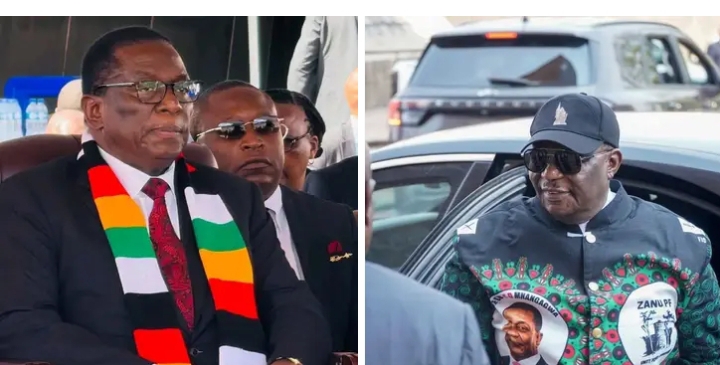
IF YOU THINK MNANGAGWA IS GOING TO FIRE CHIWENGA, FORGET AND SMILE!
By Gabriel Manyati
When political power changed hands in Harare in November 2017, the world was treated to a masterclass in the art of the sophisticated constitutional illusion. As tanks rolled down Samora Machel Avenue, military spokesmen insisted on national television that what was unfolding was not a coup d’état, but merely a targeted intervention against criminals surrounding President Robert Mugabe. It was a theatrical performance designed to preserve the veneer of legality while fundamentally altering the state.
Today, a similar misreading of political optics grips the Zimbabwean commentariat. Observers mesmerised by the visible tension between President Emmerson Mnangagwa and his powerful deputy, Constantino Chiwenga, eagerly anticipate a dramatic climax: the outright dismissal of the vice president. Yet, to expect Mnangagwa to simply fire the former general who helped orchestrate his rise to power is to misunderstand both the mechanics of dominant-party authoritarianism and the specific temperament of the man in State House.
The commentary surrounding Zimbabwean succession often assumes that executive dominance requires the public humiliation of one’s rivals. The reality of power within ZANU PF is far more subtle. Following the passage of Constitutional Amendment Act No. 3 (CAA3), which fundamentally altered the rules governing presidential succession, the strategic landscape shifted decisively in Mnangagwa’s favour. The amendment removed the requirement for running mates in presidential elections, returning the power of appointing vice presidents directly to the head of state and decoupling executive succession from an automatic constitutional handoff.
Why would Mnangagwa risk a high-stakes, volatile showdown by firing Chiwenga when the legal architecture now gives him the tools to render his rival politically peripheral without firing a single shot?
As we often reflect on in this corner of The Sunday Political Read, the strategic imperative facing Mnangagwa is rarely about the total destruction of an opponent, but rather his gradual, systemic containment. In dominant-party regimes, formal dismissal is usually the blunt instrument of an insecure ruler, whereas political management, elite bargaining, and institutional attrition represent the true repertoire of a master tactician.
Time, unlocked by constitutional engineering, has become the ultimate political currency in Harare. By extending his political horizon toward 2030, Mnangagwa has dismantled the artificial urgency that once forced his opponents into aggressive manoeuvering. Time allows a leader to alter elite coalitions, redistribute state patronage, restructure the security hierarchy, and cultivate alternative centres of influence, all while maintaining the superficial harmony required to keep foreign investors and regional partners reassured.
To understand why a summary dismissal remains unlikely, one must first examine the grave risks such a move would entail. Advocates of a swift purge argue that removing Chiwenga would instantly project absolute presidential authority, eliminate a stubborn internal challenger, and end the factional paralysis that periodically grips the state bureaucracy. This view, however, confuses formal authority with total power. Chiwenga is not merely an ambitious politician; he is the former Commander of the Zimbabwe Defence Forces, a man whose deep-seated ties within the military establishment were forged in the crucible of the liberation struggle and solidified during the 2017 transition.
Stripping Chiwenga of his official title would not extinguish his political influence. It would merely liberate that influence from the institutional constraints of government. Inside the executive, Chiwenga remains bound by cabinet secrecy, collective responsibility, and the watchful gaze of state intelligence. Expelled from government, he becomes an unguided missile, a political martyr around whom disaffected war veterans, disgruntled security officers, and sidelined party factions could coalesce. Removing a rival from office is relatively simple, but managing an externally mobilised challenger with military pedigree is an infinitely more dangerous enterprise.
Mnangagwa’s entire political career demonstrates a preference for patience over impetuousness. He is a political operator defined by strategic caution, calculating endurance, and an acute understanding of how institutional mechanisms can quietly neutralise an adversary. One need only examine his handling of Grace Mugabe following the fall of her husband. During the bitter internal warfare between the G40 and Lacoste factions, Grace Mugabe publicly humiliated Mnangagwa, stripped him of his dignity at political rallies, and famously urged her husband to crush the snake’s head.
When Mnangagwa ultimately assumed the presidency, many anticipated a campaign of total retribution against the former First Lady. Instead, he allowed her political relevance to wither organically. Deprived of the state machinery and party platforms that once sustained her influence, Grace Mugabe faded into political obscurity. Mnangagwa understood that a publicly persecuted opponent can easily become a rallying point for resistance, whereas an isolated opponent simply becomes yesterday’s news.
This logic applies with even greater force to Chiwenga. To publicly destroy the man who served as the kingmaker of the 2017 transition would expose Mnangagwa to accusations of profound political ingratitude, troubling the conscience of ZANU PF’s liberation generation. The military establishment views Chiwenga as one of their own; a heavy-handed purge would risk alienating key elements within the security sector, creating unnecessary friction between the civilian party apparatus and the armed forces. Elite legitimacy in Zimbabwe rests on a delicate equilibrium between party veterans, state intelligence, and the military high command. Disrupting this balance for the sake of personal vengeance would be an act of profound strategic recklessness.
The safer, far more effective strategy is a process of gradual neutralisation. This approach operates across several distinct fronts, beginning with the dilution of practical authority. Chiwenga may comfortably retain his title, his motorcade, his ceremonial visibility, and his senior position within the party, even as his actual sway over executive appointments, state patronage, and core economic policy is systematically trimmed. Power in dominant-party systems flows not from titles on an organisational chart, but from the ability to allocate resources and command personal loyalties.
Simultaneously, the president can quietly reshape ZANU PF’s internal structures. By ensuring that loyalists secure key positions within provincial executive committees, the Youth League, and the Women’s League, the party’s centre of gravity shifts irrevocably. Outside the formal party apparatus, the management of the security establishment relies on the quiet rhythm of routine administration: scheduled retirements, strategic promotions, diplomatic postings abroad, and the natural generational transition of senior commanders. Over time, these subtle adjustments alter the institutional landscape, ensuring that the security services become increasingly loyal to the sitting president rather than any individual former commander.
Looking forward, Mnangagwa possesses a suite of strategic options that do not require an open political rupture. He can choose to contain Chiwenga within the executive while quietly grooming alternative successors, deliberately maintaining a degree of ambiguity to keep all party factions competing for his favour. He can negotiate an informal accommodation that preserves Chiwenga’s dignity and personal security in exchange for a peaceful departure from active succession politics. Or he can simply allow political attrition to take its course, permitting time, health, and changing generational dynamics within ZANU PF to solve the problem for him.
Chiwenga, for his part, is far from powerless, but his strategic choices are constrained. He can exercise patience, banking on the unpredictable nature of Zimbabwean politics; he can build quiet alliances within the party and security networks without crossing the line into open rebellion; or he can leverage his historical liberation credentials to negotiate a secure political legacy. His primary threat is not the prospect of being fired on evening news, but the slow, imperceptible erosion of his operational influence.
This dynamic of managing rather than destroying powerful rivals is not unique to Zimbabwe. Across the continent, resilient political systems demonstrate that dominant leaders frequently prefer containment to confrontation. In Angola, President Joao Lourenco navigated the deeply entrenched interests of the dos Santos family through targeted institutional shifts rather than total political warfare. In Uganda, Yoweri Museveni has repeatedly managed powerful internal challengers, such as Amama Mbabazi, by stripping them of their institutional bases while keeping them wrapped in the broader fabric of the ruling movement. The fundamental law of authoritarian survival is simple: make your rivals weak, but do not make them desperate.
It remains theoretically possible that a sudden escalation of tensions, an unexpected political miscalculation, or an overt challenge to presidential authority could force Mnangagwa to dismiss his vice president. Political calculations are never static. Yet, when evaluated against the incentives created by Constitutional Amendment Act No. 3, the strategic arguments against a public firing are overwhelming.
Constitutional Amendment Act No. 3 did not resolve Zimbabwe’s complex succession equation, but it fundamentally altered the tempo of the game. Mnangagwa no longer requires a dramatic, dangerous showdown to secure his political horizon. The most decisive shifts in power are rarely marked by public dismissals or dramatic press conferences. They occur quietly, through the steady reallocation of patronage, the subtle realignment of elite coalitions, and the gradual migration of political loyalty.
The loudest move is seldom the smartest move, and in the high-stakes arena of Zimbabwean politics, the ultimate victory belongs to the leader who ensures that by the time a rival realises the game is over, an actual firing is no longer necessary.