

EVENING WIRE | Students Surge to State House as Election Enters Final 72 Hours
Zambia entered the final 72 hours before Thursday’s General Election with the campaign moving on several fronts at once. Thousands of students converged on State House in an emphatic show of support for President Hakainde Hichilema, Brian Mundubile’s alliance took its Southern Province campaign online, the Electoral Commission of Zambia stood by its interpretation of valid ballot markings, while international election observers intensified their work ahead of polling day
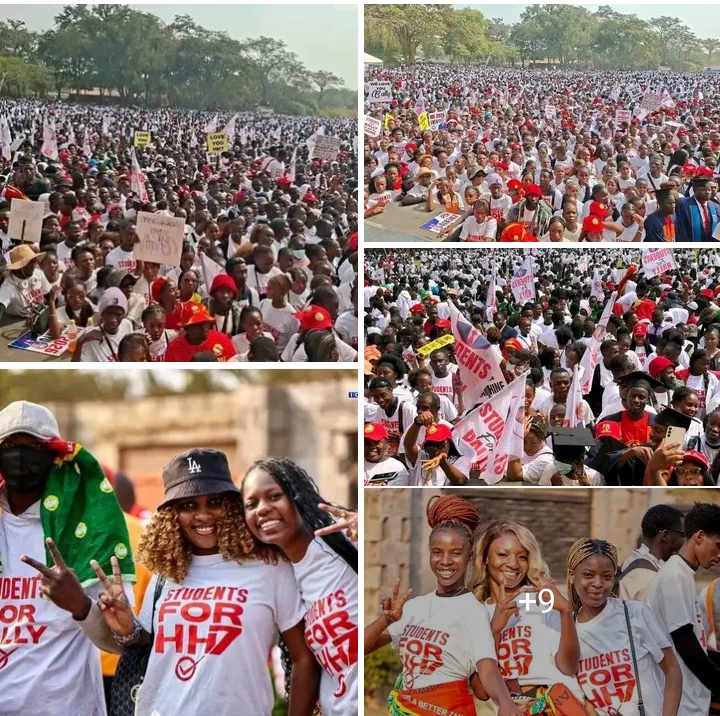
In Lusaka, the political spectacle of the day belonged to the students. Large numbers drawn from universities and colleges descended on State House, many wearing white “Students for HH” T-shirts, carrying flags and placards and chanting the UPND campaign slogan, “Kwenyu”, as they declared support for Hichilema’s re-election. Images from the grounds show the crowd stretching deep into the State House surroundings, providing one of the clearest displays so far of organised student mobilisation behind the incumbent.
The atmosphere was “electric, energetic and full of emotion”, according to The People’s Brief reporter Francine Lilu, who attended the engagement at State House. Music, dancing and political chants punctuated the gathering as students turned what was formally an engagement with the President into something closer to a youth campaign rally.
The size of the gathering also required an increased security presence as students continued arriving.
There was humour too. Students from Levy Mwanawasa Medical University presented Hichilema with a mock degree certificate awarding him a “Bachelor of Kwenyunology with Distinction”, an apparent play on “Kwenyu”, the informal UPND campaign slogan which has become shorthand among supporters for marking the party on Thursday. The certificate credited Hichilema with “successfully implementing student loans (bursaries)”. It was political theatre, but it also captured the relationship his campaign is trying to project with the student constituency.
Behind the music was a more serious political calculation. Hichilema has built part of his youth appeal around the restoration of meal allowances, expansion of student financing and bursaries, skills development and other education interventions. Monday’s mobilisation suggested those policies have translated into visible political goodwill among sections of the tertiary student population.
It would be difficult to extrapolate the State House crowd to Zambia’s entire student electorate, but the scale and enthusiasm of the gathering make one point difficult to ignore: Hichilema enters Thursday’s election with a highly organised student support base.
The moment which appeared to connect most strongly with the gathering came when Hichilema spoke about the transition from university into employment. He recalled completing university on a Friday and reporting for work the following Monday at a company where he had previously undertaken practical training. He said his administration wants to revive a structured internship system reminiscent of arrangements during the Kenneth Kaunda era, creating a clearer bridge between education, practical experience and employment.
Lilu reported a particularly strong reaction when the President addressed graduate unemployment and volunteering. Hichilema urged young graduates not to remain at home waiting indefinitely for formal employment, but to volunteer, acquire experience and contribute wherever opportunities existed. He also asked student leaders to submit information on students already volunteering while studying, signalling an interest in connecting such experience to the proposed internship framework.
The response from the crowd suggested employment after graduation remains one of the issues closest to the student electorate.
Hichilema then converted the engagement into a mobilisation exercise. He asked students to carry his campaign into homes, churches, bus stations and communities during the few remaining campaign days. The message was straightforward: the students who had assembled at State House were being asked to become political messengers beyond the university environment.
With campaigning approaching its end, the UPND is increasingly concentrating on converting visible enthusiasm into turnout.
The opposition Tonse Pamodzi Alliance spent Monday confronting a different political problem. Mundubile and running mate Makebi Zulu held their Southern Province engagement virtually after deciding against a physical campaign tour, citing security concerns and fears of political violence. The decision effectively removes the alliance from physical campaigning in one of Hichilema’s strongest electoral territories during the final days, although the opposition maintains security considerations informed the move.
The alliance also continued challenging ECZ over ballot markings. Chief Electoral Officer Brown Kasaro has maintained a ballot can remain valid whether the voter uses an X, tick, dash or another single mark, provided the intention is clear and the mark remains within the space allocated to one candidate.
NRPUP disputes the interpretation and has formally cited Regulation 33(d) of the Electoral Process (General) Regulations, which refers to marking a ballot with a cross. The disagreement has consequently moved beyond campaign rhetoric into a question of legal interpretation three days before voting.
Alongside the formal dispute, allegations of pre-marked ballot papers have circulated in opposition-aligned WhatsApp groups and social media spaces monitored by The People’s Brief.
No independently verifiable evidence has been produced establishing the existence of such a scheme. At this stage, the claims remain allegations.
Police are meanwhile investigating the controversial video attributed to Tonse Presidential Affairs Chairperson Binwell Mpundu, in which the speaker said he was prepared to “die” and “kill” over the election. Mpundu says his Facebook account was compromised and the recording was produced using artificial intelligence.
Mundubile has supported that explanation, saying, “That was AI. He could not possibly speak like that.”
An election forecast attributed to Pari-Africa has also circulated widely, placing Hichilema’s probability of victory between 70 and 80 percent and the possibility of a runoff at around 25 percent.
Monday therefore offered two sharply different pictures of the closing campaign. At State House, Hichilema was surrounded by thousands of young supporters, talking about education, internships and employment while asking them to carry his message into the electorate.
Across the opposition, Mundubile’s alliance was fighting procedural battles with ECZ, defending one of its senior officials over a disputed viral video and campaigning virtually in Southern Province.
None of those scenes settles Thursday’s contest. Crowds do not count themselves. Social media does not constitute a voter register. Campaign momentum matters only when it reaches the polling booth.
But with three days remaining, the political arguments have largely been made. Zambia is moving from persuasion to mobilisation.
The next question is no longer who can produce the loudest campaign. It is who can produce the voters.
This is the Evening Wire, pleasant evening.
© The People’s Brief | Ollus R. Ndomu; Sendoi Liteta