

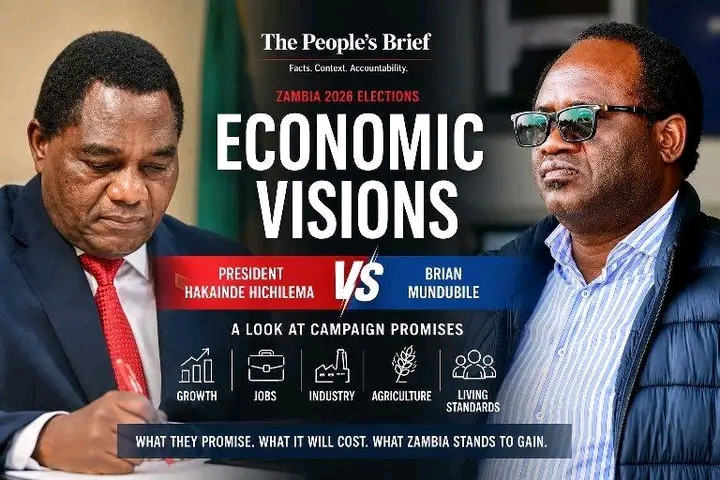
🇿🇲 ECONOMY | Hichilema vs Mundubile: Which Economic Plan Adds Up?
Zambia votes on Thursday. Beyond the crowds, endorsements and closing campaign arguments, however, lies a harder question for the two leading presidential candidates: whose economic programme provides the more credible route from political promise to economic delivery?
President Hakainde Hichilema’s UPND and Brian Mundubile’s Tonse Alliance both promise growth, employment, industrialisation and improved household welfare. There is substantial agreement on the problems confronting Zambia. Unemployment remains high, household budgets remain under pressure, industrial capacity remains shallow and the economy remains excessively dependent on copper. The real difference emerges when the two manifestos are examined for targets, financing logic, macroeconomic coherence and measurable outcomes.
The UPND enters this comparison from the position of an incumbent. Its 2026 economic proposition rests on a simple sequencing argument: the first term concentrated on stabilisation, debt restructuring and restoring macroeconomic credibility; the next five years should convert those foundations into investment, production, employment and eventually lower household pressure. Whether voters believe the first stage has sufficiently improved their lives is a separate political question. As an economic framework, however, the sequencing is recognisable.
Its targets are substantial. Hichilema promises two million new jobs, more than double TEVET enrolment, at least 100,000 young people passing through industry-linked training, more than 10,000MW of electricity generation, three million tonnes of annual copper production, 10 million tonnes of maize, another 500,000 hectares under irrigation, an 11-million cattle herd, US$1 billion in annual beef exports and more than five million tourist arrivals. Above everything sits the promise to double the size of Zambia’s economy by 2031.
Financial economist Bright Chizonde sees measurability as one of the programme’s strongest features. “Unlike many Zambian political manifestos that merely describe aspirations, the UPND document provides specific targets for jobs, GDP, mining, energy, agriculture and tourism,” he argues, awarding the manifesto 8/10.
We broadly agree with his assessment of the structure, but the numbers require harder interrogation.
The UPND manifesto is stronger on what it wants to achieve than on the detailed capital requirements needed to achieve it. Increasing generation capacity from roughly 3,400MW to above 10,000MW would require billions of dollars in generation, transmission and associated infrastructure. Increasing copper production to three million tonnes similarly depends on mining capital expenditure, power availability, regulatory stability, exploration, processing capacity and global copper prices. Government can create the investment environment. It cannot command production into existence.
The two-million-job target presents another measurement problem. Zambia needs employment on this scale, but the manifesto must ultimately distinguish formal jobs from informal economic activity, temporary employment and self-employment. If Hichilema wins another term, government should publish annual employment milestones and define precisely what counts towards the two million. Otherwise, a measurable-looking target could become difficult to audit.
The GDP promise deserves even greater caution. “Doubling the economy” sounds straightforward politically but becomes complicated economically. Real GDP, nominal GDP and GDP measured in US dollars are different measures. Inflation and exchange-rate movements can materially alter nominal economic size without producing an equivalent increase in real output or household purchasing power. A credible second-term programme therefore needs to specify the measurement behind the headline.
Tonse enters from a different position. Mundubile does not have an incumbent economic record to defend. His manifesto can therefore begin with diagnosis. It identifies poverty, unemployment, weak industrialisation, expensive living conditions and insufficient economic opportunities as central problems. Its proposed response includes upper-middle-income status within five years, sustained high GDP growth, hundreds of thousands of jobs, industrialisation, mining value addition, agro-processing, SME expansion, digital innovation, increased welfare and non-traditional exports equivalent to 50 percent of GDP.
There are sensible ideas inside this framework. Zambia needs greater value addition. It needs more domestic processing of minerals and agricultural commodities. SMEs need cheaper capital and a less burdensome operating environment. Export diversification remains essential if the country is to reduce its vulnerability to copper cycles. Mundubile’s emphasis on economic inclusion also addresses a legitimate weakness of headline GDP growth: economies ultimately exist to improve household welfare.
But Tonse’s programme becomes less convincing when the macroeconomic architecture beneath these ambitions is examined.
Chizonde identifies an immediate inconsistency. Different portions of the manifesto apparently refer to GDP growth of 6 to 7 percent and elsewhere 7 to 9 percent. These are not trivial differences. Sustaining nine percent real growth requires substantially greater productivity, investment and capital formation than sustaining six percent. A government asking markets, businesses and households to organise expectations around its economic programme should establish one baseline scenario and explain the assumptions supporting it.
The upper-middle-income promise presents a larger credibility test. Income classifications depend on gross national income per capita, not political declaration. Reaching such status requires sustained growth in national income relative to population, alongside favourable productivity and exchange-rate dynamics. Tonse identifies the destination but provides less clarity on the investment rate, export growth, productivity gains and fiscal framework capable of moving Zambia there within five years.
Its proposal to push non-traditional exports towards 50 percent of GDP is similarly enormous. Zambia would need a dramatic expansion in manufacturing, agriculture, agro-processing and services exports. Production capacity would have to rise alongside logistics efficiency, power availability, access to finance and regional market penetration. Such transformation is possible over time. The manifesto’s weakness is insufficient explanation of the transition mechanism.
The larger difference between the two programmes, in our assessment, lies in macroeconomic sequencing.
An economy cannot sustainably spend, industrialise or expand welfare without managing inflation, debt, fiscal deficits, interest rates, foreign-exchange availability and investor confidence. These variables determine the cost of capital. The cost of capital determines investment. Investment influences productive capacity. Productive capacity ultimately determines employment, exports and household income
Chizonde makes the same criticism more directly, arguing Tonse gives insufficient attention to “debt management, inflation control, exchange rate stability and fiscal sustainability.” He consequently scores the manifesto 4/10.
This does not mean every orthodox macroeconomic policy automatically improves people’s lives. Zambia’s recent experience demonstrates the opposite problem. Fiscal repair can coexist with painful household conditions. Debt restructuring can improve sovereign risk while food remains expensive. Foreign reserves can strengthen while families continue struggling with disposable income. An appreciating currency can reduce imported inflation without immediately creating employment.
This is where Hichilema’s programme carries its greatest political and economic burden.
He can no longer ask voters to judge economic stabilisation independently from living standards. If the first term repaired the balance sheet, a second term must improve the income statement of the household. Investment must become jobs. Mining expansion must create domestic supply chains. Better debt metrics must eventually reduce financing pressure. Increased agricultural production must influence food prices. Improved electricity capacity must translate into reliable power for households and industry.
The incumbent therefore carries execution risk. Mundubile carries design risk.
Hichilema has produced the more developed economic architecture, but several targets are extremely ambitious and implementation could fail. Mundubile identifies legitimate economic objectives, but his manifesto leaves larger questions about how those objectives interact with debt, inflation, government expenditure, exchange-rate management and fiscal sustainability.
Markets would also examine the two programmes differently. Investors generally do not respond to promises of jobs or industrialisation in isolation. They price sovereign risk, policy continuity, taxation, currency exposure, energy security, debt sustainability and regulatory predictability. A government promising aggressive economic expansion without explaining its fiscal anchor creates uncertainty over whether expansion will ultimately be financed through taxation, borrowing, monetary accommodation or private capital
For households, however, the test is different. People ask whether food becomes affordable, whether wages purchase more, whether businesses survive, whether electricity remains available and whether young people find work. The strongest economic programme must therefore satisfy both constituencies: markets need credibility while households need results.
On balance, The People’s Brief finds the UPND economic programme more coherent and presently more credible of the two, principally because its sector targets sit inside a recognisable macroeconomic framework and are easier to measure. This is not an endorsement of every target. We consider several of them highly ambitious, particularly the proposed scale of electricity expansion, copper production, employment creation and GDP growth within one presidential term.
Tonse’s programme contains worthwhile objectives, particularly around industrialisation, value addition, SMEs, exports and poverty reduction. Its weakness is the distance between ambition and mechanism. Mundubile’s economic proposition would be considerably stronger with clearer fiscal assumptions, one consistent growth target, quantified financing requirements, explicit debt and inflation objectives and annual benchmarks against which delivery could be measured.
This distinction matters 48 hours before voting.
A manifesto is not merely a catalogue of desirable outcomes. Serious economic policy must explain the transmission mechanism between capital, production, productivity, employment, exports, government revenue and household income.
Promises tell voters where a candidate wants Zambia to go. Economic architecture tells them whether there is a road.
On the evidence contained in the two programmes, Hichilema currently presents the clearer road. The question for him is whether he can travel it fast enough for households to feel the difference. Mundubile presents an ambitious destination. His remaining weakness is explaining, with sufficient financial precision, how Zambia gets there.
Thursday belongs to voters. The balance sheet comes afterwards.
The People’s Brief | Ollus R. Ndomu