

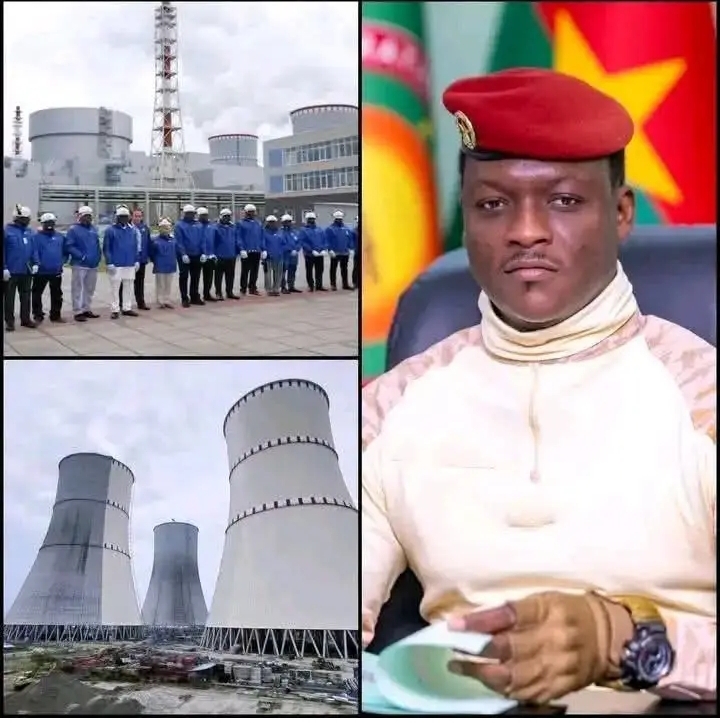
Burkina Faso Turns to Nuclear Power in Landmark Deal With Russia’s Rosatom
Burkina Faso is taking a major step toward addressing its chronic electricity shortages after signing an agreement with Russia’s state-owned nuclear giant Rosatom to explore the development of civilian nuclear energy.
The agreement marks a significant expansion of the country’s energy partnership with Russia and could pave the way for Burkina Faso to develop nuclear power for peaceful purposes, including electricity generation, healthcare and industrial applications.
A Strategic Nuclear Partnership
Under the agreement, Burkina Faso and Rosatom will cooperate on the peaceful use of nuclear technology. The partnership is expected to cover areas such as nuclear power generation, scientific research, medicine and industrial applications.
For Burkina Faso, the initiative comes as the country continues to face serious challenges in providing reliable and affordable electricity to its growing population and economy.
The government sees nuclear energy as a potential long-term solution capable of providing a stable supply of large-scale electricity, reducing dependence on limited and less reliable sources of power.
Tackling Burkina Faso’s Energy Deficit
Electricity shortages have become a major obstacle to economic development across Burkina Faso. Frequent power interruptions affect households, businesses, hospitals and industrial activity.
A future nuclear power program could provide a continuous source of electricity, potentially supporting the expansion of manufacturing, mining, agriculture and other industries that require reliable power supplies.
The project could therefore become part of Burkina Faso’s broader effort to strengthen energy sovereignty and reduce its vulnerability to external energy supplies.
Beyond Electricity
The cooperation with Rosatom is not limited to power generation.
Nuclear technology can also be used in medicine, including cancer diagnosis and treatment, as well as in agriculture, scientific research and industrial applications.
Such technologies could eventually strengthen Burkina Faso’s healthcare and scientific infrastructure while creating new opportunities for technical training and highly skilled employment.
A Growing Russia-Burkina Faso Partnership
The nuclear agreement also has an important geopolitical dimension.
Burkina Faso has significantly deepened its relationship with Russia in recent years as it seeks to diversify its international partnerships. Cooperation with Rosatom gives Moscow another avenue to expand its technological and economic presence in the Sahel.
For Ouagadougou, working with Russia could provide access to nuclear expertise and infrastructure at a time when the country is pursuing greater strategic autonomy.
Nuclear Energy Does Not Mean Nuclear Weapons
The agreement concerns civilian nuclear technology, not the development of nuclear weapons.
Nuclear power plants use controlled nuclear reactions to generate heat and produce electricity. Nuclear weapons, by contrast, are specifically designed to release enormous amounts of energy through an uncontrolled nuclear chain reaction.
Burkina Faso’s cooperation with Rosatom is therefore focused on peaceful applications of nuclear technology.
A Long-Term Project
The agreement does not mean Burkina Faso will immediately have a functioning nuclear power plant. Developing nuclear energy is a complex and lengthy process requiring feasibility studies, financing, infrastructure, regulatory institutions, trained personnel and strict international safety standards.
Nevertheless, the agreement represents an important first step.
If successfully implemented, Burkina Faso’s nuclear ambitions could transform its energy sector, strengthen industrial development and reduce the impact of chronic electricity shortages.
For Ouagadougou, the message is clear: nuclear energy is being considered as a strategic tool for achieving greater energy independence and accelerating national development.