

PROCESS INITIATED TOWARDS THE NOMINATION OF PRESIDENT HAKAINDE HICHILEMA FOR THE NOBEL PEACE PRIZE
FOR IMMEDIATE RELEASE
14 August 2026
I wish to announce that I have initiated a process aimed at the nomination of His Excellency President Hakainde Hichilema, President of the Republic of Zambia, for consideration for the Nobel Peace Prize.
As I am not presently within the categories of persons formally eligible to submit a Nobel Peace Prize nomination, I have reached out to distinguished individuals internationally who are eligible to nominate and who will contribute intellectually and institutionally towards developing the case. These include senior academics and professors of good standing, policy leaders, parliamentarians and international political figures.
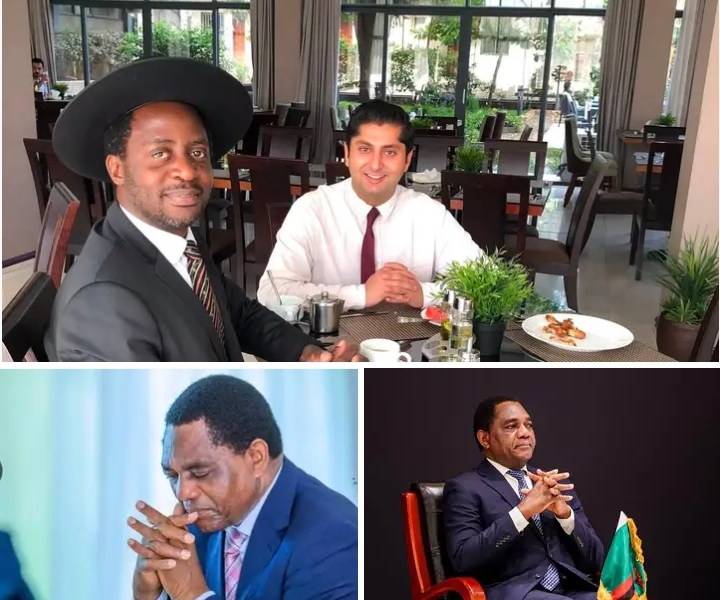
Among the distinguished individuals I have already personally reached out to is my friend, Hon. Himanshu Gulati MP of Norway, an experienced parliamentarian and former senior government official with substantial credentials in government, foreign affairs, defence and international parliamentary engagement. Hon. Gulati is currently an elected Member of the Norwegian Parliament, the Storting, representing Akershus, where he serves as Second Vice Chair of the Standing Committee on Foreign Affairs and Defence and Second Vice Chair of the Enlarged Foreign Affairs and Defence Committee.
Before and during his parliamentary career, Hon. Gulati served at senior levels of the Norwegian Government. He was State Secretary in the Ministry of Justice and Public Security and subsequently State Secretary in the Office of the Prime Minister of Norway, where he served for approximately three years. His parliamentary experience has included service on committees responsible for justice, family and cultural affairs, and education and research. Internationally, he has served as a Norwegian parliamentary delegate to the United Nations General Assembly and as a member of Norway’s parliamentary delegation to the Nordic Council.
He currently also serves as Second Vice Chair of the Norwegian Parliament’s Delegation for Relations with the European Parliament, is a member of the European Consultative Committee, and participates in the interparliamentary conference concerned with the European Union’s Common Foreign, Security and Defence Policy.
I have reached out to Hon. Gulati because I believe that an initiative of this nature must ultimately transcend Zambian partisan politics. It must be capable of being examined by people of international standing who can independently interrogate the evidence and reach their own conclusions.
I have urged him, together with the other distinguished academics, parliamentarians, policy leaders and international figures whom I am approaching, to examine objectively President Hichilema’s record and to consider playing a leading role in advancing his nomination for the Nobel Peace Prize.
This initiative is not founded upon the proposition that President Hichilema is a perfect leader. No such leader exists. It is founded upon something much more consequential. It is founded upon the extraordinary journey Zambia has travelled under his leadership and upon the proposition that peace is not merely the absence of war. Peace is also the deliberate construction of institutions, restraint, human dignity, economic stability and democratic space within which citizens can resolve their differences without destroying their country.
President Hakainde Hichilema came to office in August 2021 after spending many years as an opposition leader. He knew political persecution personally. He knew detention. He knew what it meant to operate in a political environment characterised by severe tensions between the State and the opposition.
When he eventually became President, Zambia faced another kind of threat to its stability. The country had defaulted on its sovereign debt. Inflation was extraordinarily high. Foreign exchange reserves were severely constrained. Investor confidence had deteriorated. Zambia faced the enormous task of reconstructing an economy weakened by years of unsustainable borrowing.
Four years and eleven months later, Zambia is a profoundly different country. The sovereign debt restructuring process has covered the overwhelming majority of the restructuring perimeter. Inflation has fallen dramatically. International reserves have been rebuilt. Investor confidence has strengthened. Zambia has returned to a path of macroeconomic stability.
This matters to peace. History repeatedly teaches humanity that economic collapse, institutional failure, mass unemployment, desperation and political instability can become breeding grounds for social conflict.
President Hichilema’s contribution, therefore, must be considered not merely in terms of economic statistics, but in terms of rebuilding the foundations upon which a peaceful and stable democratic society depends. There is another dimension which I believe the international community should examine carefully.
In December 2022, President Hichilema assented to legislation abolishing the death penalty in Zambia. He simultaneously abolished the offence of criminal defamation of the President, a law which had historically been capable of being used against citizens for attacking the person occupying the highest office in the land. The abolition of the death penalty was subsequently described by the United Nations in Zambia as a historic milestone.
There is something profoundly significant about a President voluntarily surrendering instruments of State power which could otherwise be used in the name of protecting authority. President Hichilema’s contribution has also extended beyond Zambia’s borders.
As Chairperson of the SADC Organ on Politics, Defence and Security Cooperation, he participated directly in regional efforts addressing some of Southern Africa’s most difficult peace and security challenges, including instability in the Democratic Republic of Congo and Mozambique. During his tenure, SADC specifically commended President Hichilema for his leadership in fostering regional cooperation towards peace, security and stability.
He consistently advanced the principle that instability in one country ultimately threatens the stability and prosperity of its neighbours.
Today, however, there is another reason why I believe the international community should begin examining the Hichilema record. Zambia has just conducted its General Election of 13 August 2026. The final electoral process and the reports of international and domestic observers must, of course, be allowed to run their full course before definitive judgments are made.
Nonetheless, as someone who has participated in Zambian politics for decades, I cannot ignore what I have personally witnessed. There have been pockets of electoral violence and incidents which must neither be concealed nor minimised. However, the overall atmosphere surrounding this election has been remarkably different from some of the deeply confrontational political environments Zambia experienced previously. Those of us who lived through the elections of 2016 and 2021 know the difference.
We remember the political tension. We remember the violence. We remember opposition political activities being restricted. We remember the fear that accompanied political participation in parts of our country. The Zambia of August 2026 must be judged against that history.
One of the greatest tests of democratic leadership occurs when a sitting President possesses all the enormous instruments of the State and nevertheless permits the people to exercise their sovereignty through the ballot. Peace is sometimes demonstrated not by what a leader does, but by the power he possesses and chooses not to abuse.
President Hichilema inherited a deeply divided political environment. He inherited sovereign default. He inherited weakened institutions. He inherited enormous public expectations. He has not solved every problem facing Zambia.
The cost of living remains a serious challenge for many families. Unemployment remains too high. Questions concerning governance and civil liberties must continue to be debated openly. No serious nomination should attempt to erase legitimate criticism.
The Nobel Peace Prize should never be sought through propaganda. It should be supported by evidence. That is precisely why I am initiating this process. I want distinguished academics, parliamentarians, statesmen, policy leaders and institutions outside Zambia to examine the evidence themselves.
Let them examine the man. Let them examine the country he inherited. Let them examine the country after nearly five years of his presidency. Let them examine his transition from a persecuted opposition leader to Head of State. Let them examine the abolition of the death penalty. Let them examine the repeal of criminal defamation of the President. Let them examine Zambia’s economic reconstruction. Let them examine his leadership in regional peace and security. Let them examine the political and electoral environment over which he has presided. Then let them reach their own conclusions. For me, this transcends partisan politics.
I have opposed governments before. I have paid a personal price for doing so. Where a leader fails, we must have the courage to say that he has failed. Where a leader succeeds, we must possess equal courage to acknowledge it.
I therefore believe that President Hakainde Hichilema’s record deserves to be placed before those empowered to consider nominations for one of humanity’s highest recognitions for peace.
I have started that process. The final decision on the Nobel Peace Prize belongs exclusively to the Norwegian Nobel Committee. History will make its own judgment.
My responsibility is simply to ensure that an extraordinary chapter in Zambia’s democratic journey is brought to the attention of those who have the standing to examine it.
Zambia Forward, TOGETHER in UNITY.
Saviour Chishimba
President
United Progressive People (UPP)
UPND Alliance Partner
NOTE: in the picture, with Hon. Himanshu a decade ago, during our diplomatic mission to South Sudan.
Take it easy bwana…
Ba Chishimba wesu, this is a tall order.
Don’t make life difficult for Mr. Gulati.
HH doesnot need international recognition. We, the Zambians, appreciate what he has done for us.