

WHEN SOUTHERN PROVINCE VOTES TOGETHER, THEY CALL IT “TRIBALISM”; WHEN THEIR OWN REGIONS DO THE SAME, THEY CALL IT A “STRONGHOLD”
By Dr. Larry Mweetwa
There is a dangerous habit in Zambian politics: when one region votes overwhelmingly for the party we support, we proudly call it a stronghold; but when another region votes overwhelmingly for a rival party, we quickly call it tribalism. And I know there will be that one person who will not even read this till the end and the keyboard ninja will rush to the comments to go and type that even this constructive and honest reflection of our political journey will be interrupted as tribal posting and that’s how they rush to switch and sway the debate once they lose the argument but let’s stay united as one Zambia one Nation.
When another region votes overwhelmingly for a rival party, we quickly call it tribalism. That is an intellectually inconsistent standard. As the old African wisdom reminds us, the same sun that hardens the clay also melts the wax. We cannot apply two different political interpretations to essentially the same electoral phenomenon merely because one result favours us and the other does not.
The Historical Lesson of Electoral Dominance
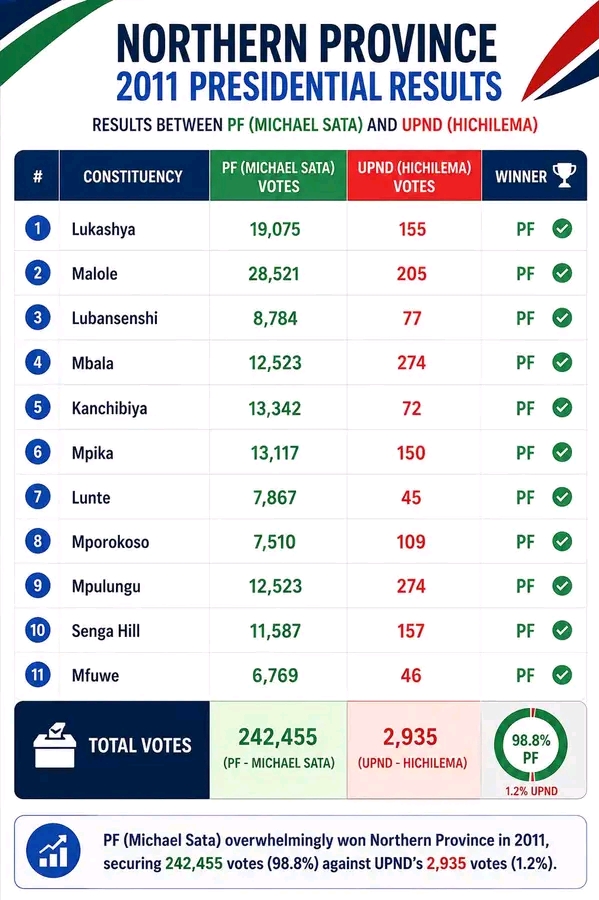
The 2011 presidential election provides a powerful historical lesson. Historical records from the Electoral Commission of Zambia demonstrate massive regional polarization during that cycle.
Northern Province: Michael Sata and the Patriotic Front (PF) secured overwhelming dominance, while opposition alternatives gained minimal traction.
Southern Province: The tables turned completely, with the opposition securing an equally massive mandate in its primary base.
That was not a small electoral difference; it was political domination. Yet Northern Province was widely understood as one of Michael Sata and the PF’s strongest political territories, just as Southern Province functioned as a stronghold for its competitors.
Therefore, the more balanced conclusion is not that regional voting patterns never have an ethnic dimension. Political science research on Zambia has, in fact, identified ethnicity and regional identity as some of several factors influencing voting behaviour. But it is equally simplistic to look at overwhelming support in a rival region and automatically reduce complex demographic and political choices to crude tribal labels.
If that is our test, intellectual honesty would require us to apply precisely the same test to every province that has historically delivered overwhelming margins to its preferred political party. You cannot have a political dictionary in which voting heavily for Party A means a stronghold, while voting heavily for Party B means tribalism.
As the old saying goes, what is sauce for the goose is sauce for the gander. A measuring tape does not change its centimetres depending on who is being measured. Political consistency demands one standard.
Persistence Over Retreat
Perhaps the more important lesson is not what numbers looked like in hostile territory during a past cycle, but what a serious candidate does afterwards.
Imagine being a presidential candidate and campaigning in a province where your initial returns are microscopic compared to your principal rival. A weak politician might conclude that those citizens will never vote for them and wonder why they should waste their time. But serious national politics cannot operate like that.
A candidate seeking to become President of Zambia must be willing to enter territory where they are unpopular, speak to citizens who distrust them, listen to communities that traditionally support their opponents, and patiently make their case.
Every additional vote matters.
If you grow your numbers from yesterday to tomorrow, that is political penetration.
You do not have to conquer a stronghold overnight; you first have to establish a beachhead.
That is why sustained campaigning beyond a traditional political base deserves recognition. The farmer who abandons a field because the first harvest was poor will never discover what the second season could have produced. Politics rewards persistence.
The Mathematics of Political Expansion
This reality exposes the flaw in any strategy that writes off opposing strongholds. A presidential candidate does not campaign only where they expect to win; they campaign everywhere they expect to gain.
If your opponent normally dominates a constituency, your immediate objective may not be to defeat them there right away. Your objective is to chip away at their margins—reducing a massive deficit while increasing your own share. Those incremental votes eventually become part of the national total. You do not have to own the whole river to draw a bucket of water.
Southern Province, Northern Province, Eastern Province, and Western Province are all part of the same republic. Any politician aspiring to govern the nation must regard every corner of the country as legitimate territory to contest.
There should be no “their province” and “our province” in presidential politics.
There are only Zambian voters who must be persuaded.
Virtual rallies and statements from afar can never fully substitute for physical political engagement, organization, and repeated presence. You cannot harvest from a field you refused to enter.
Never Insult the Voter You Will Need Tomorrow
The greatest danger of labelling an entire population as tribal because they vote against you is strategic, not merely rhetorical. You are effectively insulting the very electorate you need to persuade.
Do not burn the bridge simply because you have not yet crossed the river. A politician who receives a handful of votes in a hostile area should not ask why those people hate them; they should ask what they must do to earn a stronger mandate next time.
That question produces political growth:
Do agricultural communities require better dams and feeder roads?
Is network connectivity or market access inadequate?
Do young people need employment and enterprise opportunities?
Do local communities feel politically neglected?
That is where opposition politics should begin. Go there, listen, develop policy, return, build structures, recruit local leadership, and return again. People rarely open the door to a stranger who only appears when he needs something; political trust is accumulated through presence.
Logan constituencies, demographic loyalties, and regional strongholds are normal features of democratic politics. Parties rise, fall, and evolve. Generations change, economic interests shift, and political geography changes with them.
No political stronghold comes with a permanent title deed. Voters are not inherited property.
Therefore, rather than condemning a region for being a stronghold, a serious political strategist should study it. What makes an organization resilient there? Which developmental messages resonate? Where are the openings for an alternative vision? That is strategic politics.
When a region overwhelmingly supports a party, it should be recognized as a political stronghold while acknowledging that regional identity influences voting patterns across the nation. We should reject the selective use of tribalism as a weapon against communities simply because they vote differently from us.
A stronghold is a political reality. Tribalism is a social accusation. The two should not automatically be treated as synonyms.
The politician who wants to dismantle an opponent’s stronghold has only one sustainable solution: go there, listen, organize, present better policies, return again, and earn one voter at a time.
Because the tallest tree in the forest began as a seed, and in politics, every vote gained in an opponent’s fortress is a brick removed from the wall.
Never call people tribal simply because you have not yet persuaded them to vote for you.
Powerful message.
Selfishness is bad.
There is no tribalism here, the results we are seeing are a powerful testimony countrywide that there no good reasons for Zambians to remove HH and bring in Mundubile. All the Zambians can attest to the fact that Hakainde campaigned vigorously in all the 10 provinces of the country but Mundubile failed to do that. So there is nothing to complain about or blame the innocent Tongas for. On the same ballot, there is Siamunene Richwell, a Tonga, how many votes did he get from those who claim that they are not tribal? He also got the same votes others were getting in all the provinces. The record is there, even people like Kalaba and Dan Pule got very few votes even in their home Province, Luapula.
The other point is that you can’t vote with people whose plans you don’t know. These people were saying they have plan B but they never disclosed to anyone. No one can vote for someone whose manifesto you don’t know. If Mundubile failed to sell himself to the people of Southern Province, it is not their problem but his own problem. HH had a message for the voters and when he was going round the provinces covering four constituencies per day, the same people who are complaining now were laughing at him, saying that he was panicking. But they are now seeing how his panicking has paid off. The message is loud and clear from all the 10 Provinces, Zambians have spoken, they still love HH and there in satisfactory reason to them why he should be removed, they want him to continue. The message or voice could have louder in Southern, North-Western and Western Provinces, the same message or voice came out from all the provinces of Zambia. Leave the Tongas alone.