

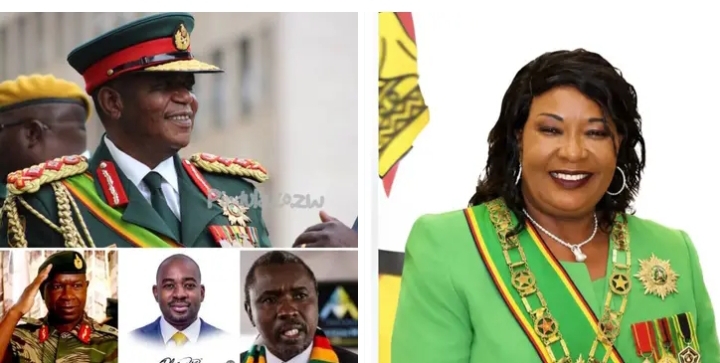
CAA3 Does Not Solve the Succession Question. It Creates New Battlefields for Chiwenga:
From defeating the presidential alternative to controlling the parliamentary electorate.
By Reason Wafawarova.
There is a tempting interpretation of Constitutional Amendment No. 3.
It says Emmerson Mnangagwa has finally solved the Constantino Chiwenga problem.
Remove the direct presidential election. Remove the running-mate mechanism.
Extend the political timetable. Concentrate presidential selection inside Parliament.
Control the party machinery that selects parliamentary candidates. Control the parliamentary majority.
And, eventually, the presidency becomes a matter of arithmetic.
That is the theory. But politics has a habit of humiliating constitutional engineers.
CAA3 may not have solved Zimbabwe’s succession problem. It may simply have moved the succession war to battlefields where different weapons matter.
The presidential election has indeed been moved away from millions of Zimbabweans.
Under the new arrangement, Parliament becomes the electoral college, with the Senate and National Assembly sitting jointly to choose the President.
That fundamentally changes the political equation. But it does not eliminate the competition.
It changes what it means to win.
And this is where Constantino Chiwenga becomes interesting.
Mnangagwa’s great political calculation:
Mnangagwa has spent years doing something that many politicians before him failed to do effectively: minimising the importance of mass presidential politics while concentrating political power inside institutions.
The logic is straightforward. If the presidential contest is decided by millions of citizens, an opposition politician with charisma, a large following and a powerful national campaign can become dangerous.
If the presidential contest is decided by Parliament, the problem changes.
You no longer need to defeat a popular presidential candidate at the ballot box.
You need to ensure that enough MPs and senators are on your side.
The national rally becomes less important. The constituency becomes more important.
The presidential candidate becomes less important. The parliamentary candidate becomes more important.
And, most importantly, candidate selection becomes succession politics.
As my earlier analysis argued, the presidential contest now effectively begins before the general election, inside parliamentary candidate selection, provincial structures and party networks.
That is a formidable advantage for an incumbent who controls the state, the ruling party and the machinery through which candidates emerge.
But there is a problem. The people being selected for Parliament will have minds of their own.
And they will have factions.
Chiwenga’s problem has changed — not disappeared:
Under the old system, Chiwenga needed something he has never conclusively demonstrated:
A national personal electoral constituency. He would have had to convince millions of Zimbabweans to vote for him.
That was potentially Mnangagwa’s strongest argument against him.
Chiwenga has never been tested in a national civilian presidential election.
His political strength has historically been institutional rather than populist.
He has liberation credentials. He has relationships within ZANU-PF.
He has relationships with war veterans. He has a history within the security establishment.
He has supporters and networks within the party.
In other words, his political capital is concentrated in organisation, rather than demonstrated mass popularity.
And then CAA3 arrives. Suddenly the system says:
You don’t need two million votes.
You need enough people inside Parliament.
That may be a very different proposition.
The constitutional reform intended to remove Chiwenga’s road to State House may have replaced a road he did not necessarily control with one built around the very institutional politics in which he has historically been strongest.
That is the paradox.
The three hurdles at State House:
Chiwenga now has to look at State House and see three potential obstacles.
The first is Auxillia Mnangagwa.
The second is Kudakwashe Tagwirei.
The third is Philip Valerio Sibanda.
But these three are not identical threats. They represent three different forms of power.
Auxillia represents family legitimacy, proximity to the incumbent, political visibility and financial resources.
Tagwirei represents money and patronage.
Sibanda represents institutional and military stature.
And Chiwenga has to work out how to neutralise all three without necessarily confronting all three in the same way.
Auxillia: the family succession option:
The immediate Auxillia succession option appears to have been politically pre-empted or at least placed on hold.
But that does not mean it has disappeared.
If Mnangagwa remains in power until 2028 or 2030, Auxillia remains available as a political instrument.
She has something that many potential successors do not have: the Mnangagwa name.
She also has political visibility and access to resources.
Most importantly, she does not need to build an entirely new political mythology.
The incumbent can potentially transfer some of his political capital to her.
That is the great advantage of family succession.
The disadvantage is equally obvious.
Zimbabwean politics has never been particularly comfortable with the idea that the presidency should become a family inheritance.
So Auxillia’s political challenge is not simply building support.
It is building legitimacy independent of the surname.
Chiwenga’s challenge is to make sure she never acquires enough organisational momentum to become inevitable.
That means working the provinces. Working the women.
Working the youths. Working the war veterans. Working the party structures.
And, critically, ensuring that the people who ultimately become MPs are not politically indebted exclusively to State House.
Then there is Tagwirei:
Kudakwashe Tagwirei is a completely different proposition.
He does not necessarily have the political depth of a veteran politician.
But he has something politics has always respected: money.
CAA3 may actually make money more powerful.
Under the old system, enormous sums had to be spent trying to influence millions of voters.
Under CAA3, the decisive political constituency is dramatically smaller.
The battle becomes provincial.
Then parliamentary. Then factional. Then ultimately parliamentary arithmetic.
That means money can be concentrated.
It can finance candidates. It can finance provincial structures. It can finance campaigns. It can create political relationships. It can support aspiring parliamentarians before they ever become MPs.
As the earlier analysis observed, the sophisticated strategy is not necessarily to buy an MP after the election; it is to help create the political environment in which the desired MP wins the primary and reaches Parliament in the first place.
That is a formidable weapon. But it has a weakness.
Money can buy access. It does not automatically buy political intelligence.
Tagwirei’s greatest vulnerability may therefore be political rather than financial.
If Chiwenga can portray him as a wealthy businessman attempting to purchase a political inheritance created by liberation fighters and party structures, Tagwirei could find himself fighting the very political culture he needs to penetrate.
Chiwenga does not need to outspend Tagwirei. He needs to make Tagwirei’s money politically suspect.
He needs party structures to ask: Who owns the party — the cadres or the billionaire?
That is a much cheaper question than competing with a billionaire dollar for dollar.
Sibanda is different:
Then there is Philip Valerio Sibanda.
Some analysts see Sibanda as possessing the same military aura and weight as Chiwenga.
That comparison requires caution.
There is a crucial distinction between military rank and military political lineage.
Chiwenga did not report to Sibanda.
Sibanda became an equal in the formal hierarchy after a career in which he ultimately rose through the same system, but the historical chain of command matters.
In military culture, hierarchy is not a minor detail.
It is the culture. It is memory. It is institutional identity. It is who commanded whom. It is who was senior when critical decisions were made. It is who carries which generation’s institutional legitimacy.
Therefore, simply saying that Sibanda carries the same military weight as Chiwenga because both eventually reached the top of the military hierarchy risks misunderstanding how military institutions actually remember their own history.
Rank can become equal. Political inheritance does not necessarily become equal.
For Chiwenga, that distinction matters.
Because if Auxillia is the family option and Tagwirei is the financial option, Sibanda represents something more complicated: an institutional alternative with military credibility.
And that is precisely why Chiwenga cannot afford to assume that defeating one successor automatically defeats the succession project.
CAA3 therefore creates a new Chiwenga strategy:
This is where I think the succession question becomes fascinating.
Chiwenga does not necessarily have to choose between:
Fight CAA3 and Accept CAA3.
He can do both. He can challenge CAA3 through the courts, through proxies of course.
He can support political resistance to aspects of the amendment.
He can contest its legitimacy.
But simultaneously, he can prepare for the possibility that the courts fail and CAA3 survives.
That is not contradiction. It is political insurance.
A serious political actor prepares for the world he wants and the world he fears.
If the courts overturn the constitutional changes, Chiwenga needs a strategy.
If the courts uphold them, Chiwenga needs another.
If Mnangagwa dies or becomes incapacitated before 2030, Chiwenga needs yet another.
If Mnangagwa remains politically active until 2030, the strategy changes again.
The biological variable cannot be ignored in a succession contest involving an ageing incumbent.
And that means Chiwenga cannot afford to make his political strategy dependent upon one constitutional pathway.
The real battlefield is now the ZANU-PF candidate:
This may be the most important consequence of CAA3.
If Parliament chooses the President, then the MP becomes part of the succession system.
The parliamentary candidate is no longer merely a parliamentary candidate. He or she is potentially a presidential elector.
The provincial chairperson is no longer merely a provincial administrator. He or she becomes a potential succession broker.
The primary election is no longer merely about who represents a constituency. It becomes part of the presidential contest.
The Senate is no longer merely another legislative chamber. It becomes part of the presidential electoral college.
And suddenly every internal ZANU-PF dispute becomes potentially presidential.
Who controls Midlands? Who controls Masvingo? Who controls Mashonaland Central?Who controls Harare?
Who controls the women’s structures? Who controls the youth? Who controls the war veterans? Who controls the candidate lists?
Who controls the provincial committees?
These questions are no longer administrative questions.
They are succession questions.
This is where Chiwenga may still be dangerous:
Mnangagwa’s greatest political achievement has been the concentration of power.
But concentration creates another vulnerability.
If too much power is concentrated at the centre, then everyone who wants to inherit that power eventually has to fight for control of the centre.
And the fight begins underneath the President.
Chiwenga does not need to defeat Mnangagwa tomorrow.
He needs to ensure that when the succession moment arrives, Mnangagwa cannot simply hand Parliament to his chosen successor.
That means Chiwenga must build a counter-network.
Not necessarily a rebellion.
Not necessarily an open factional war.
A political insurance network.
War veterans. Youth. Women. Provincial structures. Parliamentary candidates.
Traditional networks. Party intellectuals. Business interests.
And, importantly, people who may currently appear loyal to Mnangagwa but who understand that political loyalty is often conditional upon tomorrow’s power equation.
The opposition creates another complication:
There is another irony.
Mnangagwa’s parliamentary model assumes that controlling ZANU-PF’s parliamentary majority is enough.
That may be true for now.
But opposition politics adapts.
CAA3 does not eliminate Nelson Chamisa.
It changes the job Chamisa has to do.
The opposition can no longer rely principally on a charismatic presidential candidate.
It has to build parliamentary machinery.
It has to win constituencies. It has to coordinate candidates. It has to prevent opposition fragmentation. It has to turn popularity into seats.
The earlier analysis put this bluntly: under CAA3, Chamisa’s popularity must become parliamentary organisation.
And that is not impossible. Political systems designed to suppress one form of opposition often produce another.
If opposition parties realise that Parliament is now the route to State House, they will eventually organise around that reality.
The regime’s current organisational advantage therefore should not be confused with permanent organisational monopoly.
Opposition movements learn. They adapt. They change their strategies. They find new routes around political obstacles.
The system that looks perfectly controlled in 2026 may look considerably less predictable by 2030.
The greatest danger for Mnangagwa:
There is a profound irony here.
Mnangagwa may believe he has removed the presidential alternative.
He may actually have removed the presidential ballot.
Those are not the same thing. The alternative politicians remain.
Chiwenga remains. Chamisa remains. Tagwirei remains. Auxillia remains as a possibility. Sibanda remains.
And perhaps others will emerge.
What has changed is the battlefield.
The question is no longer simply:
Who can win Zimbabwe?
It becomes: Who can assemble the people who will choose the President?
That is a much more intimate political contest.
And intimate political contests can be considerably more dangerous.
A politician trying to persuade two million voters has to persuade two million people.
A politician trying to secure a parliamentary majority needs to persuade considerably fewer people.
And a politician trying to win the presidency through a parliamentary ballot ultimately needs to persuade, pressure, bargain with or outmanoeuvre only those who possess the decisive votes.
That is why CAA3 could unintentionally create a new political economy of succession.
The parliamentary auction:
And here lies perhaps the darkest possibility.
What happens if no faction controls the required majority?
The Constitution provides for a second ballot if no candidate secures the necessary majority.
That creates the possibility of kingmakers.
Opposition MPs. Independent MPs. ZANU-PF rebels. Provincial blocs. Senators.
And factions that discover, at the last minute, that their parliamentary strength is worth more than their ideological loyalty.
The presidential election could therefore become an auction.
Not necessarily a literal auction.
A political one. Promises. Appointments.bCoalitions. Policy concessions.
Constitutional reforms.
Protection. Patronage. And political survival.
The irony would be extraordinary.
A constitutional reform supposedly designed to bring stability could create a presidential election in which the presidency itself becomes the prize in a bargaining contest among a few hundred political actors.
So what does Chiwenga do?
If I were mapping Chiwenga’s strategic options, I would identify five.
First: Keep the legal war alive.
He should not abandon constitutional and court challenges merely because CAA3 appears politically entrenched.
The legal route preserves an alternative constitutional pathway.
Second: Prepare for CAA3 as if it will survive.
This is the crucial hedge. Build parliamentary influence. Build provincial influence. Influence candidate selection.
Cultivate MPs. Strengthen relationships with war veterans, women and youth.
Prepare for the electoral college.
Third: Prevent any one successor from becoming inevitable.
Auxillia should not become inevitable.
Tagwirei should not become inevitable.
Sibanda should not become inevitable.
Chiwenga’s objective need not initially be to declare himself the winner.
It may simply be to ensure that nobody else can become the uncontested winner.
Fourth: Make money work differently.
Do not compete with Tagwirei at the level of money. Compete at the level of political identity.
If Tagwirei represents financial power, Chiwenga must represent institutional and liberation legitimacy.
The question should become:
Can money inherit a political movement it did not create?
Fifth: Keep an eye on the opposition.
This may sound counterintuitive.
But CAA3 creates circumstances under which an opposition parliamentary bloc could become a kingmaker.
If ZANU-PF fractures badly enough, Chiwenga might eventually need opposition votes.
And politics has a peculiar way of turning yesterday’s enemy into tomorrow’s parliamentary arithmetic.
The succession war has not ended:
The great mistake would be to read CAA3 as the end of the succession question.
It is the beginning of a different question.
Mnangagwa may finish his term in 2030.
He may not. Biology, politics, courts, party dynamics and unforeseen events remain variables.
Auxillia may rise. Tagwirei may rise. Sibanda may rise. Chiwenga may rise. Chamisa may adapt.
Another candidate may emerge.
The point is that CAA3 cannot answer the question of who succeeds Mnangagwa.
It can only determine the mechanism through which that question is eventually answered.
And that mechanism has transformed the political game.
The stadium has become the constituency.
The presidential rally has become the parliamentary campaign.
The voter has become the intermediary.
The MP has become a presidential elector.
The province has become a succession battlefield.
The primary election has become a presidential contest in miniature.
And the parliamentary caucus may ultimately become the place where Zimbabwe’s next President is decided.
Chiwenga therefore has a choice — but not the choice many people think:
He can continue fighting CAA3.
He can prepare to exploit it. He can do both.
The smartest option is probably the third.
Because if CAA3 falls, he needs his constitutional strategy.
If CAA3 survives, he needs his parliamentary strategy.
If Mnangagwa remains until 2030, he needs his succession strategy.
If Mnangagwa leaves earlier, he needs his immediate-transition strategy.
And if Auxillia, Tagwirei and Sibanda emerge as competing alternatives, he needs the organisational machinery capable of defeating all three different forms of power.
That is why the question is no longer: Did Mnangagwa successfully remove Chiwenga from the road to State House?
Perhaps. But there is another question.
Did Mnangagwa merely remove the road that Chiwenga was expected to travel and unknowingly construct another one in its place?
CAA3 was designed to reduce the power of the presidential contest.
It may instead have concentrated the succession contest.
And concentrated power does not eliminate ambition.
0It makes ambition fight over a smaller prize pool of decisive people.
So perhaps Chiwenga is not standing outside the succession race after all.
Perhaps he is simply looking at a different map.
And on that map, State House is no longer reached through two million votes.
It is reached through provinces, candidates, MPs, senators, party structures, alliances and, ultimately, the people sitting inside Parliament when the doors close and the bal