

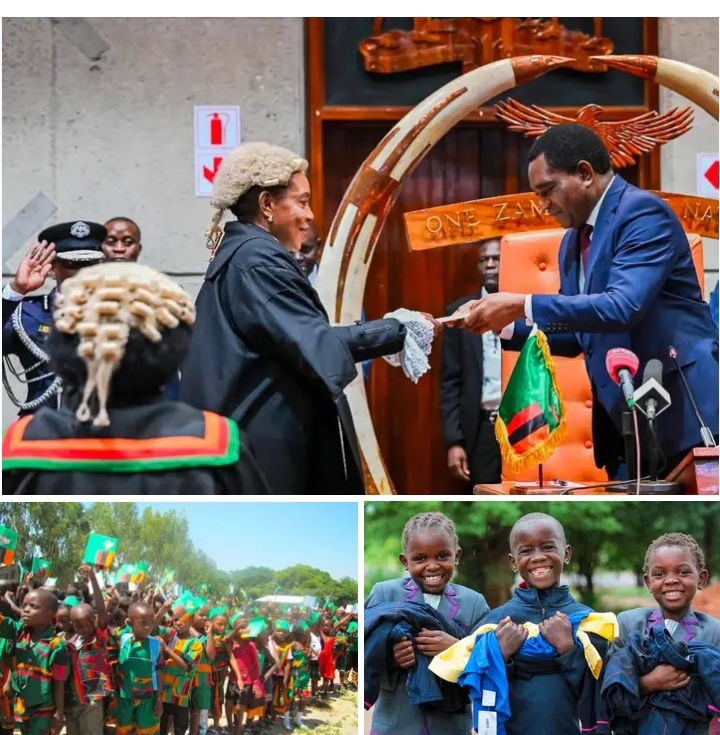
THE REPUBLIC MUST REMAIN ABOVE TRIBE
The death of Hon. Mutotwe Kafwaya has occurred at a painful and highly sensitive moment in our national life. I extend my sincere condolences to his family, relatives, friends and colleagues. Whatever our political differences, death confronts us with our common humanity. His family deserves compassion and the dignity to mourn. The circumstances surrounding his death must be established through due process, the rule of law and the competent institutions of the State.
This moment also calls upon us to confront a danger that has followed Zambia through different periods of our history. We must never allow political disagreement, allegations of discrimination, grievances about public appointments or concerns about nepotism to become instruments for mobilising one community against another.
The peoples who today constitute Zambia existed as numerous kingdoms, chiefdoms and communities long before the modern Zambian State. Colonial administration progressively brought these territories under common authority, culminating in the creation of Northern Rhodesia in 1911. Independence in 1964 presented our founding generation with a greater task. They had inherited a territory. They had to build a nation.
That nation was not built because Bembas ceased being Bemba, Tongas ceased being Tonga, Lozis ceased being Lozi, or because Ngonis, Lundas, Luvales, Kaondes, Chewas, Tumbukas, Mambwes, Namwangas and our many other peoples abandoned their histories. Zambia was built because these communities accepted that beyond our individual identities stood something greater than all of us. That something was the Republic of Zambia.
Our founding generation understood the danger of allowing ethnicity to become the organising principle of political life. Tribal and regional tensions appeared even within the nationalist movement and continued into the early years of independence. The answer our founders placed before the country was profound and enduring. One Zambia, One Nation. It was never merely a slogan. It was a doctrine for the survival of a diverse Republic.
We have not always lived faithfully by that doctrine. Successive periods of our politics have witnessed attempts to convert tribe and region into political currency. During the PF era, President Hakainde Hichilema endured years in which political opponents repeatedly sought to reduce him from a national political leader to his Tonga identity. Tribal rhetoric was directed against him and against communities perceived to support him. When the people of Zambia entrusted him with the presidency, his answer was not ethnic retaliation. His consistent message has been constitutionalism, the rule of law, peace and national unity. That record matters at this particular moment.
Where an individual public officer discriminates, practises nepotism, abuses authority or acts contrary to the law, let that individual answer for his or her conduct. We must resist the dangerous temptation to take every allegation against an individual officer and automatically place it at the feet of the President without evidence. The presidency is a national institution. To undermine it through manufactured ethnic narratives because one dislikes the person occupying it ultimately weakens the Republic itself.
Hatred is destructive across the political spectrum. It can make people abandon evidence, excuse wrongdoing by those they favour and condemn everything associated with those they oppose. At its most dangerous, hatred can persuade citizens that weakening constitutional institutions is acceptable simply because they dislike the individuals temporarily entrusted with them. Zambia must never descend to that level.
Some of the ethnic narratives of previous years have survived beyond the PF Government. During the election campaign we have just concluded, some of us encountered them directly in the field. Citizens were being told in some places that the political contest was effectively a struggle against Tongas and Lozis. Such politics is profoundly dangerous. No election should ever be presented to a Zambian as a battle against another Zambian community.
President Hakainde Hichilema’s being Tonga is neither a qualification for the presidency nor a disqualification from it. A Bemba should never have to apologise for being Bemba. A Lozi should never be treated with suspicion for being Lozi. An Easterner should never carry collective political guilt because of where he or she comes from. No Zambian should have to prove patriotism by distancing himself or herself from the community into which they were born.
The same principle extends beyond tribe. Zambians of European, Asian or other African ancestry do not become less Zambian because of their colour or the origins of their forebears. Nobody should enter a Government office and be treated as a foreigner because an official looks at the person’s face before recognising the person’s citizenship. Zambian citizenship has no tribal face and no colour.
An even more disturbing frontier has now opened in cyberspace. Social media has become a battlefield on which tribal hatred, insults, deliberate falsehoods and political dehumanisation can travel across the country within minutes. Most disturbing of all is the emerging spectacle of children being coached or encouraged to insult national leaders and repeat political and tribal language whose consequences they cannot possibly understand. Our children must never become instruments of political hatred.
A child below ten years of age should be learning mathematics, science, history, citizenship, respect and the possibilities of his or her future. That child should not be rehearsing insults supplied by adults for a camera and then being projected across social media as a weapon against another Zambian. Adults who do this are not educating children politically. They are transferring their prejudices to the next generation.
This is why cyberspace can no longer be treated merely as a communications platform. Cyberspace is part of the modern defense and national security environment. Nations today can be destabilised through disinformation, coordinated incitement, cyber operations and the systematic manipulation of social divisions without a single conventional weapon crossing a border. Protecting our digital space must therefore form part of protecting the Republic, firmly anchored in constitutional rights and the rule of law.
The same constitutional clarity is required as our security institutions undertake operations arising from the present security situation. The men and women entrusted with protecting Zambia must be allowed to perform their lawful duties professionally and without political intimidation. Their work is indispensable to the preservation of constitutional order.
Security operations must remain within the law, evidence must be preserved, investigations must be completed professionally and persons accused of offences must receive due process. We must never obstruct lawful security operations.
President Hakainde Hichilema has been consistent about the Zambia he seeks to lead. It is a Zambia governed by law, held together by peace and united beyond tribe. Those principles are particularly important now. Those serving under the President carry a corresponding responsibility to ensure that their conduct reflects them. Those opposing him carry the same national obligation not to turn legitimate political opposition into hostility against the community from which he comes.
The presidency belongs to Zambia. Our security institutions belong to Zambia. Our courts belong to Zambia. Our Constitution belongs to Zambia. Governments will change. Presidents will come and go. The Republic must endure.
Our generation has inherited a country held together through enormous historical effort. Zambia survived the difficulties of nation building after independence, political turbulence, economic crises and successive changes of Government. We must not become the generation that fragments it because somebody discovers that tribal fear is easier to sell than ideas.
There are legitimate battles that Zambians must fight together. We must fight corruption. We must fight nepotism. We must fight discrimination, poverty, inequality, unemployment and abuse of public authority. We must demand institutions that treat every citizen fairly and public officers who understand that the State belongs equally to every Zambian.
We must never turn those battles into a fight between Zambians. Our tribes are part of our inheritance. Zambia is our common destiny. The Republic must remain above tribe.
One Zambia, One Nation.
Zambia Forward, TOGETHER in UNITY. 🇿🇲
Saviour Chishimba
President
United Progressive People (UPP)
UPND Alliance Partner