

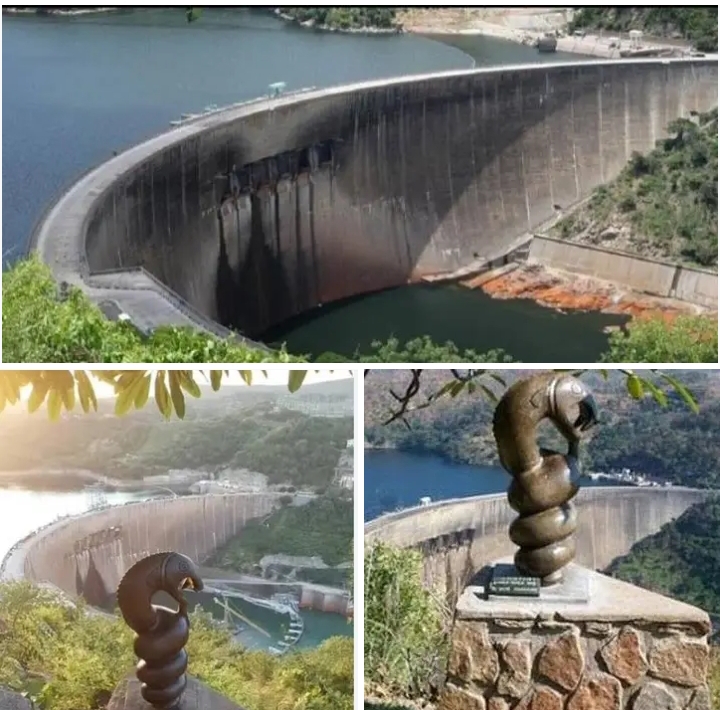
NYAMI NYAMI AND HIS WIFE KITAPO LIVED BEFORE LAKE KARIBA
When they plugged the Zambezi, Nyami Nyami fought back
By Fanuel Viriri
Long before there was a lake, there was Nyami Nyami.
The BaTonga people who lived in the middle Zambezi valley believed the river belonged to him. He was the river god, a great serpent with the body of a snake and the head of a fish. He lived under a large rock in the Kariba Gorge and he protected the valley and its people.
His wife, Kitapo, lived upriver. In the dry season Nyami Nyami would travel up to be with her. In the rains he would return down to the gorge, and his movement was the flood.
When the white men first came to the gorge, the Tonga warned them. Selous in 1877, Major Gibbons who forced the gorge in a launch in 1898, and Molyneux the geologist in 1912 all described it as dreaded, impassable and wild. The Tonga told them you cannot build in the gorge without talking to Nyami Nyami first.
In 1955 the Federation of Rhodesia and Nyasaland decided to do just that. They wanted to plug the Zambezi at Kariba to make electricity for the Copperbelt and for Southern Rhodesia’s factories. The idea had been around since 1912, when Native Commissioner at Sinoia, H.S. Keigwin, wrote that damming the Zambezi at Kariba would fire the imagination of a great dam builder. In August 1914 Keigwin’s idea sent a mule expedition from Hurungwe with 100 carriers to survey 2,000 acres for irrigation. That land is now 50 fathoms deep.
For the dam they hired an Italian company, Impregilo. It was the first dam in Africa funded by the World Bank and the biggest international loan the Bank had ever given at that time. Ten thousand men came to a gorge that was still wilderness, reached only by a dirt track from Miami in Lomagundi that was only passable in the dry season. They started pouring 975,000 cubic metres of concrete into a double curvature arch wall 128 metres high and 579 metres long. On 6 November 1956 Prime Minister Lord Malvern poured the first skip of concrete. The plan was to close the river and make the biggest man-made lake on earth
Nyami Nyami, the Tonga said, was angry. The blasting blew up the rock where he lived. His wife was now cut off on the other side of the rising wall. He tried to break free.
In March 1957 the Zambezi rose to 8,200 cubic metres per second, the highest flow ever recorded. The half-built cofferdam shuddered but held. In February 1958 the river rose again, this time to 16,000 cubic metres per second, twice the highest ever known. It jumped clean over the cofferdam and destroyed it. In 1958 a suspension bridge over the gorge collapsed and 17 workers died. The Tonga elders said it was Nyami Nyami trying to get to his wife.
The engineers had to change the design in the middle of construction, from four flood gates to six, to pass 9,500 cubic metres of water every second.
But the Italians kept pouring. On 17 May 1960 the Queen Mother inaugurated the completed dam and the lake began to fill the valley behind it. Between 1958 and 1963 it grew to 280 kilometres long, up to 40 kilometres wide, 5,580 square kilometres, 185 billion cubic metres of water, four and a half times bigger than any reservoir that had existed before.
As it filled, islands appeared and on them thousands of wild animals were trapped by the rising water. Game Ranger Rupert Fothergill and his team of Tonga paddlers spent five years rescuing them in small boats, chasing elephant, rhino, buffalo, lion and antelope through the bush. They saved more than 6,000 animals in what became famous around the world as Operation Noah.
In the same water, 57,000 Tonga people had to leave. Their villages, fields and graves, the valley where Hemans had shot kudu in 1914 and where Chief Chinoya had hidden in his caves from the Matabele, went under. The lake cut the tribe in two and today Zimbabwean Tonga and Zambian Tonga are considered separate people with slightly different languages.
After the floods, the story goes that officials finally asked Tonga elders to perform a ceremony to call Nyami Nyami out of the gorge and calm him. After that the river settled and the dam held.
Today you see a calm lake where tourists fish for kapenta and tiger fish, where hippo and crocodile live among forty species of fish. Underneath it is still that drowned valley. And below the dam wall the river was still eating away, scouring a plunge pool 80 metres deep over sixty years of spilling, so deep it threatened to undermine the dam itself. If Kariba had failed, half a million people downstream would have been at risk. That is why a $294 million rehabilitation has been working since 2017 to reshape that pool and fix the sluices.
Fishermen on Kariba still say that when the water gets rough, you should leave a little offering. Because Nyami Nyami is still down there, somewhere under 97 metres of water, separated from his wife, watching his river.