

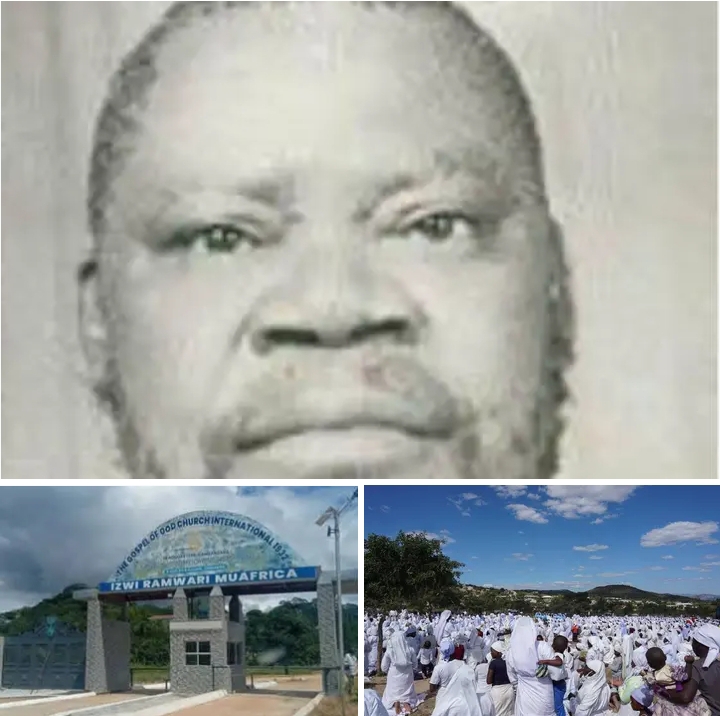
JOHANE MASOWE CAUSES CONTROVERSY EVEN IN DEATH, SONS WANT TO EXHUME AND REBURY HIM
The State feared him alive, the church fights over his body
By Fanuel Viriri
Larger than life founder of the white-garment clad Inzwi RaMwari church – Johane Masowe (Shoniwa Masedza Tandi) – continues to cause controversy even in death.
More than half a century after his death in Ndola, Zambia in 1973, the wilderness prophet who told Rhodesia and apartheid South Africa that Black people could hear God directly in the open veld – without a white missionary, without a church building, barefoot in white robes – still shakes the establishment.
His sons, Magaga and Reuben Masedza, have been locked in a bitter, decades-long court war to exhume him from his holy shrine at Gandanzara, Rusape and rebury him elsewhere – a move the Gospel of God Church International, which guards the shrine, calls desecration.
Born in 1914 in Gandanzara village, Makoni District as Shoniwa Masedza Tandi, the man who would become Johane Masowe – John of the Wilderness – founded Inzwi RaMwari – The Voice of God – in 1932 after a vision on Marimba Hill near Norton where he said he died and was told his name was John, a reference to John the Baptist.
After recovering he spent 40 days fasting and praying on the hill, surviving only on wild honey, reporting that God spoke to him from a burning bush.
Author Clive Dillon-Malone in his 1978 book The Korsten Basketmakers described him as a messianic and elusive figure who hid from both colonial police and his own followers, using aliases like Jack Sithole, Titus Muchuchu and Peter Masedza.
Viewed as a nationalist threat because of his Black consciousness teachings and his unique blending of traditional and biblical thought, he was restricted by the Rhodesian government, fled to Korsten, Port Elizabeth in South Africa, was deported back, and his persecution forged his church into a self-reliant movement famed for tinware and basketry. Men with shaved heads, women in distinctive white dresses and head cloths, worshipping on Saturdays in open wilderness masowe shrines.
He also crossed into Matabeleland in the late 1930s baptising many Ndebele, later setting up headquarters in Bulawayo.
He died on 13 September 1973 aged 58 and was buried at Gandanzara. A 1974 synod declared his role singular and unrepeatable with no successor. That burial site is now Zimbabwe’s most sacred white-garment shrine. His prophetic name later gave rise to a separate movement, the Johane Masowe weChishanu Church, though he himself never named a church after his own person.
Since 2003, his sons have fought for the body. In 2003, Judge Hungwe J dismissed Magaga’s bid to visit the shrine without church consent in HH 164/03. In 2023 the sons tried again, asking the High Court to order the Minister of Local Government to issue a reburial permit.
On 6 February 2025, Justice Chitapi J in HH 64/25 refused to usurp the Minister’s powers under section 38(4) of the Cemeteries Act but declared the sons had the right as children to seek exhumation through due process. The Supreme Court in SC 112/25 on 9 December 2025 confirmed that, holding no substantive exhumation order was granted, only a procedural right to approach the proper forum.
Then came the shortcut. On 10 March 2026, Provincial Registrar J. Munamati issued authority for exhumation on 2 April 2026, claiming the High Court and Supreme Court had already authorised it. The letter was based on instructions from the Permanent Secretary dated 19 February 2026. The Church only became aware on 25 March 2026 when the sons’ lawyers communicated it and rushed to the High Court on 30 March 2026 in HCH 1563/26.
On 1 April 2026, Judge Dembure issued a case management order staying the exhumation and ordering the sons to file their opposing papers by end of 1 April. They filed on 2 April. Their lawyer first insisted it was on time, then conceded. The Church raised the bar. Under Mauritius v Versapak SC 02/22, failure to comply with a court timeline triggers an automatic bar. The sons sought condonation from the bar, blaming instructing attorneys, with no supporting affidavit.
Judge Dembure dismissed it as casual, holding that condonation is not there for the mere asking, citing Doves Funeral Assurance SC 64/23 and Jockstar Investments SC 104/25. Opposition was expunged. The Registrar and Minister of Home Affairs, the first and second respondents, conceded they were no longer opposed.
On the merits, Judge Dembure found a double illegality. Only the Minister under section 38(4) can authorise removal from a closed cemetery, or a person duly authorised by him. Munamati was not authorised by the Minister. And section 38(5) is peremptory, requiring notice of intention to exhume to be published once a month for three consecutive months in the Gazette and in a local newspaper, with three months allowed for objections to the Minister.
What was done was a notice published by the third respondent himself calling for objections within 30 days to himself. As the court put it, citing Minister of Justice v Muskwe SC 67/22, any action done in contravention of peremptory provisions of a statute is invalid.
In the order of 10 April, with full reasons given on 5 May 2026, the court declared the 10 March 2026 decision in violation of section 3(1) of the Administrative Justice Act and set it aside. It ordered that whether Johane Masowe should be exhumed must be determined afresh by the Minister of Home Affairs in accordance with section 38(4) of the Cemeteries Act after considering all objections, that the Minister must invite submissions from all parties and their lawyers, and that his determination must be accompanied by full written reasons. Magaga and Reuben Masedza were ordered to pay costs jointly and severally.
So Johane Masowe remains at Gandanzara. The prophet who rejected church buildings still rests in his wilderness shrine until, if ever, the Minister follows the law the sons tried to bypass.
What began as a spiritual movement in 1932 has become a legal battle over a body, over who owns a prophet, his blood family or his spiritual family. #religion #history