

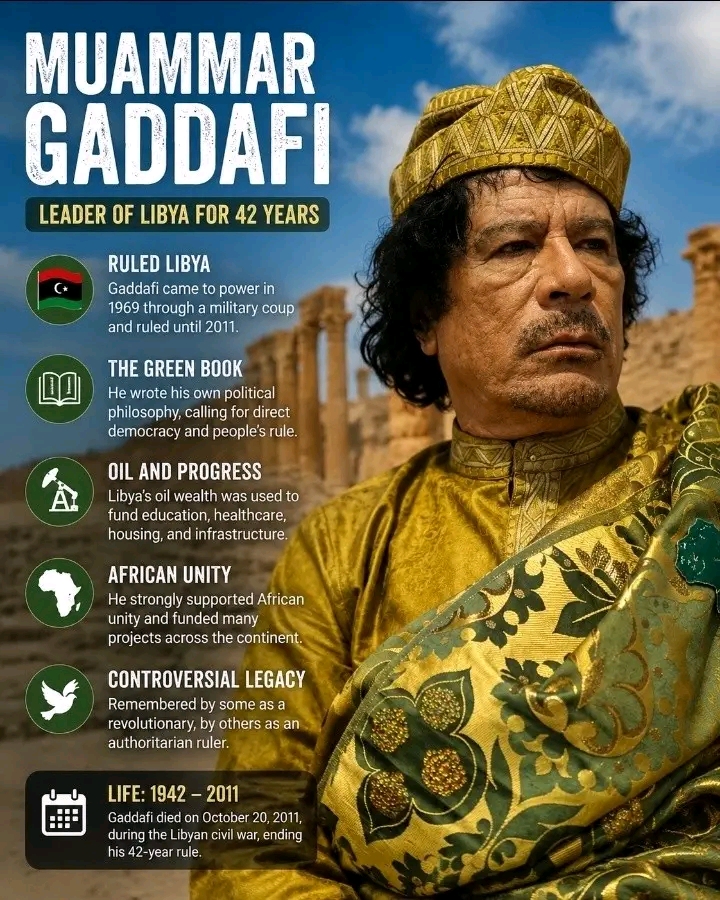
MUAMMAR GADDAFI: THE MAN WHO RULED LIBYA FOR 42 YEARS—AND DIED AS HIS REGIME COLLAPSED
What happens when a young army officer takes power promising to free his country from foreign influence—then spends more than four decades building one of Africa’s most controversial authoritarian regimes?
On September 1, 1969, a 27-year-old Libyan army officer named Muammar Mohammed Abu Minyar Gaddafi helped lead a military coup that overthrew King Idris I.
Gaddafi would eventually become the dominant figure in Libya for the next 42 years.
His story is not simply one of dictatorship.
It is a story of revolution, oil wealth, Arab nationalism, African politics, international confrontation, repression, terrorism allegations, diplomacy, and ultimately a violent downfall.
And to understand Gaddafi, you have to understand both sides of his legacy.
🇱🇾 FROM DESERT CHILD TO REVOLUTIONARY
Gaddafi was born in 1942 near Sirte, Libya, into a Bedouin family.
He joined the Libyan military and became influenced by Egyptian President Gamal Abdel Nasser, whose Arab nationalist and anti-colonial ideas strongly shaped Gaddafi’s worldview.
In 1969, Gaddafi and a group of young military officers overthrew the monarchy while King Idris was abroad.
Gaddafi became the central figure of the new revolutionary government.
He abolished the monarchy, removed many foreign military installations, and promoted Arab nationalism and socialism.
But unlike many traditional presidents, Gaddafi increasingly rejected conventional political structures.
📗 THE “GREEN BOOK”
Gaddafi developed his own political philosophy, which he presented in The Green Book.
He argued that representative democracy and conventional parliamentary systems were fundamentally flawed.
Instead, he promoted what he called “Jamahiriya”—a system supposedly based on direct rule by the people through people’s congresses and committees.
In practice, however, Libya remained dominated by Gaddafi and a powerful security apparatus.
Political opposition was heavily restricted, and critics of the regime faced imprisonment, torture, disappearance and other forms of repression.
Human Rights Watch documented extensive restrictions on freedom of expression and association during the Gaddafi era.
🛢️ OIL CHANGED EVERYTHING
Libya possessed enormous petroleum resources.
Gaddafi used the country’s oil wealth to transform important parts of Libyan society.
The government invested heavily in education, healthcare, infrastructure, housing and subsidies.
Literacy and access to education expanded substantially compared with Libya’s pre-revolutionary era.
This is one reason Gaddafi’s legacy remains complicated.
Some Libyans remember the period for relatively extensive social welfare and state-funded services.
Others remember it as a period in which political freedom was severely restricted and dissent could be extremely dangerous.
Both realities are important.
🌍 GADDAFI WANTED TO CHANGE AFRICA
Gaddafi was not interested only in Libya.
He dreamed of greater political unity across Africa and became one of the continent’s most unconventional political figures.
He provided financial assistance and political support to numerous African governments and movements.
He promoted the idea of a stronger and more unified Africa and eventually became a major financial supporter of the African Union.
His African diplomacy sometimes made him appear less like a conventional North African ruler and more like a self-appointed revolutionary statesman.
But his foreign policy was also highly controversial.
His government was accused of supporting armed groups and militant organizations abroad, creating serious international tensions.
💣 THE LOCKERBIE TRAGEDY
Gaddafi’s government became internationally isolated during the 1980s and 1990s.
One of the most damaging episodes was the 1988 bombing of Pan Am Flight 103 over Lockerbie, Scotland, which killed 270 people.
UN sanctions were imposed on Libya in 1992 over its failure to comply with international demands concerning the Lockerbie investigation.
After Libya surrendered two suspects for trial, the sanctions regime was suspended in 1998 and the UN Security Council lifted the measures in 2003.
Libya subsequently moved toward reconciliation with Western governments.
Gaddafi even gave up Libya’s programs for weapons of mass destruction in 2003 and sought to normalize relations with Europe and the United States.
For a time, it appeared that the man once treated as an international pariah had successfully reinvented himself as a diplomatic partner.
⚠️ BUT INSIDE LIBYA, THE REPRESSION CONTINUED
One of the darkest chapters of Gaddafi’s rule was the 1996 Abu Salim prison massacre in Tripoli.
Human Rights Watch reported that approximately 1,200 prisoners were killed after a prison revolt over poor conditions.
For years, Libyan authorities denied or concealed the full story.
Families continued demanding answers about what had happened to their relatives.
The killings eventually became one of the most powerful symbols of opposition to Gaddafi’s government.
And that history would become crucial in 2011.
🔥 THE REVOLUTION THAT ENDED HIS RULE
In early 2011, the Arab Spring reached Libya.
Protests began in February, particularly in Benghazi, and quickly developed into an armed uprising.
The government responded with force.
The United Nations Security Council condemned the violence and adopted Resolution 1973, authorizing member states to take “all necessary measures” to protect civilians, including establishing a no-fly zone.
NATO subsequently conducted an air campaign against Gaddafi’s forces.
The conflict became a full-scale civil war.
Gaddafi refused to step down.
Instead, he vowed to fight what he described as an armed rebellion supported by foreign powers.
⚖️ THE INTERNATIONAL CRIMINAL COURT WANTED HIM
On June 27, 2011, the International Criminal Court issued an arrest warrant for Gaddafi.
He was accused of crimes against humanity, specifically murder and persecution, allegedly committed during the government’s crackdown on the 2011 uprising.
Importantly, these were allegations under the ICC proceedings—not a conviction. The case was terminated after his death.
🏚️ THE FALL OF A 42-YEAR REGIME
By August 2011, rebel forces had entered Tripoli.
Gaddafi’s government effectively collapsed.
But he refused to surrender.
He fled toward his hometown of Sirte, where loyalist forces continued fighting.
Then came October 20, 2011.
Gaddafi’s convoy attempted to leave Sirte.
He was captured alive by anti-Gaddafi fighters.
Images and videos from his final moments spread around the world.
He was badly injured and died shortly afterward.
Human Rights Watch later found evidence suggesting that Gaddafi had been captured alive and that other captured members of his convoy were apparently executed. The circumstances of his death therefore remain a deeply controversial part of the Libyan war.
Gaddafi was 69 years old.
His death brought an end to one of the longest personal political reigns in modern African history.
🤔 SO, HOW SHOULD HISTORY REMEMBER GADDAFI?
This is where the story becomes complicated.
Some people remember Gaddafi as an anti-colonial revolutionary who challenged Western influence, invested oil revenues into social programs and promoted African unity.
Others remember him as an authoritarian ruler whose government crushed political opposition, imprisoned dissidents and was responsible for grave human-rights abuses.
Neither the romanticized image of Gaddafi as simply an African liberator nor the simplistic image of him as merely a one-dimensional villain fully explains his historical significance.
He was both a revolutionary and an authoritarian ruler.
He challenged foreign powers while brutally suppressing opposition at home.
He promoted African unity while supporting controversial foreign interventions.
He built social programs while maintaining a political system with little tolerance for dissent.
And after his fall, Libya did not immediately become the stable democracy many had hoped for.
🕯️ THE BIGGEST LESSON
Gaddafi’s story offers a powerful warning about political power:
A country can have oil wealth, infrastructure, social programs and a powerful leader—and still suffer enormously when institutions are weak and political power becomes concentrated around one person.
Gaddafi ruled Libya for 42 years.
But when his regime finally collapsed, it collapsed with extraordinary speed.
His death did not end Libya’s problems.
Instead, Libya entered a new and difficult chapter of political fragmentation, armed conflict and competing centers of power.
And perhaps that is the most intriguing question of all:
Did Libya lose a dictator in 2011—or did it lose the system that, for better or worse, had held the country together for four decades?
What is your view of Muammar Gaddafi’s legacy?
Was he primarily an African revolutionary, an authoritarian dictator, or a complicated combination of both?
👇 Share your thoughts in the comments—but let’s keep the discussion historical and respectful.