

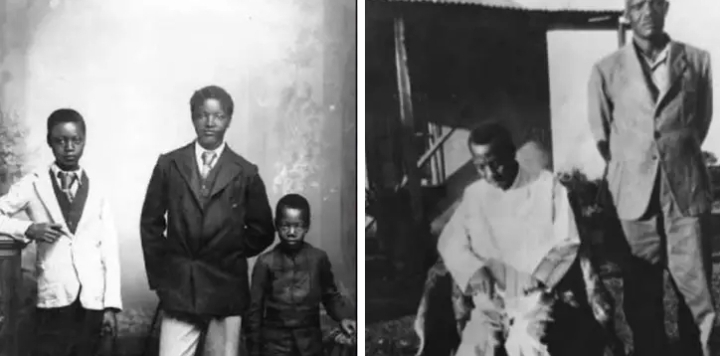
KING LOBENGULA’S SON DIED SAD, LONELY IN BULAWAYO WITH NO KINGDOM
How Muzenda, Burombo helped in naming a suburb Nguboyenja
By Fanuel Viriri
The youngest of King Lobengula’s royal sons, Nguboyenja, was caught between two cultures – the demands of royalty and an urban, western life after being raised like a British man.
He died a sad and lonely figure in Bulawayo in 1944, but his name lives on in the City of Kings.
Nguboyenja was royal because his mother was a Ndiweni, from the line that could produce a king. In 1894, after the Anglo-Ndebele War and after Lobengula disappeared into the bush, Cecil John Rhodes told the British South Africa Company to take responsibility for Lobengula’s family. Most of the Queens were given a small pension. The three princes who could claim the throne – Njube, Mpezeni and Nguboyenja, then about ten years old – were taken to Cape Town to be raised as Englishmen.
According to historian R.S. Roberts, who pieced together Nguboyenja’s life from Company files, mission records and Native Department correspondence, the plan was clear.
In February 1895 they entered Zonnebloem College, the Anglican school for sons of chiefs. The written policy in London was to wean them from their traditional status, Roberts notes.
Mpezeni died of pneumonia in 1899. Njube finished and left. Nguboyenja stayed alone for twelve years, a record at the college. And he excelled. He became Head Prefect, Captain of cricket, and best in divinity. He was baptized as Christopher and confirmed by the Archbishop of Cape Town in 1900. In 1905 the Administration decided he should go to England to train as a veterinary surgeon.
But he was homesick. In early 1906 he wrote secretly to Simon Mhlatuzana in Bulawayo asking him to get the chiefs to let him come home to see his mother. London replied that he had lofty aspirations to be paramount and must not return.
He became troublesome at school and demanded to go home. He was finally allowed to visit in January 1907 for a fortnight. The Chief Native Commissioner even gave him a certificate exempting him from carrying a pass. The only incident noted was a terrible attack of headache that kept him indoors for days. It was the first medical note on file, Roberts writes.
He went back to Zonnebloem for Lent 1907, then sailed to England and enrolled at Denstone College in Staffordshire in June 1907. He settled well. Then in 1908 he returned to Rhodesia, and his life broke.
He was called to meet the Chiefs and the Chief Native Commissioner. They told him he had no chiefly position. He asked whether he did not enjoy any difference in standing between himself and other people. The answer was that he had no responsible position like the other chiefs.
The Chief Native Commissioner, Taylor, reported to the Administrator that political difficulties might arise from younger educated men who might follow him. He described Nguboyenja as an extremely intelligent youth studying conditions of native life, but very undecided, not yet adapted and perhaps mentally ill.
Orders went out not to let the Ndebele see he was a cause for concern, but to watch him closely. Police were told to demand his pass, a deliberate reversal of the 1907 exemption, to show him that as a native he must comply with the laws affecting such.
As Roberts details from the Fort Usher diary, the Native Commissioner wrote that Nguboyenja was a little ill and very unhappy back from an aimless tour in the veld, complaining of headache, looking more unhappy if that was possible. He did not know where he wanted to go and cared less.
He was offered four choices: work in the Chief Native Commissioner’s office in Bulawayo, farm near Fort Usher or on the Rhodes Estate at Inyanga, take a job in Northern Rhodesia, or return to Cape Town on an allowance of one hundred pounds a year. He chose Cape Town. Within a fortnight he left Matabeleland, refusing to see his mother to say goodbye.
What followed was three decades of silence. He went to live with Jacob Tshokwane, a jobbing gardener in Cape Town. In 1909 his mother died. He received the news without any outward sign of emotion. Tshokwane reported that he had become very peculiar, only rarely leaving his room and then naked, moping all day and refusing to talk.
Doctors said he was suffering from depression, that he was not melancholy mad at present but might become so. He assaulted a Company clerk with his walking stick. The Company stopped his direct allowance and paid Tshokwane for his board.
In August 1928, after pressure from Ndebele Chiefs and organizations on the Rand who were collecting money on his behalf, he was brought back to Bulawayo. Manja Mpondo Khumalo took him to a small cottage on Bulawayo Commonage near Loets Kraal (now Sunnyside near Tegela and Romney Park in Bulawayo) that had been bought from a Chinese market gardener. There he lived as a recluse, in European style, in pyjamas, never reading, never walking, indicating by severe silence if he wanted coffee instead of tea.
Yet old subjects still came. Almost weekly there was a respectful pilgrimage of grey-headed servitors who found him indifferent. As Roberts records, Windrum, collecting Ndebele traditions in 1937, visited twice and found him in pyjamas saying nothing. Journalist Greta Bloomhill photographed him seated outside the cottage with Manja.
On 18 June 1944 he died in that cottage of tuberculosis after three decades of silence. The journalist who reported his death said he had always enjoyed reading but that his education had proved a curse rather than a blessing. He was buried by Christian rites at Entumbane at the foot of the kopje where Mzilikazi is interred. As the cortege left Bulawayo, Main Street was lined with some six hundred Ndebele.
In 1951, when Bulawayo City Council was building new houses in what were called the Bulawayo African Townships, a new suburb was named Nguboyenja after him. Robert says the name was pushed through with the support of a young Shona bricklayer who had migrated to Bulawayo for work – nationalist Simon Vengai Muzenda.
He was secretary general of African Voice under another nationalist and leader from Buhera, Benjamin Burombo. Robert said the nationalists demanded an African royal name instead of a colonial name. Muzenda lived in Barbourfields where he owned a carpentry shop and worked in the city. He later moved to Mvuma with his wife Maud.
However Nguboyenja’s name is still being called every day in kombis, shops and schoolchildren in the City of Kings.
Historical detail drawn from R.S. Roberts’ research on Nguboyenja’s life (Rhodesian history archives).