

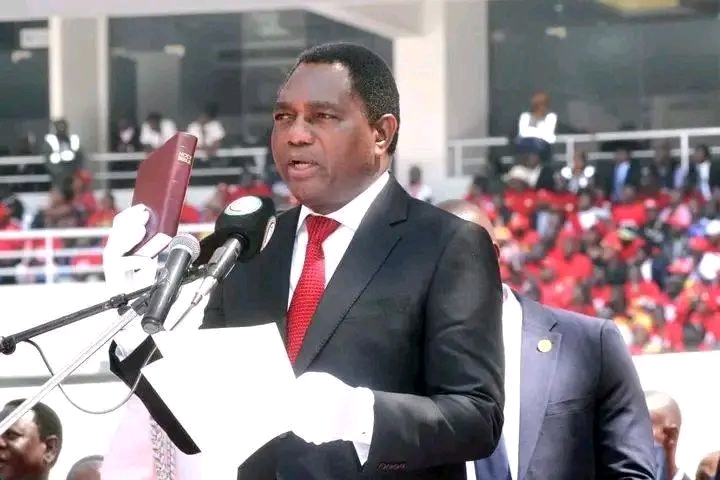
🇿🇲 INAUGURAL ANALYSIS | Hichilema opens second term with unity message, shifts economic argument from stability to growth
President Hakainde Hichilema has used his second inaugural address to draw a line under the election campaign, reaching directly to voters who opposed him while recasting the economic task of his second term around one central idea: turn stability into household growth.
“The person who voted against us is not our enemy,” Hichilema said. “Whatever our political choices, we remain one people.”
It was the clearest political signal in the address. Rather than treating his re-election as an endorsement only from those who voted for him, Hichilema sought to place the new administration above the campaign divide.
“To those who chose other candidates and other parties, we have heard you and we respect your choice,” he said, arguing that democracy does not require citizens to agree on everything.
He reinforced the point with unusually direct language: “There should be no humiliation of the person who voted against us. They are our brothers, they are our sisters. We are one people.”
The message matters after a competitive election and a tense post-election period. Hichilema appears to be signalling that the political logic of campaigning must now give way to the institutional responsibility of governing.
“The campaign is over, the job of building our country continues,” he said.
From stabilisation to growth
The economic argument was equally significant. Hichilema framed his first term largely as a period of repairing and stabilising an economy burdened by debt, high inflation and fiscal pressure. His second-term proposition is different.
“We are moving from stabilisation to growth,” he said. “Stability must begin to flow to our households.”
This sentence may become the benchmark against which the second term is judged. Macroeconomic stability can be measured through inflation, debt restructuring, exchange rates, fiscal balances and investor confidence. Household experience is measured differently: food prices, wages, jobs, electricity, business opportunities and disposable income.
Hichilema is therefore raising the political test himself. Economic indicators will no longer be sufficient if ordinary households do not experience the improvement.
His criticism of the “tantameni syndrome” also pointed towards a broader governing philosophy. “We must think of tomorrow and not only consuming today,” he said, calling for a shift from dependence on handouts towards production, investment and longer-term economic participation.
There is political risk in that argument. Citizens facing immediate economic pressure will still expect government intervention. The challenge will be balancing fiscal discipline and productive investment with the immediate demands of households.
Hichilema closed the political circle by promising to remain a “servant President for all the people of Zambia.”
The architecture of the speech was therefore clear: reconciliation in politics, production in economics and delivery in government. The first term asked Zambians to accept the argument for stabilisation.
The second will face a harder test. Can stability be converted into something households can actually feel?
That is the standard Hichilema has now set for himself.
© The People’s Brief | Ollus R. Ndomu